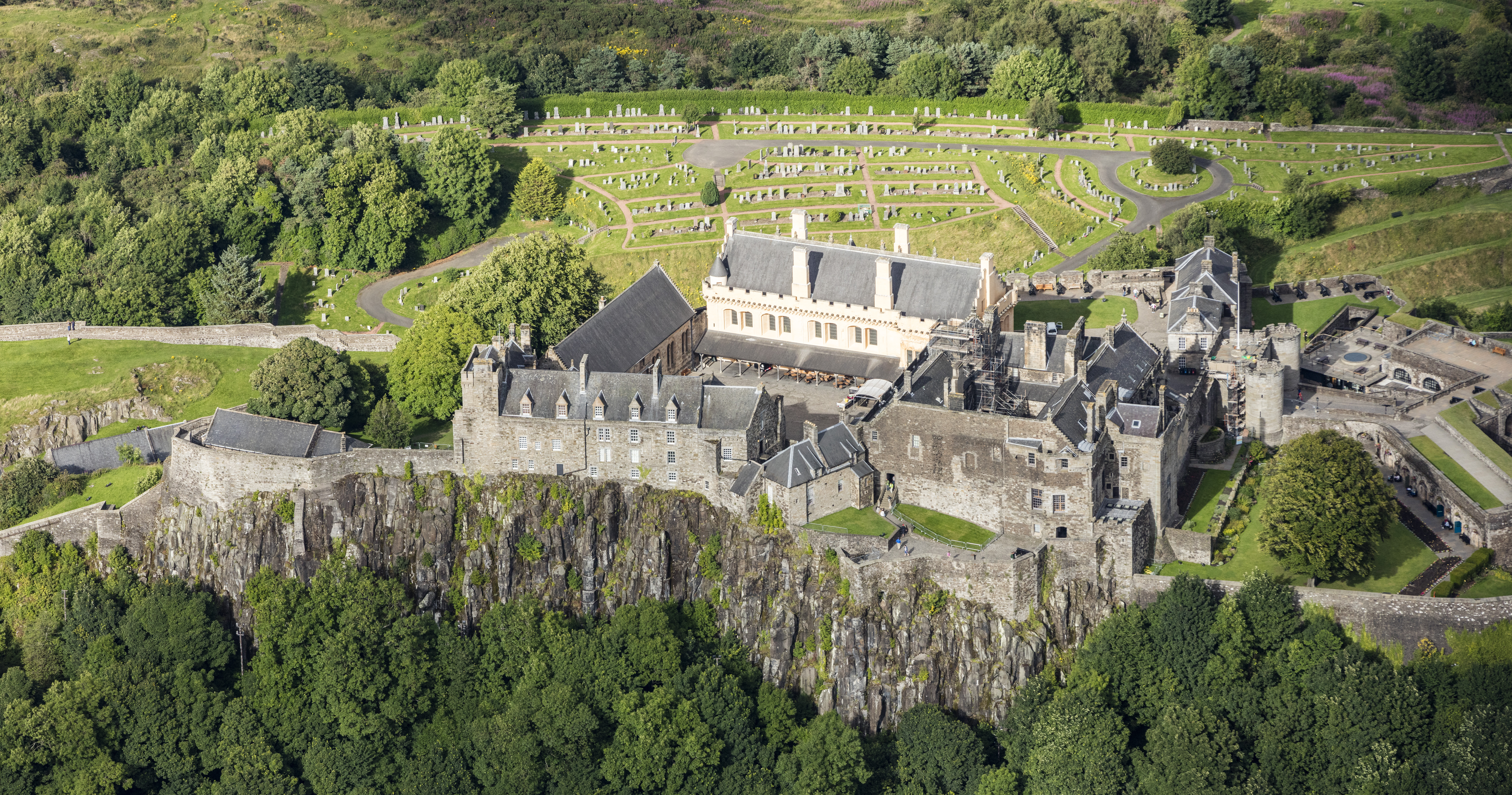
Stirling Castle
Whoever held Stirling held Scotland. That was the strategic logic that made this castle, perched on a plug of volcanic dolerite above the lowest crossing point of the River Forth, the most fought-over fortress in the kingdom. At least eight sieges tested its walls between the thirteenth and eighteenth centuries. Mary, Queen of Scots was crowned here as an infant. James IV built a Renaissance palace within its medieval defences. And in 1746, Bonnie Prince Charlie's Jacobites became the last army to lay siege to an English-held castle in Britain when they tried and failed to take it. Stirling Castle is not merely one of Scotland's greatest castles. It is the hinge on which much of Scottish history turned.
The Crag and the Crossing
The castle's power derives from geology. The Stirling Sill, an intrusive sheet of dolerite rock, created a crag surrounded on three sides by steep cliffs that rise above the flood plain of the Forth. The only approach is from the south, through the town, making the castle virtually impregnable to direct assault. Below, the River Forth winds through its carse in extravagant meanders, and until the 1890s, the bridge at Stirling was the farthest downstream crossing. Every army moving between the Highlands and the Lowlands, between Edinburgh and the north, had to pass beneath these walls. This geographical fact shaped Scotland's wars for five centuries. William Wallace fought to control the bridge in 1297. Robert the Bruce razed the castle after Bannockburn in 1314 rather than let it fall back into English hands. Edward I of England besieged it with the largest trebuchet ever built in Britain, a monster called Warwolf that took five master carpenters three months to assemble.
Palace of the Stewarts
The castle's military importance was matched by its role as a royal residence. James IV transformed it in the late fifteenth century, building the Great Hall, the largest medieval banqueting hall in Scotland, with its distinctive yellow-ochre render and hammerbeam roof. His son James V continued the work, adding a Renaissance palace whose exterior sculptures drew on French and Italian models. The result was a building unlike anything Scotland had seen: classical columns, planetary roundels, and carved figures that reflected the cosmopolitan ambitions of a king who had married two French noblewomen. Mary, Queen of Scots was crowned in the Chapel Royal at nine months old in 1543. Her son, the future James VI, was baptised here in 1566 in a ceremony of deliberate magnificence designed to impress the courts of Europe. The Chapel Royal was later rebuilt entirely in 1594, for the baptism of James VI's own son, Prince Henry.
Eight Sieges and a Final Stand
The castle's roll of sieges reads like a compressed history of Scotland. Edward I took it in 1296, and the Scots recaptured it in 1299. Edward besieged it again in 1304 with Warwolf and a force so large it required 17 lead-lined siege engines. During the Wars of Scottish Independence, the castle changed hands repeatedly, each siege adding scars to its stonework. The last siege came in January 1746, during the Jacobite rising. Bonnie Prince Charlie's forces besieged the castle after their retreat from England, bombarding it from nearby high ground. The government garrison held firm, and the Jacobites withdrew after a few weeks, making Stirling the final siege of a British castle in recorded history. After the rising's defeat at Culloden, the castle's role shifted from active fortress to military garrison and depot, a function it retained into the twentieth century.
The Castle Today
Managed by Historic Environment Scotland and designated a Scheduled Ancient Monument, Stirling Castle has undergone extensive restoration. The Great Hall's ochre render has been renewed to approximate its medieval appearance, and the Royal Palace's interior has been refurnished with reproductions of the original tapestries and furnishings, including the Stirling Heads, a series of carved oak roundels depicting kings, queens, and classical figures. The castle houses the regimental museum of the Argyll and Sutherland Highlanders, connecting its medieval past to more recent military service. Standing on the castle esplanade, visitors look north across the Forth valley toward the Highlands and south toward the Bannockburn battlefield, understanding at a glance why this rock mattered so much for so long. The view itself is the argument: from here, you see what every Scottish king and English invader saw. The crossing. The gateway. The place that had to be held.
From the Air
Located at 56.12N, 3.95W atop a prominent volcanic crag in the city of Stirling. The castle is unmistakable from the air, its yellow-rendered Great Hall and palace buildings clearly visible on the summit. The River Forth meanders below to the east, with Cambuskenneth Abbey visible on a river loop 1 nm to the east and the Wallace Monument on Abbey Craig 1.5 nm to the northeast. Nearest airports: Glasgow (EGPF) approximately 30 nm west; Edinburgh (EGPH) approximately 28 nm east. Best viewed at 2,000-3,000 ft AGL.