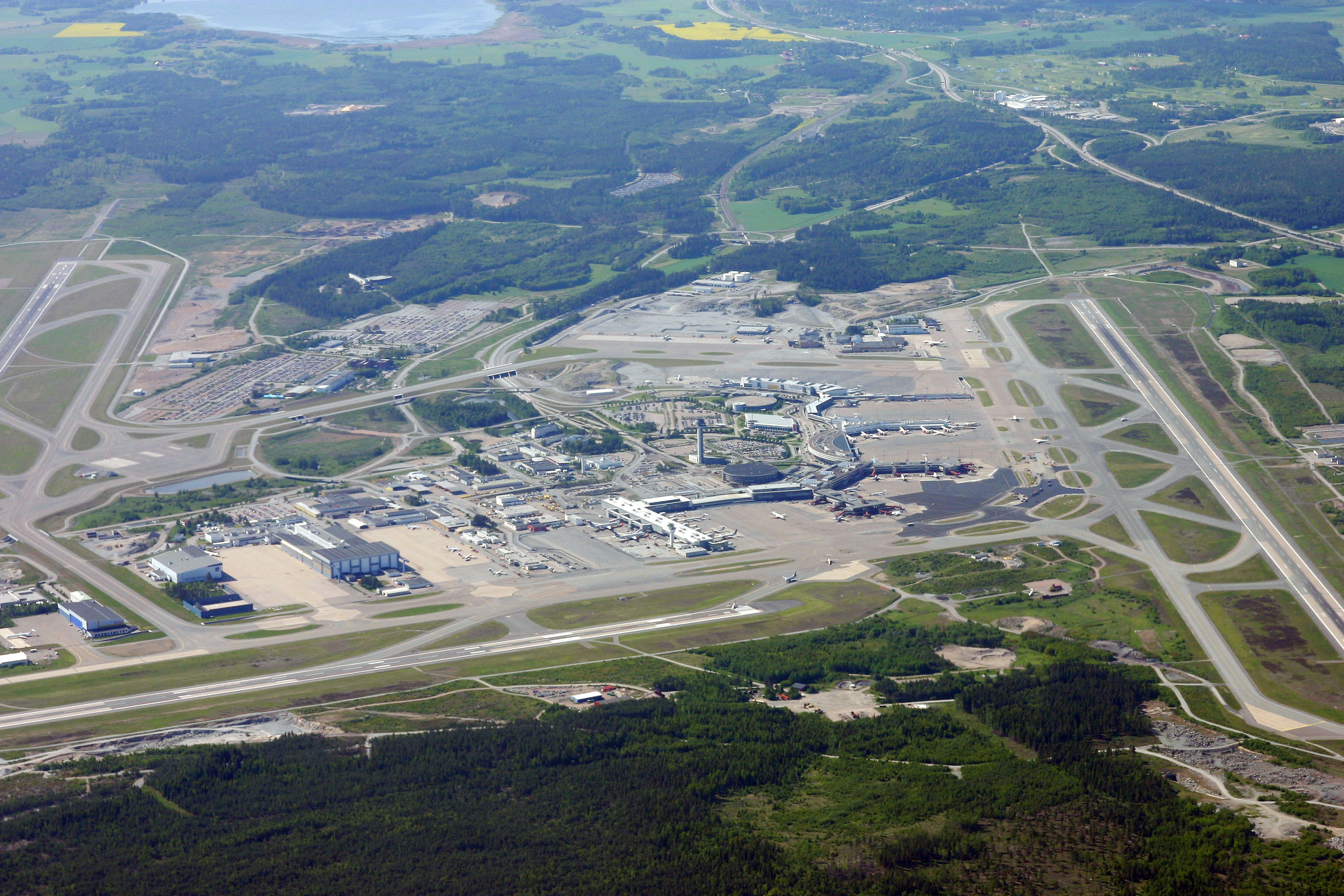
Stockholm Arlanda Airport
The name came from a competition, and it carried a pun. Arlanda derives from Arland, the old name for the parish of Arlinghundra where the airport sits, but the '-a' was added deliberately to echo Swedish place names ending in '-landa' and to play on the verb 'landa' - to land. Since 1962, this linguistic joke has welcomed millions of travelers to Sweden's capital, growing from a single runway too long for downtown Bromma's charter traffic into Scandinavia's third-largest aviation hub. Today, three runways, four terminals, and the high-speed Arlanda Express connect Stockholm to the world, while underground, an innovative aquifer system heats and cools the entire complex using ancient groundwater.
From Practice Flights to Jumbos
The first aircraft used Arlanda in 1959, but only for practice. Commercial traffic began in 1960, and the official opening came on April 1, 1962, with Prince Wilhelm presiding. The airport existed because Bromma, Stockholm's downtown field, couldn't handle the intercontinental jets that were transforming air travel. Scandinavian Airlines began running Douglas DC-8s to North America; Pan American followed soon after. The Boeing 747 arrived in the 1970s, bringing both scheduled transatlantic service and charter flights to the Canary Islands - Swedes escaping the long winter darkness for Spanish sunshine became an Arlanda tradition. Domestic traffic moved here from Bromma in 1983 because the DC-9s serving Gothenburg, Malmo, and the Arctic cities of Lulea and Kiruna were considered too noisy for the city center. The airport expanded relentlessly: new domestic terminals in 1990, a third runway in 2003, and in 2010, the first Airbus A380 superjumbo touched down on Swedish soil.
A Terminal Without a Number One
Arlanda's terminals are numbered 2, 3, 4, and 5 - there has never been a Terminal 1. The designation was reserved for a planned facility south of Terminal 2 that was never built, leaving a permanent gap in the sequence. Terminal 5, the oldest surviving structure, opened in 1976 as Arlanda International, handling the growing mix of scheduled and charter traffic. Terminal 4, originally called Inrikes 1 (Domestic 1), was inaugurated by King Carl XVI Gustaf and Queen Silvia in 1983. The terminals have traded roles repeatedly over the decades, shuffling between domestic and international traffic as Swedish aviation rose and fell with economic cycles. The COVID-19 pandemic emptied the airport so completely that passenger numbers dropped 97.7% in April 2020; for more than eighteen months, only Terminal 5 remained open, handling a trickle of essential travel.
Engineering Underground
Beneath Arlanda lies one of aviation's most innovative environmental systems. A network of wells connects to a massive underground aquifer, drawing water that stays naturally cooler than summer air and warmer than winter air. In summer, this groundwater cools the terminals without air conditioning; in winter, it's heated with biofuel and circulated through the buildings. The same heated water warms concrete pads on the ramp and near hangar doors, melting ice without chemicals. After passing through the system, the water returns to the aquifer to be used again. The airport also receives its jet fuel by an unusual route: tankers deliver it to Gavle on the Baltic coast, trains carry it to Brista near Marsta, and pipelines bring it the final distance to the aircraft - eliminating the truck convoys that once rumbled through central Stockholm.
Surviving the Storm
Lake-effect snowstorms sweep across Arlanda when cold northeastern air meets the open Baltic. The airport maintains 250,000 square meters of pavement, and during the long Swedish winter, a team of 100 workers - sixty-five of them seasonal hires - clear snow in coordinated sweeps directed by radio from the control tower. Friction vehicles test each runway after plowing; pilots receive the measurements and decide whether conditions are safe for landing. It's a ballet of machinery and radio calls repeated every thirty-five to forty-five minutes during heavy snowfall, keeping at least one runway operational at all times. The third runway, controversial when it opened in 2003 over protests from residents beneath its flight path, now operates only during peak hours to limit noise - a compromise between capacity and community that defines modern aviation.
The Shape of Tomorrow
Arlanda's future is already under construction. Terminal 5 is gaining a new pier, Pier G, planned for completion by 2040 and designed to push the airport's capacity to forty million passengers annually - a dramatic increase from the twenty-five million it handled before the pandemic. The airside connection between Terminals 4 and 5, built during the COVID closure, allows them to function as a single facility. Meanwhile, Bromma Airport appears headed for closure as Braathens Regional Airlines announced in 2024 it would relocate operations to Arlanda, potentially eliminating ninety percent of Bromma's traffic. If that happens, Arlanda will stand alone as Stockholm County's public airport - the sole gateway for a region of 2.4 million people, carrying forward a name that began as a joke about landing and became Sweden's connection to the sky.
From the Air
Stockholm Arlanda Airport (ICAO: ESSA, IATA: ARN) at 59.65N, 17.92E. Three runways: 01L/19R (3,301m), 08/26 (2,500m), and 01R/19L (2,500m). Located approximately 40 km north of central Stockholm in Sigtuna Municipality. The Arlanda Express provides 20-minute rail service to Stockholm Central Station. Hub for Scandinavian Airlines and Norwegian Air Shuttle. Terminal 5 handles most international traffic; Terminal 4 serves low-cost carriers including Ryanair and Wizz Air. VFR arrivals should expect lake-effect snow in winter when winds blow from the northeast over the Baltic.