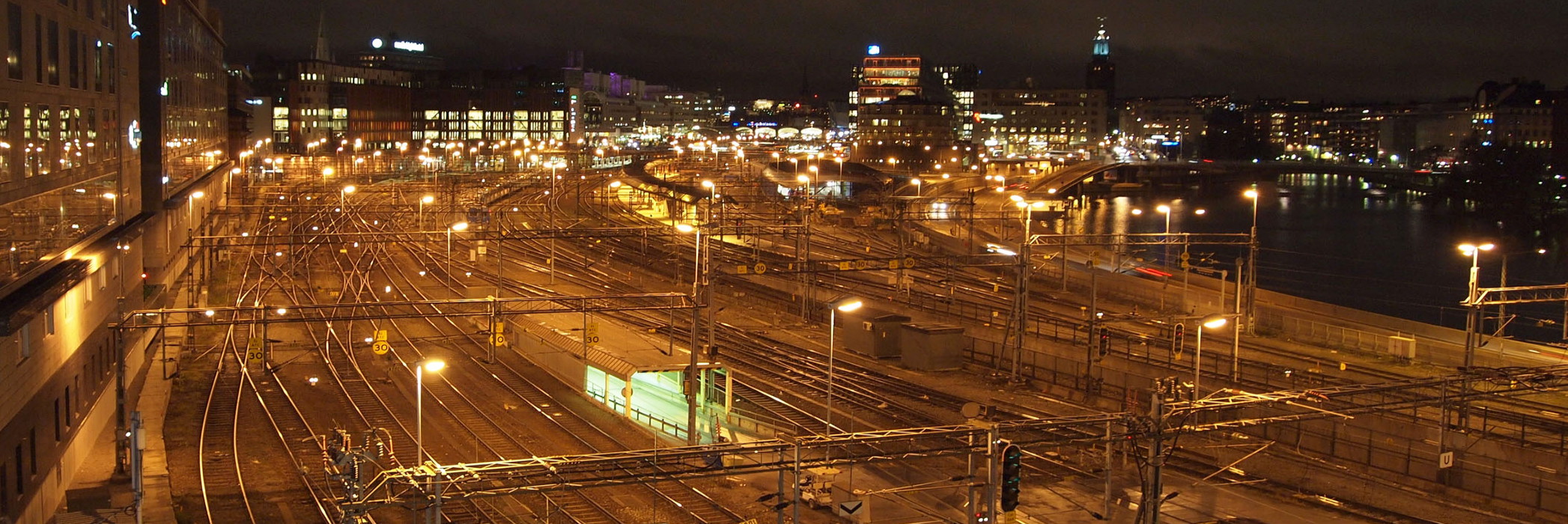
Stockholm Central Station
Eight million red bricks form the bones of Sweden's largest railway station, but it is the warmth of human bodies that makes Stockholm Central truly remarkable. In 2011, engineers discovered they could channel the heat generated by 200,000 daily commuters to warm an office building across the street. This fusion of 19th-century architecture and cutting-edge sustainability captures something essential about Swedish pragmatism: even the mundane act of walking through a train station becomes an opportunity for innovation.
A Station Grows Up
When architect Adolf W. Edelsvärd completed Stockholm Central in 1871, trains ran directly into the building. The station served a young nation hungry for connection, its tracks reaching north toward Uppsala and south toward the continent. Over the next 150 years, the station would transform itself repeatedly. Between 1925 and 1927, the tracks migrated westward, and the former rail hall became a soaring waiting room designed by Folke Zettervall. The royal family gained their own waiting area, where they still gather before departing by train. In 1958, an underground passage linked the station to T-Centralen, weaving rail travel into the fabric of Stockholm's metro network. The building earned heritage protection in 1986.
Nineteen Tracks to Everywhere
Modern Stockholm Central operates as two stations in one. Tracks 1 through 7 face north, forming a terminal for trains to Uppsala, Arlanda Airport, and points beyond. The Arlanda Express departs from platforms designed with floors level to the trains, allowing seamless boarding. Tracks 10 through 19 run through the western section, carrying long-distance and regional services south to Gothenburg, Malmö, and even Berlin via night train. In 2017, commuter rail operations moved underground to the new Stockholm City Station beneath T-Centralen, freeing Central for expanded regional and international traffic. The X 2000 high-speed trains now streak to Copenhagen and Oslo, connecting Sweden to its Scandinavian neighbors.
Art on the Walls
High on the walls of the central hall hang eight landscape paintings that transport waiting passengers across Sweden without ever leaving the station. Artists Natan Johansson and John Ericsson, both decorators at the Royal Dramatic Theatre, completed these murals in 1927 as the renovated station took shape around them. The paintings capture the nation's geographic diversity: the midnight sun gleaming on a lake at Saltoluokta in Swedish Lapland, autumn melancholy along a Nordingrå river, winter darkness at Åreskutan, Leksand's church rising through frost. Vadstena Castle floats in its protective waters while Varberg Fortress guards the western coast. These scenes remind travelers of the country their trains will carry them through.
The Beating Heart
Stockholmers call the circular information desk 'Spottkoppen'—the spittoon—with typical Swedish directness. Around this landmark, 200,000 people flow daily, some bound for the airport via the 20-minute Arlanda Express, others heading to the adjacent Cityterminalen for bus connections across the country. The station code 'Cst' appears on departure boards throughout Sweden, a shorthand everyone recognizes. Since Jernhusen took ownership in 2001, the station has balanced its heritage status with modern demands, adding a conference center in the southern pavilion while preserving the grand spaces that have welcomed travelers for over 150 years. The body heat innovation continues: passengers warming a building simply by passing through, their collective energy captured and recycled in a city that wastes nothing.
From the Air
Located at 59.33°N, 18.056°E in Stockholm's Norrmalm district. The station's long rectangular form and adjacent rail yard are visible from altitude between the waterways of Riddarfjärden and Norrström. Best viewed from 2,000-3,000 feet AGL. Nearby airports: Stockholm Bromma (ESSB) 4nm west, Stockholm Arlanda (ESSA) 22nm north.