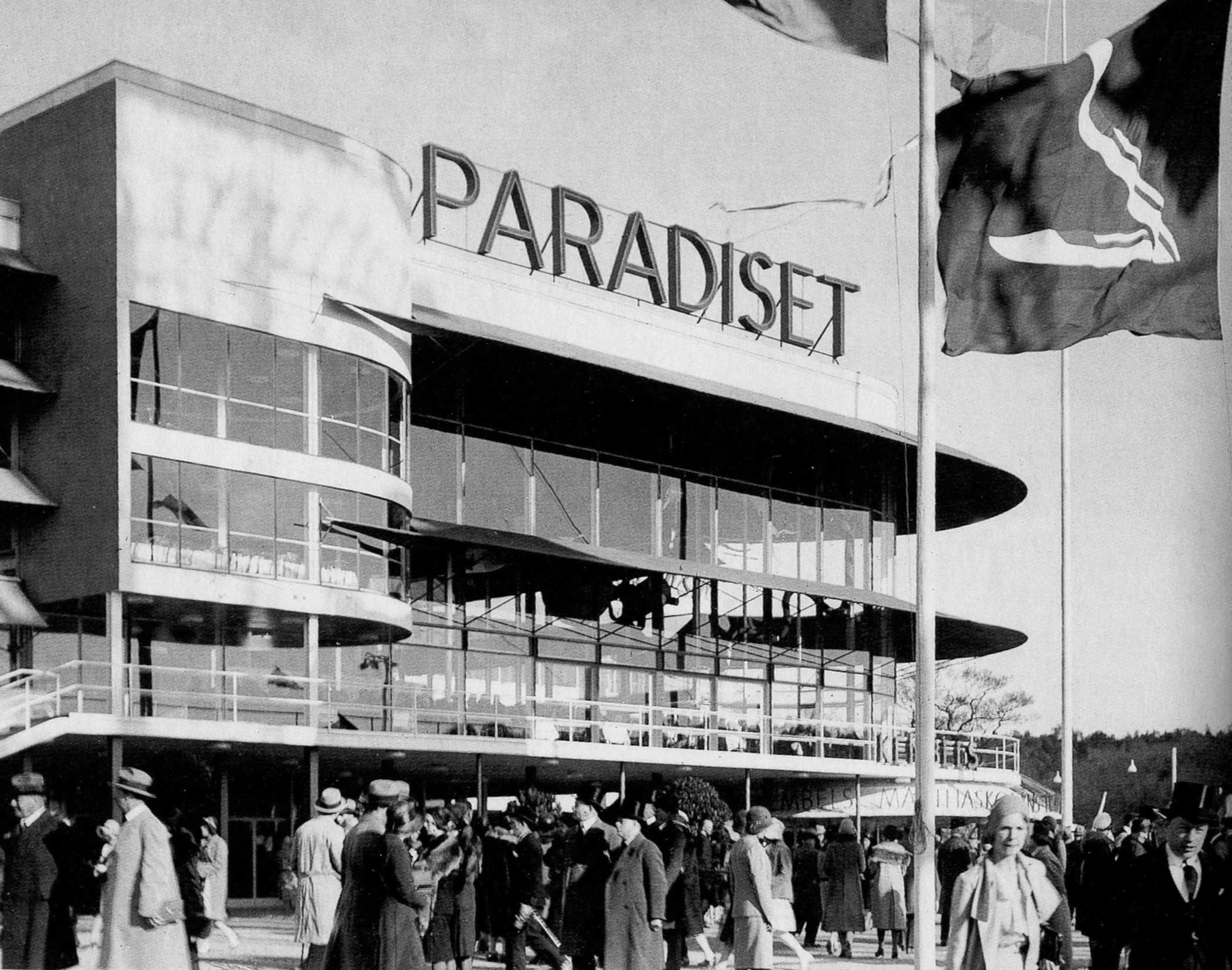
Stockholm Exhibition (1930)
The slogan said it all: Acceptera! Accept! In the summer of 1930, Stockholm staged an exhibition that demanded Swedes embrace the future. For five months, four million visitors wandered through a temporary city of glass, steel, and radical ideas on Djurgarden's southern shore. They came expecting a trade fair and left questioning everything they knew about how buildings should look, how families should live, and what progress truly meant. When the pavilions came down in September, Swedish architecture would never be the same.
The Conversion of Gunnar Asplund
The fair's chief architect arrived as one of Sweden's most celebrated practitioners of the Neo-Classical Swedish Grace style. By opening day, Gunnar Asplund had become a convert to stripped-down functionalism. His Paradise Cafe stood as the manifesto made physical: exposed steel frame, airy expanses of glass, dramatic lighting that transformed the structure into a glowing beacon after dark. Above it all rose Sigurd Lewerentz's towering advertising mast, its electrically-lit Flying V logo visible across the water. Le Corbusier himself had been invited to contribute but declined. No matter. Asplund and Lewerentz had conjured something that needed no endorsement from Paris. The Entry Pavilion alone announced that Swedish architecture had crossed a threshold from which there would be no return.
Living Laboratories
The exhibition showcased bright, hygienic apartments with ample space for every family member. Sven Markelius, Paul Hedqvist, Nils Ahrbom, Helge Zimdal, and Uno Ahren designed housing that represented more than aesthetic change. Central heating. Private bathrooms with running hot and cold water. Fully equipped kitchens. Large windows flooding rooms with light. Balconies for fresh air. Some critics found the architecture too crisp and cold to live with permanently, but the architects were not designing for critics. They were designing for a nation transforming itself. Within a year, three of these architects would co-author the Acceptera! manifesto, articulating in print what their buildings had already declared in steel and glass.
From Pavilions to Policy
Every fair building was temporary, but the ideas proved permanent. Uno Ahren won the commission for the terraced settlement at North Angby in Bromma the very next year. By 1938, his housing projects at Traneberg and Hammarbyhojden were rising on Stockholm's outskirts. Ahren collaborated with Nobel laureate Gunnar Myrdal on a social housing commission from 1932 to 1935, producing The Housing Question as a Social Planning Problem, a work that shaped Social Democratic Sweden. Markelius and reformer Alva Myrdal designed a 57-unit communal-living Collective House in central Stockholm. Even Prime Minister Per Albin Hansson, who coined the term Folkhemmet, the people's home, moved into an Ahren-designed functionalist house in 1936.
A Garden City Preserved
The largest surviving testament to the exhibition's influence lies at Sodra Angby in Bromma. Between 1933 and 1939, approximately 500 single-family homes rose in the functionalist style, designed by the same architects who had created the fair's pavilions. Built around cooperative Social Democratic values, these neighborhoods represented the physical manifestation of Folkhemmet. Alvar Aalto, covering the exhibition for the Finnish press, captured its essence: The exhibition speaks out for joyful and spontaneous everyday life. And consistently propagates a healthy and unpretentious lifestyle based on economic realities. In those words lay both the fair's promise and its lasting achievement.
A Summer in Color
Many images of the fair survive in vivid color, captured by pioneering photographer Gustaf Wernersson Cronquist using the Autochrome Lumiere process. These photographs, published by Swedish Form, preserve the lakeside views at night, the restaurant crowds, the bold Winged V emblem on posters. Swedish artists, craftsmen, and companies displayed their latest work, with glass producer Orrefors Glasbruk featuring prominently. Mass-produced food was served as part of the effort to convince citizens that a modernized lifestyle offered genuine benefits. The temporary city by the water had color, life, and argument. For one remarkable summer, Stockholm staged a debate about the future that Sweden decisively won.
From the Air
Located at 59.33N, 18.12E on the southern portion of Djurgarden island in eastern Stockholm. The exhibition grounds sat along the water, visible from approaches over Lake Malaren. Nearby airports include Stockholm Bromma (ESSB) approximately 8km northwest. Best viewed at 2,000-3,000 feet for context of the island's position relative to central Stockholm.