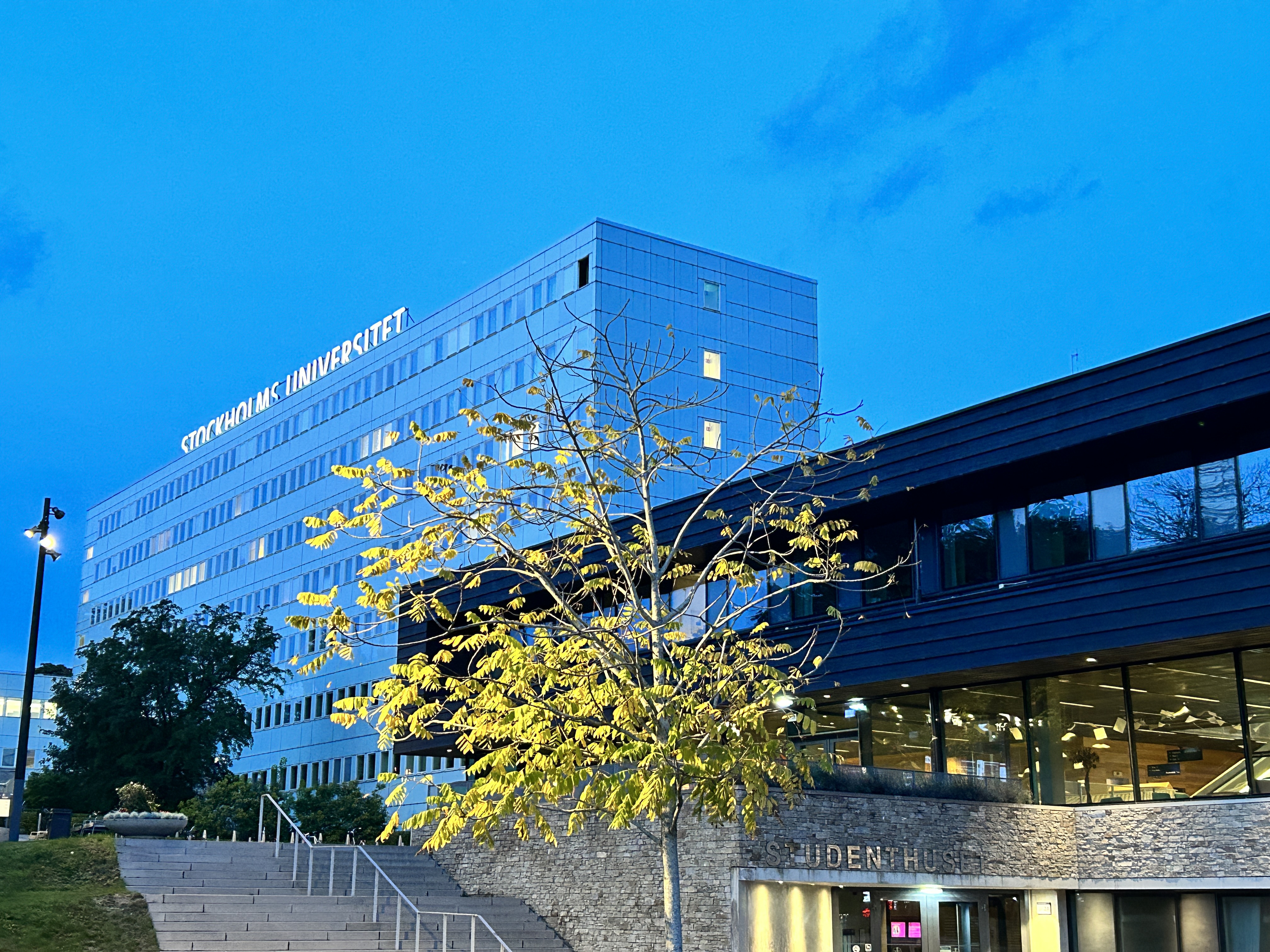
Stockholm University
In 1889, a Russian mathematician named Sofia Kovalevskaya accepted a chair in the mathematics department, becoming only the third female professor in all of Europe. She had been rejected by universities across the continent before Stockholm took a chance. That willingness to embrace talent others overlooked has defined this institution since 1878, when it opened as a college offering natural science lectures to any curious citizen who walked through the door. Today over 33,000 students attend what has grown into one of Scandinavia's largest universities, their predecessors including two Swedish prime ministers, a Greek prime minister, a UN Secretary General, and the Crown Princess herself.
A City Council's Gift
The initiative came from Stockholm's City Council in December 1865, establishing a fund and committee to create a higher education institution in the capital. Professor Pehr Henrik Malmsten joined prominent citizens in the Stockholm University College Association, founded in October 1869. Their memorandum declared the association would not be dissolved until the college came into being and its future could be considered secure. By May 1877, that future seemed secure enough. The autumn semester of 1878 brought the first lectures. In 1904, the college gained official degree-granting status. Not until 1960 did it achieve full university status, becoming Sweden's fourth state institution of higher learning. Growth forced a move from central Stockholm's Observatorielunden to the Frescati campus in 1970, built on the former Experimentalfaltet, once home to the Royal Swedish Academy of Agriculture and Forestry.
From Glaciers to Genomes
The university's reach extends far beyond its Stockholm campuses. At Tarfala research station, 1,135 meters above sea level on Kebnekaise's east side, researchers conduct glaciological, hydrological, meteorological, and climatological studies in arctic conditions. The Asko Laboratory on the Baltic coast has operated as a marine research center since Professor Lars Silen built it in 1961. Tovetorp Zoological Research Station, 95 kilometers southwest of Stockholm, welcomes up to 600 students annually for ecology and ethology fieldwork. These outposts reflect the university's four faculties: law, humanities, social sciences, and natural sciences, with 56 departments, institutes, and centers spread across the academic spectrum.
The Nobel Connection
The roll call of affiliated Nobel laureates reads like a history of twentieth-century science. Svante Arrhenius won Chemistry in 1903. Hans von Euler-Chelpin followed in 1929, George de Hevesy in 1943, Paul Crutzen in 1995. Gunnar Myrdal shared the Economics prize in 1974. Tomas Transtromer received Literature in 2011. Frank Wilczek earned Physics in 2004. Bert Bolin served as the first chairman of the Intergovernmental Panel on Climate Change. University researchers sit on Nobel committees and international expert bodies, responding to proposed legislation and engaging in governmental investigations. The tradition of public lectures for curious citizens continues, connecting contemporary research to the open-door ethos of 1878.
Prime Ministers and Princesses
The alumni list tells stories of power and influence across continents. Dag Hammarskjold earned his doctorate in economics here in 1933 before becoming UN Secretary General. Carl Bildt studied before serving as Prime Minister from 1991 to 1994 and Foreign Minister from 2006 to 2014. Fredrik Reinfeldt followed the same path to the Prime Minister's office from 2006 to 2014. Olof Palme attended before his own tenure leading Sweden. Greek politics claims two alumni prime ministers: Andreas Papandreou, who taught here from 1968 to 1969, and his son Georgios, who studied sociology from 1972 to 1973. Crown Princess Victoria studied political science. Princess Madeleine pursued art history and ethnology. The filmmaker Ingmar Bergman also passed through these halls.
The Italian Names
The main Frescati campus sits in the world's first national urban park, stretching from Bergius Botanical Garden in the north to Sveaplan in the south. Many area names date to the 1780s, when King Gustav III returned from Italy and bestowed Italian names on places around Brunnsviken. The Aula Magna auditorium anchors a landscape where nature, architecture, and modern art intersect. A second campus in Kista houses computer and systems sciences. The Universitetet metro station on the red line delivers students to Frescati, while the Roslagsbanan commuter train stops nearby. Within these grounds, students from more than 100 partner universities worldwide pursue exchange studies, continuing the international spirit that welcomed a rejected Russian mathematician when no one else would.
From the Air
Located at 59.37N, 18.06E in the Frescati area north of central Stockholm. The campus occupies the former Experimentalfaltet within the world's first national urban park, visible from the air as a concentration of institutional buildings amid preserved green space along Brunnsviken bay. Stockholm Bromma Airport (ESSB) lies approximately 6km to the west-southwest. At 2,500-3,500 feet, the university's position between the bay and surrounding parkland is clearly visible, with the Bergius Botanical Garden marking the northern boundary.