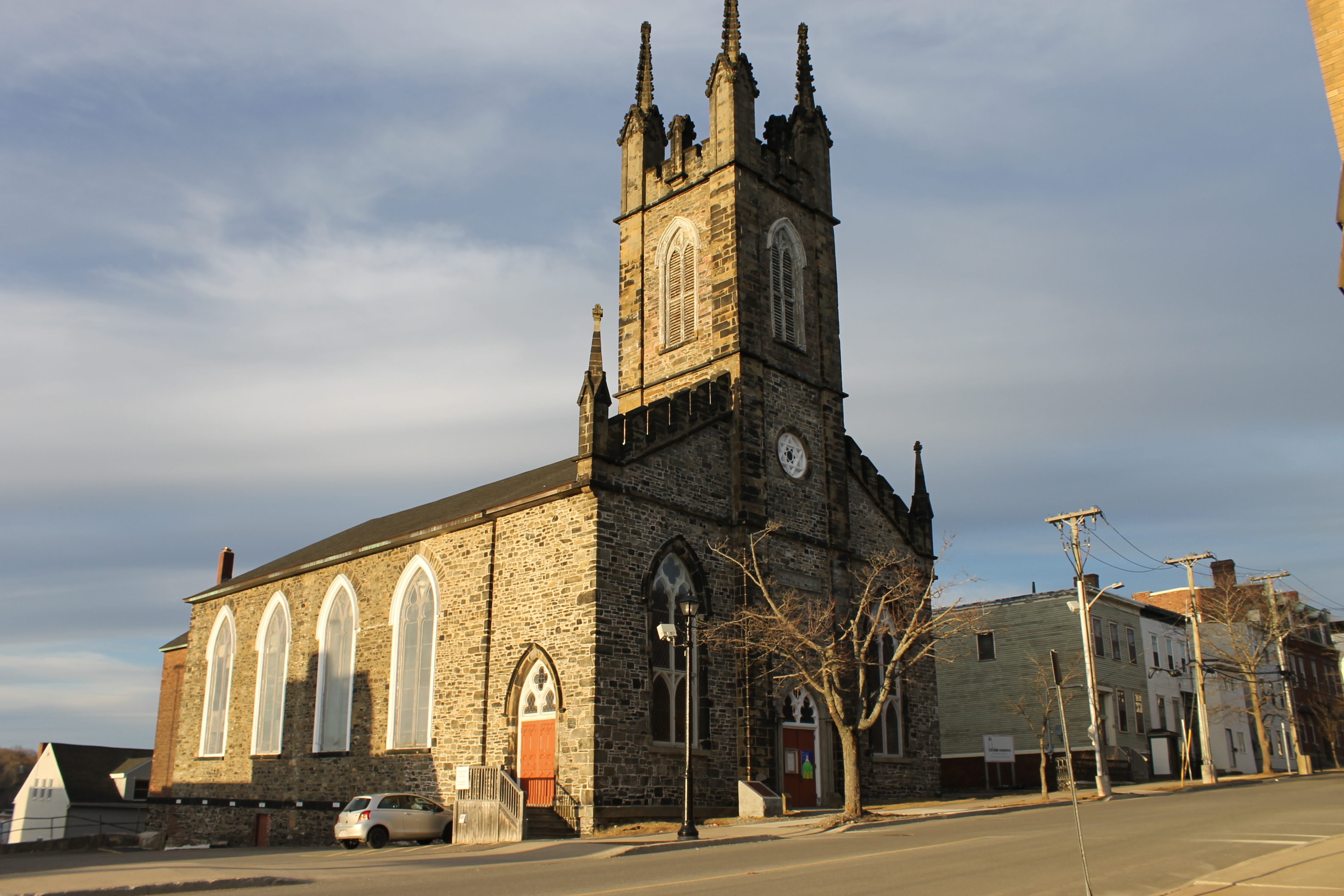
Stone Church (Saint John)
The stones came as dead weight. Sailing ships arriving in Saint John from England carried ballast in their holds to keep stable on the Atlantic crossing, and when they loaded New Brunswick timber for the return voyage, that ballast had to go somewhere. Beginning in 1823, architect John Cunningham and builder Lloyd Johnston took those discarded rocks and turned them into a church. The resulting building, St. John's Anglican Church on Carleton Street, became one of the earliest examples of Gothic Revival architecture in Canada and earned a name that stuck: the Stone Church.
Ballast into Beauty
The decision to build with ballast stones was born of practicality, not aesthetics. In the 1820s, Saint John was a timber port. Ships arrived light and left heavy, their hulls packed with spruce and pine destined for British shipyards. The stones they dumped on the wharves were a byproduct of that trade, available in quantity and costing nothing. Cunningham's design transformed this industrial refuse into something permanent. The walls of the Stone Church carry the texture of their origin, each block slightly different in color and character, imported from quarries the builders never visited and reassembled on a hillside above the Bay of Fundy. Construction began in 1823, and the first service was held on September 11, 1825, though the building was not fully completed until 1826.
A Chapel of Ease for a Growing Garrison
The Stone Church began as a Chapel of Ease, a supplementary place of worship built to serve parishioners who lived too far from the main Trinity Church to attend regularly. By 1822, Saint John's Anglican population had outgrown a single church, and the British military garrison stationed in the city needed a place of worship closer to their quarters. The Vestry of Trinity Church authorized the new chapel, and its construction reflected both the spiritual needs and the imperial architecture of a colonial outpost. Gothic Revival was still a young movement in the 1820s, particularly in British North America. The Stone Church's pointed arches, buttresses, and vertical proportions made it an architectural statement in a city where most buildings were wooden and functional.
Endurance and Near Collapse
The Stone Church has survived nearly two centuries in a city where fire, weather, and economic cycles have erased most of its contemporaries. The Great Fire of 1877 destroyed much of Saint John's central peninsula, but the church on Carleton Street endured. Its stone walls were more resistant to flame than the wooden structures that surrounded it. Survival, however, is not the same as good health. By the 21st century, the church was in serious structural trouble. A CBC News report in 2023 revealed that the building had been closer to collapsing than most people realized. Masonry contractors undertook extensive restoration work to stabilize the walls and preserve the structure. The Stone Church was designated a National Historic Site of Canada in 1989, recognizing its significance as one of the country's earliest Gothic Revival buildings.
Stones That Crossed the Atlantic
What makes the Stone Church unusual is not just its age or its architecture but its material. Every block in its walls made a transatlantic voyage before it became part of a building. The stones were cut in England, loaded into the holds of merchant vessels as stabilizing ballast, carried across the North Atlantic, and dumped on the docks of a colonial port. They were never intended to be building material. That transformation, from dead weight to sacred space, mirrors the story of Saint John itself: a city built by Loyalist refugees who arrived with little and made something enduring from what was at hand. The Stone Church stands today at 87 Carleton Street, its rough-hewn walls a testament to both the resourcefulness of its builders and the unlikely journeys that brought their materials to the shores of New Brunswick.
From the Air
Located at 45.28N, 66.06W at 87 Carleton Street in uptown Saint John, New Brunswick. The church is identifiable by its stone Gothic Revival architecture amid the city's residential and commercial buildings. Nearest airport is Saint John Airport (CYSJ), approximately 14 km east. The city sits on a hilly peninsula at the mouth of the Saint John River where it meets the Bay of Fundy.