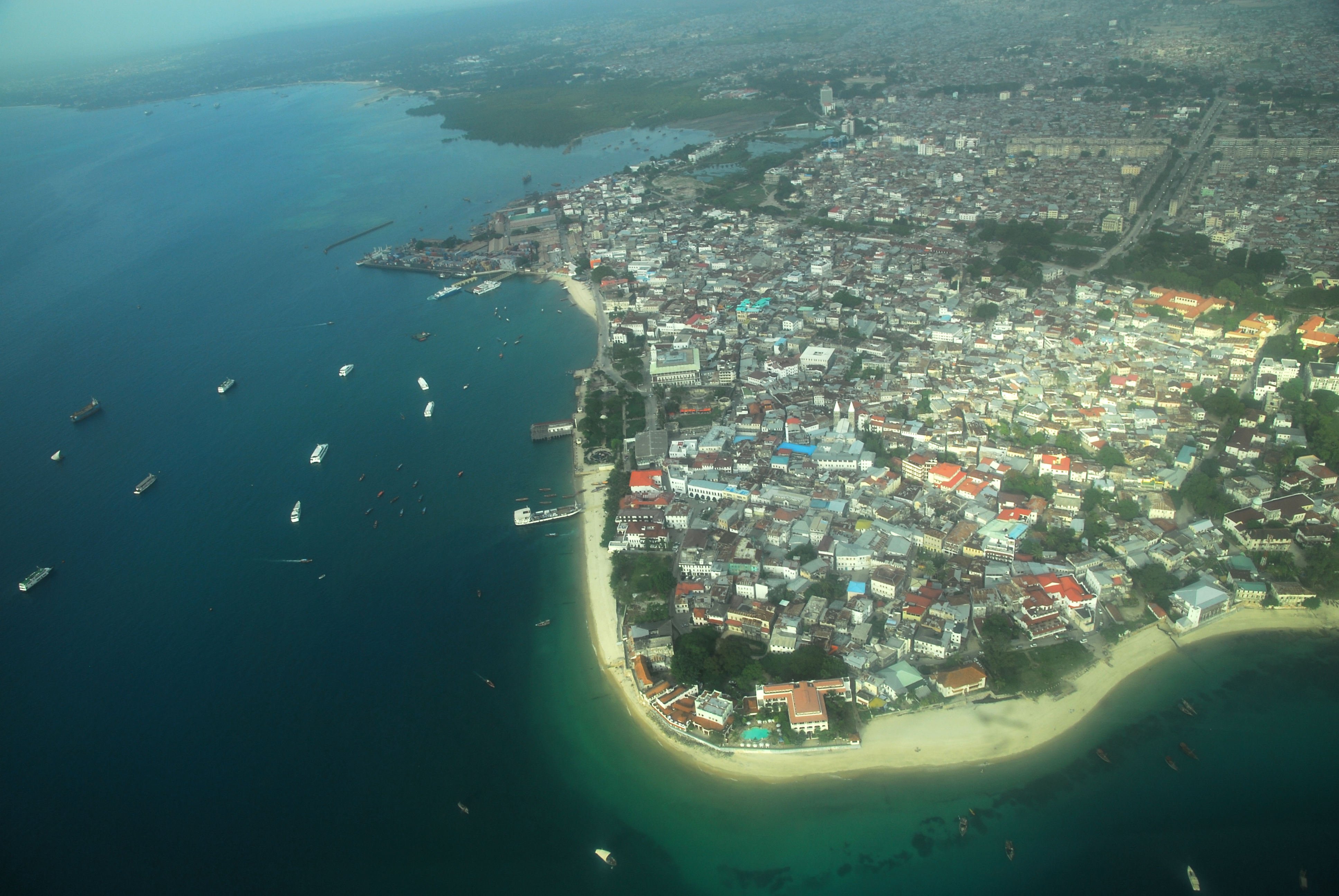
Stone Town
Freddie Mercury was born here. That fact alone draws visitors to Stone Town, the historic core of Zanzibar City on the western coast of Unguja. But the labyrinth of narrow alleys, carved wooden doors, and coral-stone buildings that sprawls across the promontory predates the Queen frontman by centuries, and the forces that shaped it -- Swahili traders, Omani sultans, Indian merchants, Portuguese soldiers, British administrators -- left marks far deeper than any single biography. Stone Town earned its name from the coral rag used in nearly every structure, a building material that gives the old city its warm reddish hue and its constant need for maintenance. UNESCO designated it a World Heritage Site in 2000, recognizing an urban center where the architecture itself records the convergence of African, Arab, Persian, Indian, and European traditions.
The Maze and Its Doors
The streets of Stone Town are too narrow for most cars, so you walk, dodging bicycles and motorbikes that weave through the alleys. The layout defies mapping -- you learn Stone Town by getting lost in it, emerging at the seafront or a mosque or a spice vendor and resetting your internal compass. The buildings press close, their carved wooden balustrades shading the passages below. Built into the facades are baraza, long stone benches that serve as elevated sidewalks during heavy rains and as social gathering spots otherwise. But the doors are what visitors photograph. Zanzibari doors are works of art: heavy wooden panels covered in intricate carvings and bas-reliefs, sometimes studded with large brass fittings from the Indian tradition. Each door announced the wealth and taste of the household behind it. A conservation authority now oversees their preservation, though the friable coral stone demands constant attention that funding does not always provide.
From Fishing Village to Sultanate Capital
Shangani, the original settlement that grew into Stone Town, was a modest fishing village founded in the 11th century. Zanzibar had been part of Indian Ocean trade networks for centuries before that -- a Greco-Roman text from as early as the 1st century mentions an island that may be Unguja -- but the real transformation began when the Omanis took the island from the Portuguese in the late 17th century and built the Old Fort in 1699. The first proper stone houses appeared in the early 1800s, gradually replacing the fishing village. When Sultan Said bin Sultan moved his capital from Muscat to Stone Town in 1840, the settlement entered an era of rapid growth. Grand royal structures like the House of Wonders and the Sultan's Palace rose along the seafront. Indian merchants built elaborately decorated houses. The slave trade brought wealth and horror in equal measure -- Stone Town was the center of the East African slave market until British pressure ended it in 1873.
The Revolution's Shadow
On 12 January 1964, the Zanzibar Revolution overthrew the sultan and the predominantly Arab government. The violence that followed was devastating. Estimates of those killed range from several hundred to as many as 20,000, with thousands more fleeing, and refugees -- particularly Arabs and Indians -- fled the island, leaving behind everything they owned. The revolutionary Afro-Shirazi Party seized the abandoned homes and converted them into public buildings, fundamentally altering Stone Town's social fabric. The grand Arab and Indian houses that had defined the town's architecture became government offices, party headquarters, and communal housing. The revolution reshaped who lived in Stone Town, how they lived, and what the buildings meant. When Tanganyika and Zanzibar merged to form Tanzania later that year, Stone Town retained its role as the semi-autonomous government seat for Zanzibar, a political status that persists today.
Restoration and the Tourist Tide
The irony of Stone Town's preservation is that poverty saved the buildings. Decades of economic stagnation after the revolution meant that there was no money to demolish the old coral-stone structures and replace them with modern buildings. The architecture survived through neglect rather than intention. When tourism began arriving in force, it brought both the resources and the pressures of revival. The Aga Khan Trust for Culture has funded major restoration projects along the seafront. Boutique hotels have filled former trading houses. Restaurants occupy buildings that once served as merchant warehouses. The Forodhani Gardens food market, where seafood sizzles on charcoal grills each evening, has become one of Zanzibar's signature experiences. The challenge, as with any lived-in heritage site, is maintaining Stone Town as a neighborhood rather than a museum -- keeping the spice vendors, the mosques, the schoolchildren alongside the tourists and the hotel developers.
Where Worlds Intersect
Stone Town's character comes from collision. The Anglican Cathedral sits on the site of the former slave market, its altar deliberately placed where the whipping post once stood. St. Joseph's Cathedral, built by French missionaries, stands minutes from the Malindi Mosque. Hindu temples share streets with Swahili coffee houses. This is not curated multiculturalism but the organic residue of centuries during which Persians, Arabs, Indians, Africans, Portuguese, and British lived in close quarters, traded, intermarried, and built. The result is architecture -- and food, and language, and custom -- that belongs entirely to this place. Zanzibari pilau rice, mishkaki skewers, spiced coffee: these are neither African nor Arab but something that could only have been invented where both traditions met. The harbor still connects Stone Town to Dar es Salaam and Pemba by ferry, and the airport 9 kilometers south links it to Nairobi, Mombasa, and Johannesburg. Stone Town remains what it has been for centuries: a crossroads.
From the Air
Stone Town (6.16S, 39.20E) occupies a promontory on the western coast of Unguja, the main island of the Zanzibar Archipelago. From altitude, the dense historic core is distinguishable from the newer Ng'ambo district to the southeast. The seafront landmarks -- House of Wonders, Old Fort, Palace Museum, Forodhani Gardens -- line the western waterfront facing the Zanzibar Channel. Nearest airport: Abeid Amani Karume International Airport (HTZA/ZNZ), 9km south of Stone Town on runway 18/36 (3,053m). The harbor in Stone Town's heart serves ferries from Dar es Salaam (35km across the channel) and Pemba. Tropical climate year-round; peak visibility outside monsoon seasons March-May and November-December.