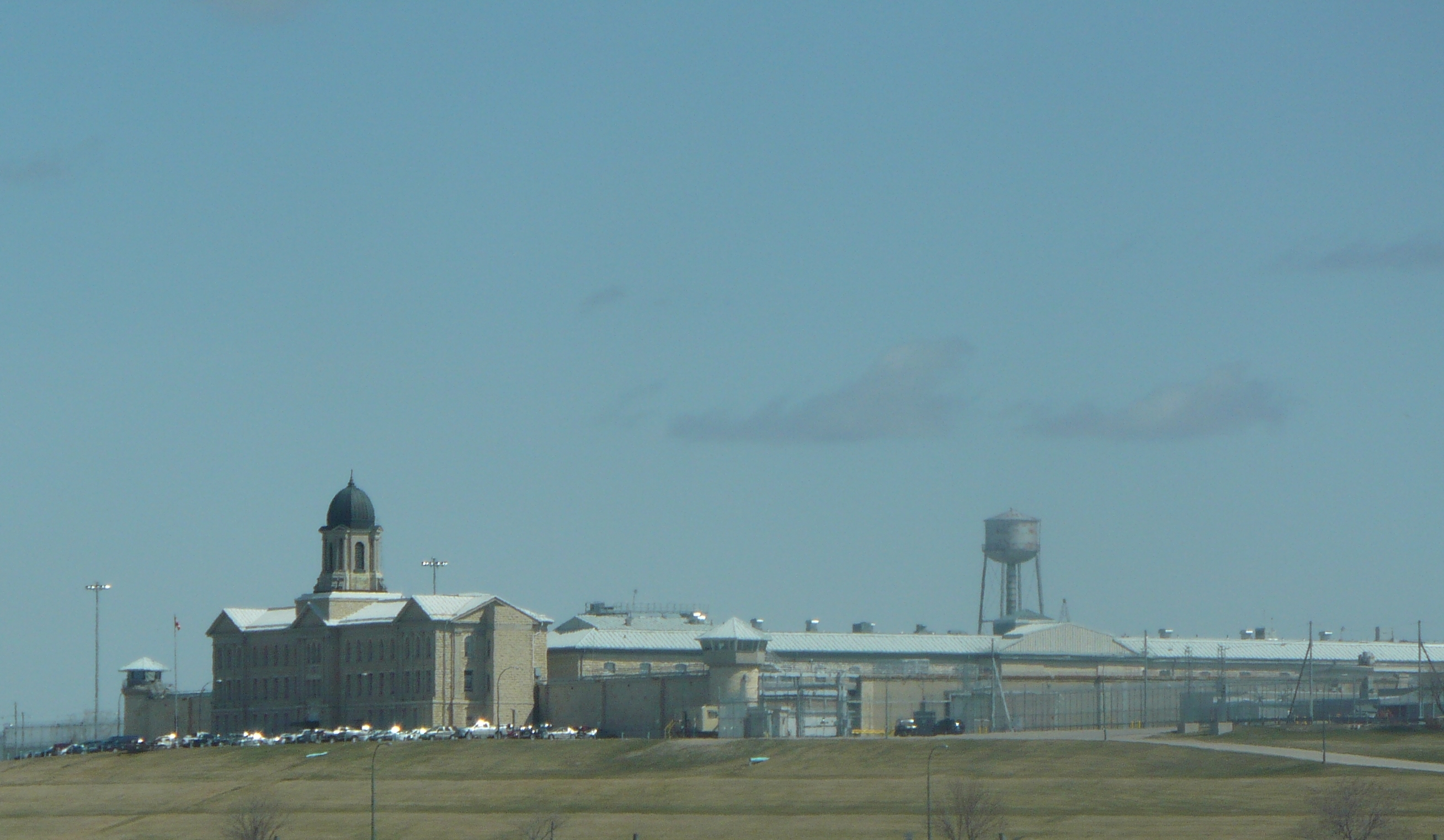
Stony Mountain Institution
On August 15, 1877, Lord Dufferin, the Governor General of Canada, stood on the Manitoba prairie and formally opened a penitentiary with fourteen inmates, one of whom was recorded simply as a female "lunatic." The ceremony must have felt grandly disproportionate to the occasion, a vice-regal affair for a small cluster of cells on a stony ridge north of Winnipeg. But nearly a century and a half later, the Stony Mountain Institution remains open, its walls having absorbed more of Canada's turbulent history than almost any other building on the prairies. Indigenous chiefs imprisoned after the North-West Rebellion, a bank robber who earned his nickname by flying stolen gold out of Winnipeg, labour leaders jailed for daring to strike -- they all passed through the same gates.
Born of Rebellion
The Manitoba Penitentiary, as it was originally known, was commissioned in 1872, just five years after Confederation. The site was chosen near Stony Mountain, Manitoba, not far from Lower Fort Garry, where Sir Garnet Wolseley's expeditionary force had been stationed to suppress the Red River Rebellion of 1869-70. Samuel Lawrence Bedson, a member of that military force, stayed in Manitoba rather than return east, and became the penitentiary's first warden. From the beginning, the prison was entangled with the politics of western expansion. Lands were expropriated, buildings rose quickly -- stables, a schoolhouse, hospital, chapels, a forge, and a slaughterhouse -- and by 1885, forty-four cells were in use. The institution grew in fits and sprawls, decentralized across a large area, a pattern that persists in today's clustered complex of maximum, medium, and minimum security units.
Chiefs Behind Bars
After the North-West Rebellion of 1885, three Indigenous chiefs were sent to Stony Mountain: Big Bear, One Arrow, and Poundmaker. All three had been wrongfully convicted of treason. The penitentiary proved devastating. Their health deteriorated rapidly behind the walls, and upon release, each died shortly after. Their imprisonment stands as one of the starkest examples of how the Canadian justice system was wielded against Indigenous leaders who had resisted the encroachment on their lands and treaty rights. Today, Stony Mountain operates healing units for Indigenous inmates -- NI-MIIKANA at the medium security site and AANIIKEKANA at the minimum security site -- an acknowledgment, however belated, of the particular harm the system has inflicted on Indigenous communities.
The Flying Bandit and Other Notorious Guests
Kenneth Leishman earned his nickname "The Flying Bandit" the hard way. In 1958, he pleaded guilty to two bank robberies and received a twelve-year sentence at Stony Mountain, close to his family in Winnipeg. The warden described him as a "model prisoner," and he was paroled after just three and a half years. Robert B. Russell, one of the leaders of the 1919 Winnipeg General Strike, served two years at the Manitoba Penitentiary for his role in the landmark labour action. Ernest Cashel passed through briefly for theft before being transported to Calgary on murder charges; his subsequent escape was described as "the greatest blow the Mounties had received in all their experience." Thomas Sophonow and James Driskell both endured years inside Stony Mountain for murders they did not commit, their wrongful convictions later overturned.
The Weight of the Walls
When Ontario's Kingston Penitentiary closed on September 30, 2013, Stony Mountain quietly inherited a distinction nobody celebrates: Canada's oldest operating federal prison. Renamed from Manitoba Penitentiary in 1972, the institution has continually expanded. A maximum-security wing was completed in 2014, creating the only maximum-security unit in Manitoba and adding roughly forty staff positions. The adjacent Rockwood Institution, a minimum-security facility, has operated alongside it since 1962. Together, the complex houses seven operational units across multiple security levels. For the small community of Stony Mountain, Manitoba, the penitentiary is both the largest employer and an unavoidable presence, its walls visible from the town's streets, a daily reminder that history here is not abstract but built of stone and iron.
From the Air
Located at 50.08N, 97.22W, approximately 25 km north of downtown Winnipeg in the Rural Municipality of Rockwood. The institution's compound is visible from the air as a large clustered facility adjacent to the small community of Stony Mountain. Nearest major airport is Winnipeg James Armstrong Richardson International Airport (CYWG) roughly 30 km to the south-southeast. At 3,000-4,000 feet AGL, the prison complex and the adjacent Rockwood Institution are distinguishable from the surrounding agricultural landscape.