.png)
Storm Bay
In 1980, an RCMP officer at the Sechelt detachment was asked how many communes were still operating on the Sunshine Coast. He could think of one. Storm Bay, a notch of shoreline near the mouth of Narrows Inlet with no road to it and no plans for one, had outlasted every other back-to-the-land experiment in the region - and its residents, characteristically, objected to the term. They were not a commune, they said. They were a neighbourhood. That distinction has held for more than half a century now, through the deaths of founders and the arrival of second generations, in a bay that can only be reached by boat or floatplane and where the mail does not come at all.
Eight Thousand Years of Shell
The bay's newcomers arrived in the 1960s. Everyone else had been here considerably longer. Storm Bay lies in shíshálh territory - specifically that of the téwánkw, the group associated with the Sechelt, Narrows, and Salmon Inlets - and the archaeological evidence puts continuous habitation here at roughly eight millennia. The proof is underfoot: shell middens, the compacted remains of countless meals, built up over so many generations that they alter the soil chemistry and the plants that grow in it. Middens are the quietest kind of monument. They record not a single event but the accumulated ordinariness of people eating dinner beside the same water for eight thousand years, which is a harder thing to build than a monument and a far more convincing one.
The Brickworks That Wouldn't
The twentieth century arrived with saws and ambitions. Storm Bay was logged hard and homesteaded early, and the stumps left behind still carry the rectangular springboard notches where fallers wedged in planks to stand on above the swollen base of a tree. In 1907 the Sechelt Brick & Tile Company Limited put up a small brickworks on the bay, betting on the local clay. The clay was not good enough, and the operation closed after two years. Fourteen years later the Canadian government tried again on a much larger scale, building a substantial brick plant in 1921 as a "returned men's project" - work for veterans coming home from the First World War with nothing arranged for them. It failed too. Two attempts, one bad clay deposit, and a bay that declined to become an industrial site.
Not a Commune
What arrived next was harder to categorize. Beginning in the late 1960s, people loosely connected to the intentional community movement began settling Storm Bay, and an unusual number of them turned out to matter to Canadian art. Kate Craig, who co-founded Vancouver's Western Front Society in 1973 and ran its media program from 1977 to 1993, kept a cabin here and spent roughly eight weeks of every summer in it from 1976 onward. Glenn Lewis, another Western Front founder, was part of the circle, as were the artist Hank Bull, the filmmaker David Rimmer, and the choreographer Karen Jamieson. They were not retreating from the art world; they were commuting to it. Storm Bay functioned as the place where the work got made, and Vancouver as the place where it got shown. Craig died here in 2002.
Rain, Moss, and No Road
The setting does most of the persuading. Storm Bay sits in the wet coastal forest of the British Columbia mainland, the kind of dense, moss-laden temperate rainforest where the light arrives filtered green and the ground never entirely dries. Sechelt Inlet is a long fjord system reaching back from the Strait of Georgia, steep-sided and sheltered, with Narrows Inlet branching off nearby. Access remains exactly what it has always been: a boat, or a floatplane on the water. No ferry serves the bay, no road reaches it, and the practical consequence is that everyone who lives there chose the inconvenience deliberately and keeps choosing it.
What Endures Here
Three settlements have now been attempted in this bay. The oldest is still the most successful by an enormous margin - eight thousand years of shíshálh presence against two brickworks that lasted a combined handful of seasons. The artists' community sits somewhere in between, sixty-odd years old and still going, sustained by the same things that sustained the téwánkw: the water for transport, the forest for shelter, and a location remote enough that nobody with a better business plan has bothered to interfere. It is the rare place in coastal British Columbia where the industrial chapter is the brief one and the human chapter is the long one.
From the Air
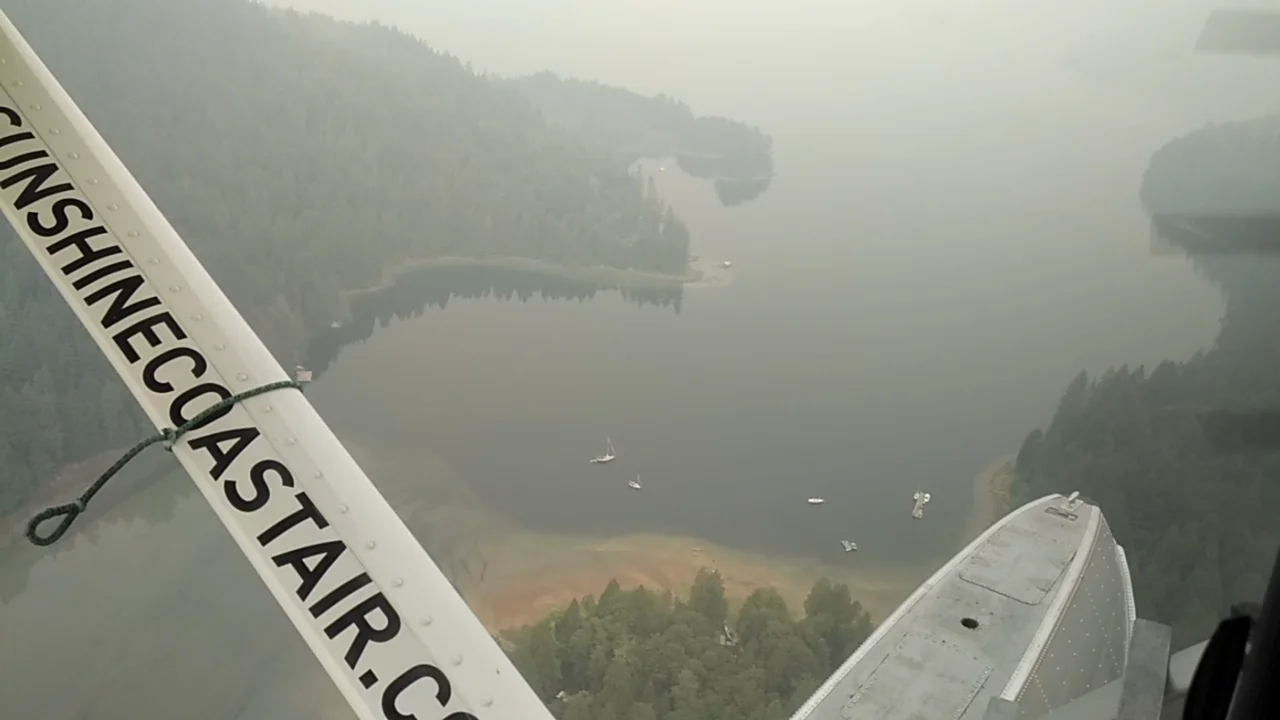
Storm Bay lies at 49.662 N, 123.822 W on the east shore of Sechelt Inlet, near the mouth of Narrows Inlet on British Columbia's Sunshine Coast. A viewing altitude of 2,000-4,000 feet MSL keeps the fjord walls in frame while still resolving individual cabins and floats along the shoreline; note that the inlet is steep-sided, with terrain rising sharply on both flanks, so maintain adequate clearance and be alert for downdrafts and channelled winds along the fjord axis. The navigational picture is straightforward: Sechelt Inlet runs roughly north-south from Porpoise Bay, with Salmon Inlet and Narrows Inlet branching east - Storm Bay sits near the Narrows Inlet junction. Skookumchuck Narrows lies at the inlet's northern end. Sechelt Aerodrome (CAP3) and the Porpoise Bay water aerodrome are about 10 nm south, Vancouver Harbour Flight Centre (CYHC) is roughly 30 nm southeast across the strait, and Powell River (CYPW) lies to the northwest. Floatplane traffic on the inlet is frequent. Expect low ceilings, rain, and fjord-trapped cloud for much of the year.
Nearby Stories
- Bowen Island 1.7 km away
- Qualicum National Wildlife Area 4.2 km away
- Canadian Forces Maritime Experimental and Test Ranges 11 km away
- Britannia Mine and the Mountain That Bleeds 15 km away
- Blubber Bay 18 km away
- Lund, British Columbia 23 km away
- Malibu Hydro 25 km away
- Whistler 38 km away