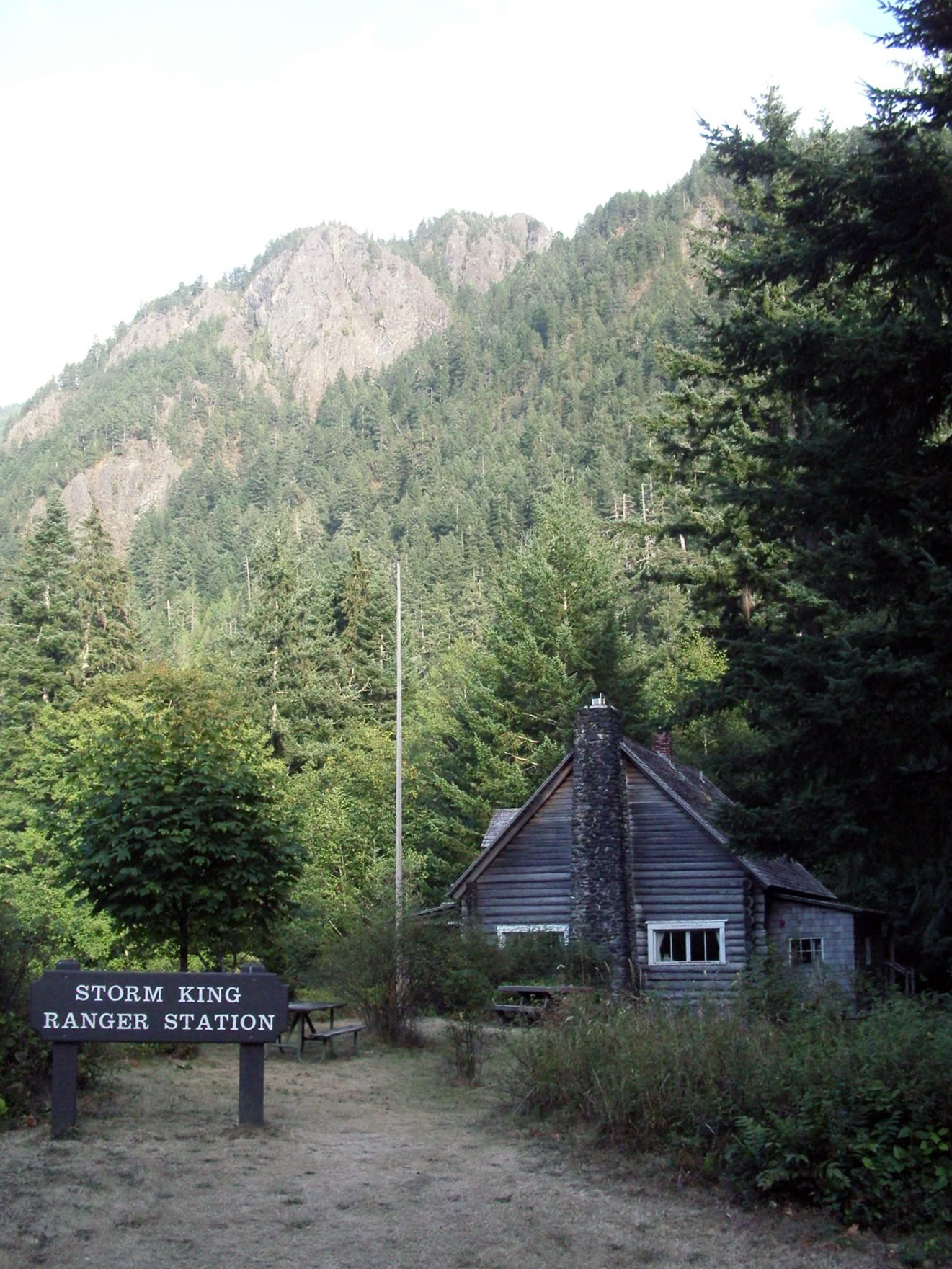
Storm King Ranger Station
In 1979, a tractor loader broke free from its moorings and slammed into the east wall of a small log building on the south shore of Lake Crescent, collapsing the chimney and punching through hand-hewn timbers that had stood since the early twentieth century. It was the kind of accident that would have been the end of most backcountry structures. But the Storm King Ranger Station was not most buildings. It carried the legacy of Chris Morgenroth, one of the Olympic Peninsula's earliest and most determined champions of wilderness protection, and the people who cared about that legacy were not about to let a runaway machine finish what a century of rain and rot had started.
The Ranger Who Dreamed a Park
Chris Morgenroth arrived on the Olympic Peninsula as a settler along the Bogachiel River, one of those remote, rain-soaked drainages on the peninsula's western side where old-growth Sitka spruce tower above carpets of fern. He became one of the first Forest Service rangers in the region, eventually rising to district ranger of the Olympic National Forest. From that position, Morgenroth advocated tirelessly for something larger: a national park that would protect the peninsula's ancient forests, alpine meadows, and wild rivers from the logging industry that was rapidly transforming the Pacific Northwest. His vision helped lay the groundwork for what became Olympic National Park in 1938. The cabin that bears his name -- sometimes called the Morgenroth Cabin -- sits on the south shore of Lake Crescent, southeast of Barnes Point, roughly seventeen miles southwest of Port Angeles.
A Building That Refuses to Disappear
The station was remodeled in 1937, updating a structure that had already served decades of forest patrols and backcountry administration. Then came the tractor incident in 1979, which destroyed the east wall and chimney. Five years later, in 1984, park staff relocated the building a short distance from the Olympic Highway -- State Route 101 -- and the lakeshore, getting it away from road traffic and erosion. During the move, workers discovered extensive deterioration in many of the exterior logs, damage hidden beneath layers of moss and lichen. They restored every compromised timber, a painstaking process that amounted to rebuilding much of the exterior while preserving the cabin's original character. The care was justified: in 2007, the Storm King Ranger Station was added to the National Register of Historic Places, formally recognizing both its architectural significance and its connection to the people who shaped Olympic's conservation history.
Lake Crescent's Southern Shore
The setting matters as much as the history. Lake Crescent is one of the Olympic Peninsula's deepest and most beautiful lakes, a glacially carved basin where the water runs so clear that submerged logs are visible dozens of feet below the surface. The south shore, where the ranger station sits, is backed by the steep flanks of Mount Storm King -- the peak that gives the station its name. Thick stands of Douglas fir and western red cedar crowd the lakeshore, and on quiet mornings the only sounds are the lap of water and the calls of common mergansers cruising the shallows. State Route 101 passes nearby, making the site accessible, but the forest absorbs the road noise quickly. The combination of deep lake, towering peak, and handmade cabin creates a scene that feels less like a roadside attraction and more like a window into the Peninsula's past.
What the Logs Remember
Historic ranger stations scattered across the national park system serve as physical records of the era before helicopters, satellite phones, and paved roads. The Storm King station belongs to a time when a ranger's district was defined by how far he could walk or ride a horse in a day. Morgenroth and his contemporaries patrolled on foot and horseback through terrain that remains some of the most rugged in the lower 48 states, monitoring fire danger, surveying timber, and making the case -- report by report, season by season -- that these forests deserved permanent protection. The cabin's hand-hewn logs, restored and standing, are a quiet monument to that effort. They do not shout about conservation. They simply endure, much as the park they helped bring into existence has endured against the pressures that have not stopped pushing since 1938.
From the Air
Located at 48.06N, 123.79W on the south shore of Lake Crescent within Olympic National Park, about 17 miles southwest of Port Angeles. Look for the distinctive blue crescent of the lake along the SR-101 corridor. Nearest airport: William R. Fairchild International (KCLM) in Port Angeles. The ranger station is a small log structure at the lake's southern edge, backed by the steep slopes of Mount Storm King.