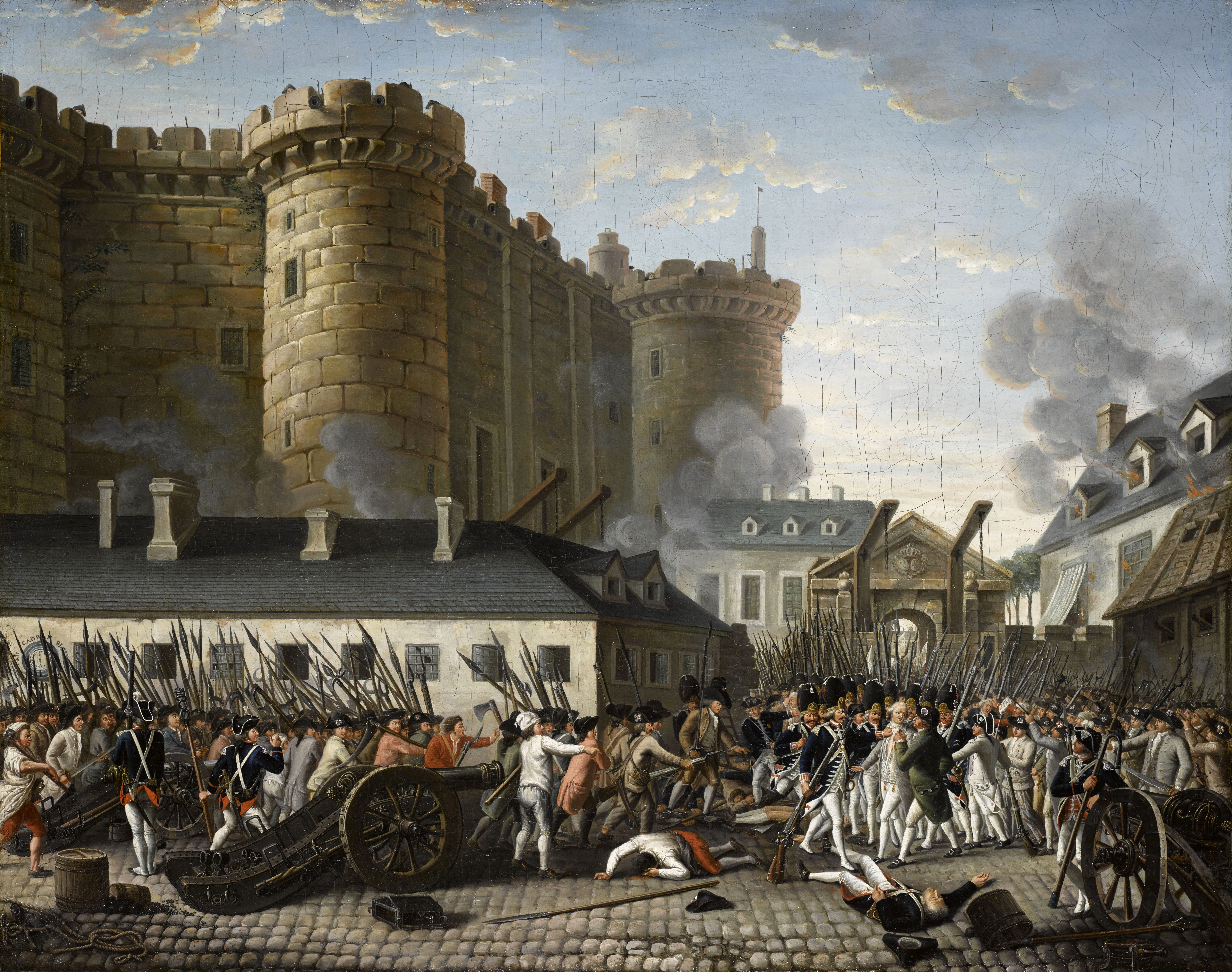
The Storming of the Bastille: The Day the Old Regime Fell
Seven prisoners. That was all the Bastille held on the morning of July 14, 1789 -- four forgers, two men committed for mental illness, and one aristocrat imprisoned at his family's request. The medieval fortress had already been scheduled for demolition. Yet by nightfall, after four hours of fighting that killed ninety-five people, the Bastille's fall had become the defining moment of the French Revolution. Its governor's head was paraded through the streets on a pike. Within months, crowds would reduce the fortress to rubble, and entrepreneurs would sell pieces of its stone as souvenirs. The building was almost empty, but what it represented -- the arbitrary power of the monarchy to imprison anyone without trial -- made its capture the flashpoint of a new world.
A Kingdom on the Brink
France's crisis had been building for years. The crown was effectively bankrupt, drained by the cost of supporting the American Revolution and by a tax system that exempted the nobility and clergy. Poor harvests in the late 1780s pushed bread prices to crisis levels. When Louis XVI convened the Estates General in May 1789, the Third Estate -- representing commoners who made up over 97 percent of the population -- broke away to form the National Assembly, declaring itself the legitimate voice of the French people. The king initially resisted, then appeared to capitulate, then massed troops around Paris and Versailles. On July 11, he dismissed Jacques Necker, the popular finance minister, sending Paris into open revolt. The Palais-Royal became a site of continuous political agitation. Demonstrators broke into prisons to free sympathetic guards, and clashes with German cavalry units in the streets convinced many Parisians that a military crackdown was imminent.
The Search for Arms
The crowd that converged on the Bastille on the morning of July 14 was not driven by ideology but by practical need: they wanted weapons. The previous day, rioters had seized around 30,000 muskets and some cannons from the Invalides, but they lacked gunpowder. The Bastille, as a royal armory, was believed to hold substantial reserves. Its governor, Bernard-Rene Jourdan de Launay, commanded a garrison of about 80 retired soldiers and 30 Swiss guards. The fortress's eight towers, thick walls, and drawbridges made it formidable, but de Launay knew he could not hold out indefinitely. He had already transferred most of the gunpowder from the Bastille's magazines, and his provisions could sustain the garrison for only two days.
Four Hours That Changed History
Negotiations began in the morning, with delegations from the newly formed city government requesting that the Bastille's cannons be withdrawn from the towers. De Launay agreed and invited the delegates to lunch. But the crowd outside grew impatient. Around 1:30 in the afternoon, a group broke through the outer courtyard's undefended gate. When they pressed toward the inner courtyard, the garrison opened fire. The attackers believed they had been lured into a trap and fought back with muskets and cannons dragged from the Invalides. The battle raged for nearly four hours. Ninety-four attackers and one defender were killed. De Launay, his position hopeless, threatened to ignite the fortress's remaining powder magazine -- a bluff his own men refused to support. He surrendered shortly after five o'clock.
The Aftermath
De Launay was promised safe passage but never received it. Dragged through the streets, he was stabbed repeatedly and eventually beheaded, his head fixed on a pike and paraded through Paris. Several garrison members met similar fates. Jacques de Flesselles, the provost of the merchants' guild who was suspected of siding with the crown, was shot on the steps of the Hotel de Ville. The seven prisoners were freed to general jubilation, though their stories were hardly revolutionary -- the most notable among them, the Marquis de Sade, had been transferred to another prison just ten days earlier. Within hours, the National Assembly had established a citizens' militia -- soon renamed the National Guard -- under the Marquis de Lafayette. When the king was told of the Bastille's fall, he reportedly asked, "Is this a revolt?" The Duke de La Rochefoucauld answered: "No, sire. It is a revolution."
Symbol and Stone
Demolition of the Bastille began the next day, carried out by an entrepreneur named Pierre-Francois Palloy, who turned the destruction into both a civic spectacle and a profitable business. He employed hundreds of workers and sold carved stones as mementos to all eighty-three departments of France. Within a year, almost nothing remained of the fortress. Today the Place de la Bastille, with its July Column commemorating a later revolution in 1830, occupies the site. The outline of the fortress's foundations can be traced in the paving stones. Each July 14, France celebrates its national holiday -- not the anniversary of the storming itself, strictly speaking, but also the Fete de la Federation of 1790, which marked the first anniversary of the event. The distinction is a polite fiction. What France commemorates is the day ordinary Parisians challenged the crown by force and won.
From the Air
The Bastille site (48.853N, 2.369E) is now the Place de la Bastille in the 4th, 11th, and 12th arrondissements of Paris, marked by the July Column. The square is visible from the air at the intersection of several major boulevards. Paris Charles de Gaulle (LFPG) is 25km northeast; Paris Orly (LFPO) is 14km south. The nearby Canal Saint-Martin and the Seine provide good visual reference points from the air.