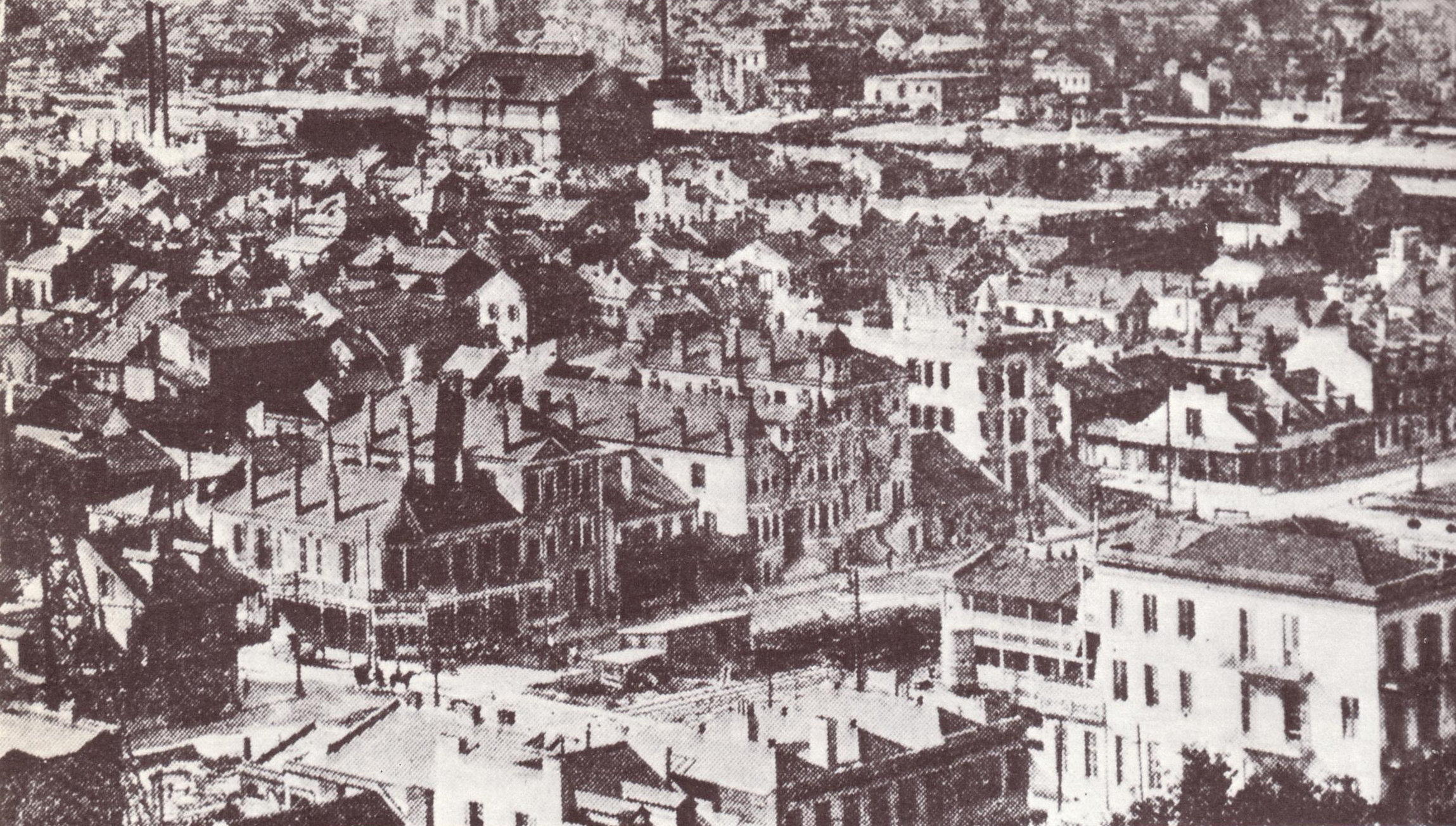
Storyville, New Orleans
The man who created it was mortified by the name. Sidney Story, a prim New Orleans alderman, drafted the 1897 ordinance to contain the city's flourishing vice trade within a regulated thirty-eight-block zone bounded by Iberville, Basin, St. Louis, and North Robertson streets. He envisioned orderly governance. What he got was the most notorious red-light district in American history -- and the locals, with characteristic irreverence, named it after him. Storyville, as everyone called it despite the alderman's protests, existed for just twenty years, from 1897 to 1917. In that brief window, the District became New Orleans' largest revenue center, the proving ground for a new American art form called jazz, and a place so brazen that women would wave naked from balconies at passing trains.
Marble Halls and Fifty-Cent Cribs
Storyville was a place of sharp contrasts. Along Basin Street, elegant mansions catered to wealthy clientele, their interiors furnished with chandeliers, potted ferns, and steam heating. The most famous was Mahogany Hall, run by madam Lulu White, originally called the Hall of Mirrors. Built of solid marble with a stained-glass fan window over the entrance, it rose four stories and held five parlors, fifteen bedrooms with attached bathrooms, and roughly forty women in White's employ. A few blocks away, the cribs charged fifty cents. Between these extremes, the District developed its own ecosystem of saloons, restaurants, and barbershops. Printed 'Blue Books' -- pocket guides inscribed with the motto 'Shame on Him Who Thinks Evil of It' -- listed houses, services, and advertisements for local cigar makers and taxi companies. Approximately sixteen editions were published between 1895 and 1915, sold on the corner of Basin and Canal streets.
The Crucible of Jazz
The brothel parlors of Storyville offered musicians something rare: uncritical audiences and steady employment. Madams hired pianists to entertain clients at all hours, and performers like Jelly Roll Morton and Manuel Manetta played day and night, free to experiment without fear of judgment. The District became a crucible where African musical traditions -- the Bamboula Rhythm, call-and-response patterns, the syncopated beat, and the improvisation rooted in West and Central African traditions -- collided with European musical forms. At the district's founding, black and white musicians were segregated, but the shared space gradually eroded those boundaries. White musicians increasingly absorbed the influence of black performers, and informal musical ventures brought the races together even as record labels kept them apart. Dance halls pulsed with ragtime bands. The experimentation happening inside Storyville's walls was producing something the world had never heard.
Midnight, November 12, 1917
The District's end came swiftly. When the United States entered World War I, the federal government ordered that no brothel could operate within five miles of a military base. Four soldiers were killed within the District in quick succession, and Secretary of the Navy Josephus Daniels declared Storyville a 'bad influence.' The city fought back. Mayor Martin Behrman delivered what became the District's epitaph: 'You can make it illegal, but you can't make it unpopular.' He then ordered Storyville shut down by midnight on November 12, 1917. The area continued as a diminished entertainment center through the 1920s, with speakeasies and gambling joints persisting despite police raids, but the grand era was over. The musicians who had depended on the District's saloons and parlors scattered -- some to riverboats, some to Chicago, carrying jazz with them and planting it across the nation.
Ghosts on Basin Street
Almost nothing remains. During the 1930s, the city demolished nearly every building in the former District to construct the Iberville Housing Projects, leveling even the grand mansions along Basin Street -- some of the finest structures in New Orleans. The street itself was temporarily renamed North Saratoga, as if the city could erase the memory by changing the sign. Today, only three buildings survive from the Storyville era: Lulu White's Saloon, Joe Victor's Saloon, and Tark 'Terry' Musa's store, once known as Frank Early's Saloon. Mahogany Hall, originally built for $40,000, sold for just $11,000 in 1929, served as a House for the Unemployed in the 1940s, and was demolished in 1949. Its memory lives on in Spencer Williams' jazz tune 'Mahogany Hall Stomp' and in the New Orleans Storyville Museum in the French Quarter, which holds original copies of the Blue Books and other artifacts from the District's twenty extraordinary years.
From the Air
Located at 29.959N, 90.074W in the Faubourg Treme neighborhood, two blocks inland from the French Quarter. The former District occupied a thirty-eight-block area now largely covered by the Iberville redevelopment. Look for the area between Basin Street and North Robertson Street, just north of the French Quarter's grid. Nearest airport is Louis Armstrong New Orleans International (KMSY), approximately 11 nm west. Lakefront Airport (KNEW) is about 7 nm northeast. Best viewed at 2,000-3,000 ft AGL approaching from over the Mississippi River or Lake Pontchartrain.