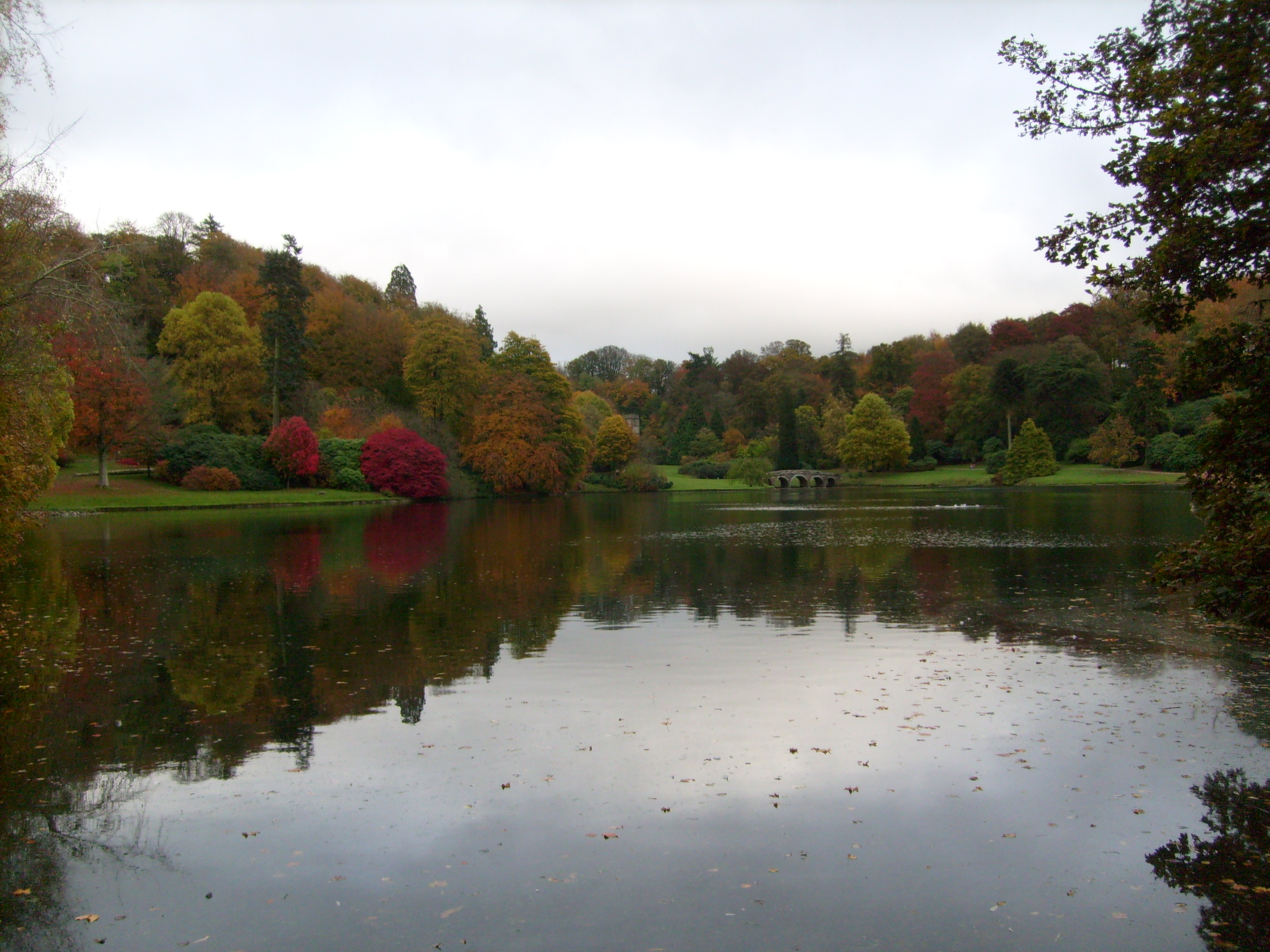
Stourhead
Henry Hoare II owned a painting by Claude Lorrain called Aeneas at Delos. Between 1741 and 1780, he built it. Not on canvas, but across 2,650 acres of Wiltshire countryside at the source of the River Stour, Hoare created one of the supreme achievements of the English landscape garden. A path winds around an artificial lake past classical temples, through a grotto where a stone river god reclines, and up to a hilltop where the Temple of Apollo surveys the whole composition. Walking Stourhead is not visiting a garden. It is entering a painting that moves.
A Banker's Vision
The Stourton family had lived on this estate for five hundred years before selling it in 1714. It changed hands twice more before Henry Hoare, son of the wealthy banker Sir Richard Hoare, bought it in 1717. He demolished the old manor house and commissioned Colen Campbell to design a new one, built by Nathaniel Ireson between 1721 and 1725. It was one of the first Neo-Palladian mansions in England, a symmetrical stone box that declared its owner's taste and ambition. But the house was merely the prelude. It was Henry Hoare II, the son, who understood that the real masterpiece would be the landscape surrounding it.
A Journey Through Myth
The gardens are designed as a narrative. Damming a small stream to create the central lake, Hoare laid out a circuit walk inspired by the painters Claude Lorrain, Poussin, and Gaspard Dughet, whose Utopian views of Italian landscapes established the visual vocabulary of the ideal scene. Each stopping point along the path corresponds to a stage in Aeneas's mythological journey. The Temple of Flora, built in 1744, was the first structure, predating the lake itself. The Pantheon, added between 1753 and 1754, was considered the most important visual feature, appearing in artworks Hoare collected that depicted Aeneas's travels. In the grotto, a sleeping nymph and a river god rest beside flowing water, a subterranean pause between the sunlit classical world above.
Towers and Crosses
Henry Flitcroft, the architect Hoare employed for decades, created the three temples and designed King Alfred's Tower, a 50-metre brick folly that was not completed until 1772. The tower stands on a hilltop at the edge of the estate, commanding views across three counties. The medieval Bristol High Cross, originally erected in 1373, was relocated to the gardens in 1764, rescued from the city where it had stood for four centuries. Sir Richard Colt Hoare, inheriting in 1783, enhanced the planting -- the Temple of Apollo rises from a wooded slope he planted -- and removed features he considered insufficiently classical, including a Turkish Tent. With the antiquarian passion of his era, he excavated four hundred ancient burial mounds to inform his pioneering History of Ancient Wiltshire.
Given Away by Grief
In 1902, fire gutted the house. The family saved many of the heirlooms -- the art collection, the library -- and rebuilt in nearly identical style. But the estate's passage to the National Trust in 1946 was driven by loss of a different kind. Sir Henry Hugh Arthur Hoare, the 6th Baronet, gave the property away one year before his death. His son and sole heir, Captain Harry Hoare of the Queen's Own Dorset Yeomanry, had died of wounds at the Battle of Mughar Ridge on 13 November 1917. There was no one left to inherit. The garden that Henry Hoare II had designed as an allegory of Aeneas's journey through the underworld became, in the end, a memorial to the family's own losses. Even Stourhead's font tells a story: the National Trust's corporate typeface is based on an inscription in the grotto, carved around 1748 and accidentally destroyed around 1960.
From the Air
Located at 51.106N, 2.318W at the source of the River Stour in southwest Wiltshire, near the Somerset border. The artificial lake, mansion, and temples set among mature woodland are visible from the air. King Alfred's Tower is a prominent landmark on the hilltop. Nearest airports: Bristol (EGGD) approximately 25nm north, Bournemouth (EGHH) approximately 30nm southeast. Best viewed from 2,000-3,000ft to appreciate the garden's designed landscape.