Strängnäs Cathedral
The thieves arrived by speedboat. On a summer afternoon in July 2018, two men walked calmly into Strängnäs Cathedral, smashed open a display case, and escaped across Lake Mälaren with two crowns and an orb that had adorned Swedish royalty since the 1600s. The audacious daylight robbery made international headlines, but for this brick cathedral rising above the water's edge west of Stockholm, such drama is nothing new. The site has witnessed a millennium of transformation, from pagan sacrifice grounds to Christian martyrdom, from medieval construction to Baroque renovation, from royal burial vault to unlikely crime scene.
Blood and Conversion
Long before the first stones were laid, this spot on the shores of Lake Mälaren served as a gathering place for Norse rituals. The missionary Eskil arrived here in the mid-11th century, determined to convert the locals to Christianity. The pagans responded by stoning him to death. His martyrdom, rather than ending the Christian mission, made the site sacred to the new faith. A wooden church rose on the very ground where Eskil fell, likely in the early 12th century. By 1240, when Strängnäs became a diocese, the decision was made to replace wood with brick. Construction of the present cathedral began around 1260, with the core structure completed by 1330. The building grew organically through the medieval centuries, gaining a sacristy, towers, and side chapels. The distinctive Baroque tower hood, with its copper-green patina visible for miles across the water, was added in 1723.
Scandinavian Brick Gothic
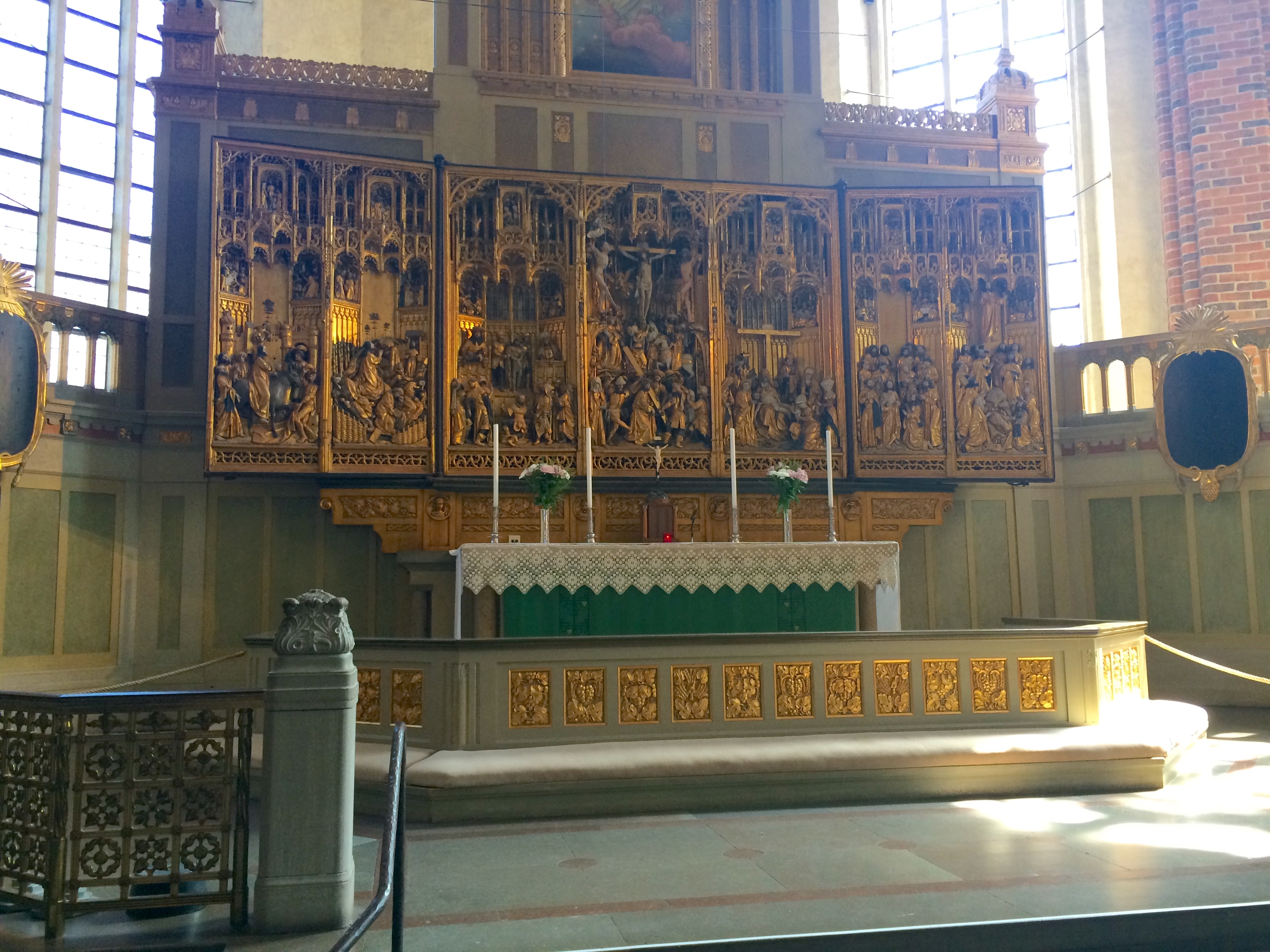
The cathedral represents the quintessential Scandinavian interpretation of Gothic architecture. Unlike the soaring stone cathedrals of France or Germany, Strängnäs achieves its vertical ambitions through brick, the building material of choice where good building stone was scarce. The result is a warmer, more intimate aesthetic, the red-brown brick absorbing light rather than reflecting it. Inside, the contrasts startle. The nave and chancel maintain traditional medieval restraint, dominated by a magnificent gilded triptych altarpiece from the 1480s that fills the entire east wall. Yet two side chapels have been transformed with contemporary art, modern altars beneath abstract religious symbolism creating a dialogue across five centuries. This coexistence of old and new reflects a living faith community rather than a preserved museum.
Resting Place of Kings
The cathedral floor conceals the remains of Swedish power. Charles IX, the king who consolidated Protestant rule in Sweden, lies here, as does Sten Sture the Elder, the 15th-century regent who fought to keep Sweden independent from Danish rule. The tombs of Maria of Palatinate-Simmern and the military commander Gustaf Otto Stenbock add to the royal and aristocratic presence. The burial regalia stolen in 2018 belonged to Charles IX and his queen Christina of Holstein-Gottorp. After the thieves escaped by motorboat across Lake Mälaren, police launched an extensive search. Seven months later, in February 2019, the treasures were recovered and a suspect faced trial. The crowns and orb returned to the cathedral, their dramatic absence having only enhanced public awareness of the irreplaceable items sleeping beside Sweden's monarchs.
A Library of War Trophies
In the cathedral's northwestern corner sits one of Sweden's oldest continuously operating libraries. Its origins trace to 1316, when a widow's bequest of books arrived at the local Dominican monastery. But the collection's most remarkable chapter came during Sweden's imperial adventures of the 17th century. Queen Christina, the learned daughter of Gustavus Adolphus, enriched the library with spoils of war from Prague, Olomouc, and Mikulov. These volumes, seized during the Thirty Years' War, represent both scholarly treasure and troubling legacy. Swedish troops carried off entire libraries as other armies might carry off gold. The 1863 catalog of the collection runs over 600 pages. Today, most titles are searchable through the Swedish national library system, making this small cathedral corner a research destination for scholars of early modern Europe.
Approaching Strängnäs
From the air, Strängnäs Cathedral commands its setting unmistakably. The town occupies a peninsula jutting into Lake Mälaren, with the cathedral's Baroque spire marking the highest point. The surrounding landscape of islands, inlets, and forested shores creates a distinctly Scandinavian waterscape that has remained largely unchanged since the cathedral's medieval builders chose this prominent location. The brick walls catch afternoon light with a warm glow, while the copper tower hood has weathered to a pale green that stands out against both water and sky. On summer evenings, the white nights of northern latitudes keep the cathedral visible well past midnight, a silhouette that has oriented travelers across these waters for eight centuries.
From the Air
Located at 59.3756°N, 17.0346°E on a peninsula in Lake Mälaren, approximately 60km west of Stockholm. The cathedral's distinctive Baroque tower hood is visible from considerable distance over the flat lake terrain. Recommended viewing altitude 2,000-4,000 feet for full context of the waterfront setting. Nearest airport is Stockholm Bromma (ESSB), 45km east. Stockholm Arlanda (ESSA) is 70km northeast. The cathedral sits prominently on the town's highest point, making it an excellent visual reference when flying the Lake Mälaren corridor.