Strata Florida Abbey
Its name means "Vale of Flowers" in Latin, but Strata Florida sits in some of the bleakest uplands in Wales. The abbey's Cistercian founders chose isolation deliberately, settling on the banks of the Afon Fflur near Tregaron in Ceredigion, far from the Norman strongholds that controlled the coast. What they built there between the 12th and 16th centuries became nothing less than the intellectual and spiritual capital of Welsh-speaking Wales -- a place where princes were buried, chronicles were written, and the Welsh language itself was preserved against the forces that would have extinguished it.
A Princely Sanctuary
The abbey was founded in 1164 through the patronage of Rhys ap Gruffydd, the Lord Rhys, prince of the kingdom of Deheubarth. After the Normans had seized control of St Davids and its religious authority, the princely house of Dinefwr needed a new center for Welsh Christianity, one beyond Norman reach. Strata Florida became that center. Rhys reaffirmed its charter in 1184, and his descendants made the abbey their dynastic burial ground. Eleven princes of the house of Dinefwr were interred here during the 12th and 13th centuries, including Prince Gruffydd ap Rhys II. The poet Dafydd ap Gwilym, widely regarded as the greatest Welsh-language poet, also lies here beneath an ancient yew tree.
Chronicle and Council
Strata Florida's influence extended well beyond the spiritual. Around 1238, Prince Llywelyn ap Iorwerth -- Llywelyn the Great -- summoned a council to the abbey where he compelled the other Welsh leaders to acknowledge his son Dafydd as his rightful successor. It was a defining moment in Welsh political unity, and the choice of venue reflected Strata Florida's status as neutral ground respected by all the Welsh principalities. The abbey also produced the most important primary source for early Welsh history: the Brut y Tywysogion, the Chronicle of the Princes, a record of Welsh history compiled by the monks over generations. The abbey's library held national records, the works of bards, and genealogies of the great families of Wales.
Burned, Fined, and Garrisoned
Being the symbolic heart of Welsh identity made Strata Florida a target. King John ordered its destruction in the early 13th century; the monks paid a fine of 700 marks to avert it. English soldiers burned the abbey's granges twice during that century, and in 1231 the abbot was fined 200 pounds for helping Llywelyn ab Iorwerth destroy an English force near Hay-on-Wye. When Owain Glyndwr rose in rebellion in 1401, Henry IV seized the abbey, evicted the monks for their suspected sympathies with the Welsh cause, and turned the religious buildings into a military base. By 1402, the Earl of Worcester held it with hundreds of soldiers. The abbey remained garrisoned through further campaigns in 1407 and 1415, only returning to the Cistercians when the rebellion finally subsided.
Dissolution and Rediscovery
Henry VIII dissolved the abbey in 1539. Its church and ancillary buildings were demolished for materials -- glass, stone, lead, roof tiles. The refectory and dormitory were rebuilt as a gentry house. For centuries, the ruins mouldered in the Welsh uplands. It took a railway engineer named Stephen Williams, surveying a possible rail route through the area in the 1840s, to rekindle interest. Williams was a founder member of the Cambrian Archaeological Association, and he led excavations that uncovered the remains still visible today. Victorian tourists arrived by train to see them, drawn by the same romance of ruin that had animated the Romantic poets.
What Remains
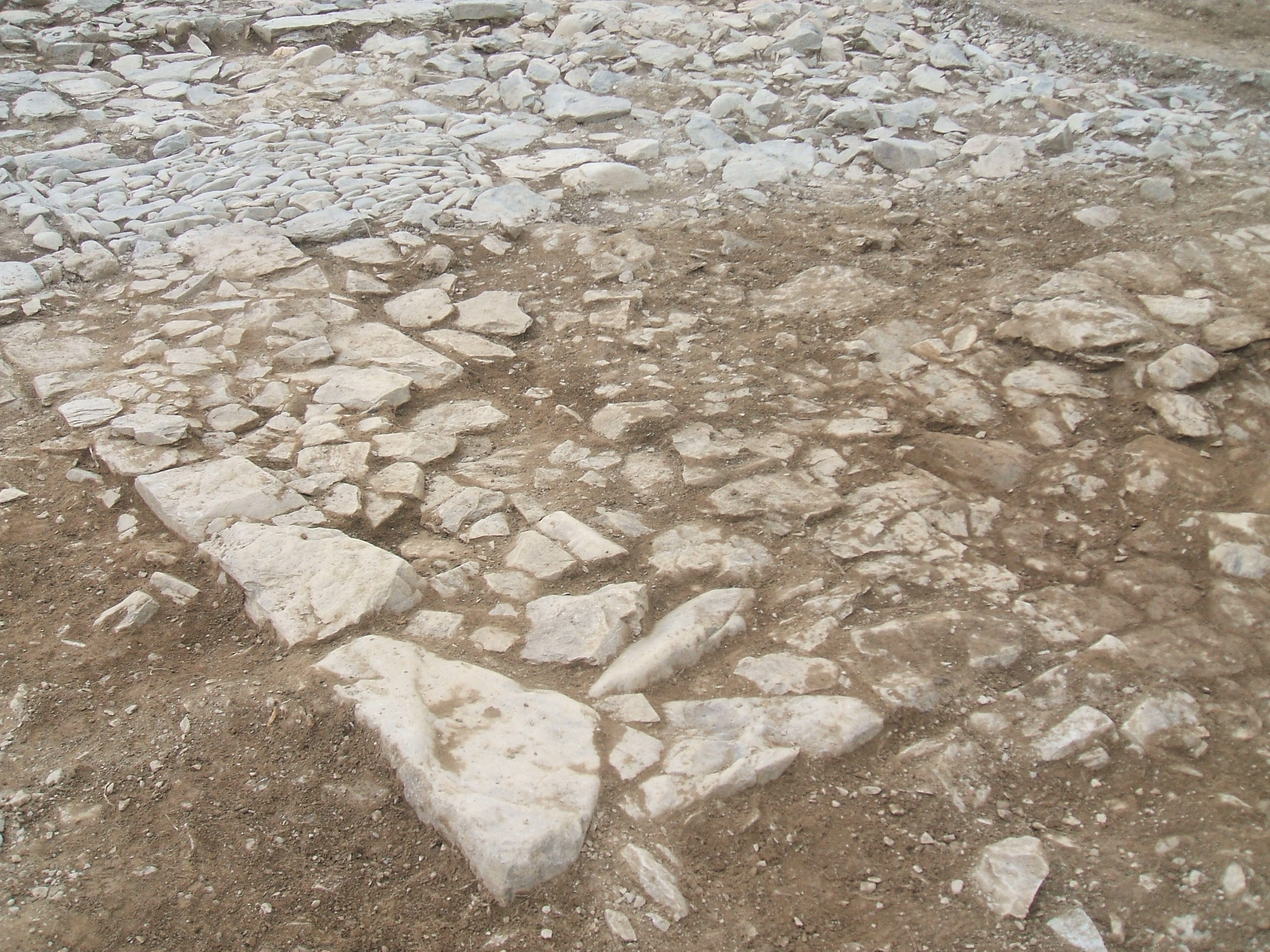
Today the site is managed by Cadw, designated a Scheduled Ancient Monument since 1919. The only substantial structure still standing is the Great West Door, a carved Romanesque archway that once welcomed pilgrims to one of Wales's most powerful abbeys. Low walls mark the outline of the church and its six subsidiary chapels. A modern roof protects an area of excavated medieval floor tiles, including one depicting a gentleman admiring himself in a mirror. The graveyard beside the ruins remains in active use, the living buried alongside the medieval dead. Archaeological work by the University of Wales continues to reveal new structures, including what may be the abbey's gatehouse. Geophysical surveys have traced field boundaries, leats, and evidence of iron working, all testimony to the industrial scale on which the monks operated across their remote Welsh domain.
From the Air
Located at 52.28N, 3.84W in the uplands of Ceredigion, Mid Wales. The abbey ruins sit in a green valley beside the Afon Fflur. From the air, look for the distinctive archway and low walls in an otherwise sparsely populated landscape. Nearest airport: Aberystwyth (no ICAO). West Wales Airport (EGFE) at Haverfordwest is the closest licensed field. Recommended altitude: 2,000-3,000 ft. The surrounding terrain is hilly and remote -- the so-called 'Desert of Wales.'