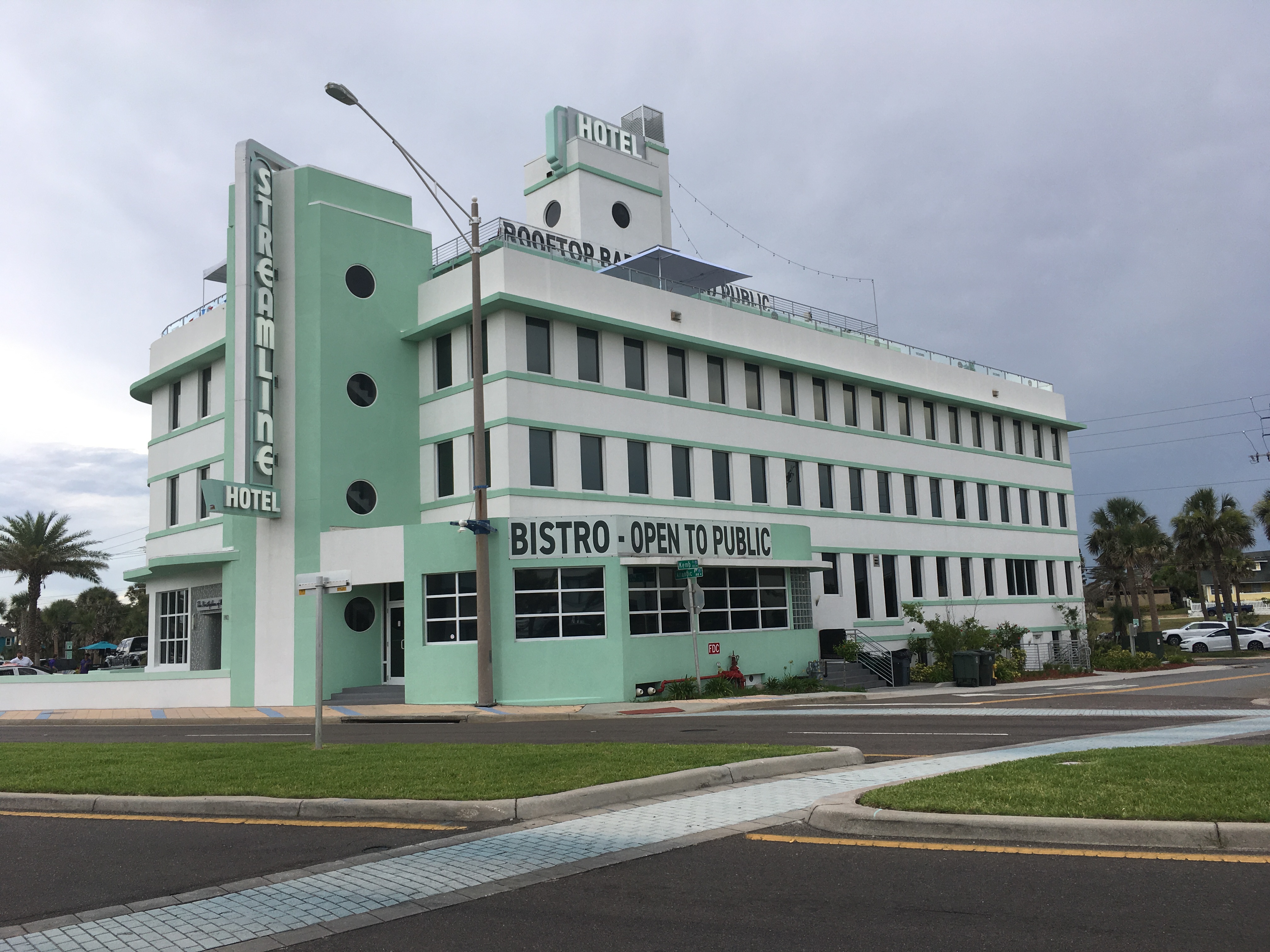
The Streamline Hotel
On the evening of December 14, 1947, a group of drivers, mechanics, and promoters crowded into the Ebony Club, the rooftop bar of a four-story mint-green hotel on South Atlantic Avenue in Daytona Beach. They were angry. Promoters had been skipping town with gate receipts before races ended. Rules changed from track to track. Drivers risked their necks for purses that might never materialize. Bill France Sr., the Washington D.C. transplant who had been promoting beach-and-road races for a decade, had called them together with a proposition: organize or die. Sixty-nine days later, the National Association for Stock Car Auto Racing was born. The building where it happened -- the Streamline Hotel -- still stands, its story as turbulent as the sport it launched.
Curves of a Machine Age
The Streamline Hotel opened in 1940, its rounded corners and horizontal lines a textbook example of Streamline Moderne architecture -- the style that made buildings look like they were moving at speed even while standing still. The four-story structure sits on the west side of State Road A1A, the same road that once formed half of the Daytona Beach and Road Course, where stock cars tore along the highway before swinging onto the hard-packed beach for the return leg. A plaque on the building declares it Daytona Beach's first fireproof structure, and during World War II it doubled as the city's first bomb shelter. It remains the oldest standing hotel in Daytona Beach, its mint-green paint a quiet declaration of survival.
The Rooftop Where Racing Found Its Rules
Bill France Sr. had moved to Daytona Beach from Washington D.C. in 1935, drawn by the weather and the racing culture that had grown around the city's uniquely hard-packed sand. By 1947, he understood that stock car racing would destroy itself without structure. The December meeting at the Streamline's rooftop bar drew three dozen figures from the fractured world of Southern racing. The conversations stretched across weeks, wrestling with prize money, uniform rules, and a sanctioning body that drivers could trust. On February 21, 1948, the group formalized its creation -- initially calling it the National Stock Car Racing Association, then discovering that name was already taken and rechristening it NASCAR. The organization's first offices opened three blocks away at the Selden Bank Building. Daytona International Speedway, which France would build a decade later, sits just west of the hotel.
A Den of Iniquity and Other Chapters
Glory did not protect the Streamline from neglect. Through the decades, the hotel accumulated rust-stained walls and sun damage. A local police chief called the building a "den of iniquity." It cycled through incarnations that no one could have predicted: a youth hostel, a retirement home run by an evangelist who claimed to have ministered to Elvis Presley, and at one point a gay bar -- the birthplace of stock car racing reinvented as a nightlife venue. In 2006, the city's redevelopment board floated the idea of purchasing the hotel and converting it into a NASCAR museum. A mysterious $400,000 appeared on the board's budget under "historic preservation," though the city's finance director denied knowing anything about it. The museum never materialized.
Resurrection on Reality Television
The Streamline's salvation came from Eddie Hennessy, a local businessman who purchased the building in 2014 with plans to transform it into a South Beach-style boutique hotel. The renovation made national television when the property was featured on an episode of Hotel Impossible that October. Hennessy gutted the building entirely, spending $6 million to restore what decades of neglect had hollowed out. The Streamline Hotel reopened in May 2017, its Streamline Moderne lines intact, its rooftop bar once again welcoming guests. The resurrection lasted two years. In April 2019, Hennessy decided to exit the hotel business and put the property up for online auction. Two weeks after the auction closed, the hotel was pulled from sale. The Streamline endures, as it always has -- battered, reinvented, stubbornly standing on A1A where the highway meets the memory of racing on sand.
From the Air
Located at 29.22°N, 81.01°W on the barrier island side of Daytona Beach, just west of the Atlantic shoreline. From altitude, A1A runs north-south with the hotel along its west side. Daytona International Speedway (KDAB nearby) is visible to the west. The nearest airport is Daytona Beach International Airport (KDAB), approximately 4 miles west. At low altitude, the four-story mint-green building is identifiable along the beachfront hotel strip. The former beach-and-road course ran along this same stretch of A1A and the adjacent beach.