Stroganov Church
Peter the Great closed it in 1722, and nobody could explain exactly why. The Church of the Nativity of the Blessed Virgin Mary -- known universally as the Stroganov Church -- had been consecrated just three years earlier, its white stone carvings still sharp-edged, its bell tower gleaming above Rozhdestvenskaya Street in Nizhny Novgorod. The tsar ordered it shut, and shut it remained until his death in 1725. Whatever offended Peter died with him. What survived was one of the finest examples of what would come to be called Stroganov Baroque: an architectural style born from the collision of old Russian church-building traditions with Western European decorative excess, funded entirely by one of the empire's most powerful merchant families.
A Merchant's Monument
Construction began in 1696 at the expense of Grigory Dmitrievich Stroganov, whose family had built their fortune on salt mining, fur trading, and land development across the Urals. The church was nearly complete by 1701 when fire gutted the interior. Grigory's wife, Maria Yakovlevna, oversaw the rebuilding. The restored church was finally consecrated in 1719 by Archbishop Pitirim of Nizhny Novgorod and Alatyr. The Stroganovs did not merely fund a church; they created a statement. The building's lavish decoration -- intricate white stone carvings covering both exterior and interior surfaces -- announced the family's wealth and taste to every merchant, pilgrim, and official who passed along the busy commercial street below.
Fire, Flood, and a Leaning Tower
The Stroganov Church seemed to attract misfortune. After Peter the Great's unexplained closure and the fires that swept through in 1768, 1782, and 1788, the building required constant attention. Between 1807 and 1812, Alexander Stroganov -- a descendant of the founder -- funded major repairs. In the 1860s, the bell tower began to lean. Over two decades it drifted 1.2 meters from vertical, a slow-motion crisis that must have alarmed parishioners watching it tilt above the busy street. In 1887, workers dismantled the upper tiers of the tower and rebuilt them plumb. Thorough restorations followed in the 1870s and 1880s under architects Lev Dahl and Robert Kilevain, preserving the ornamental stonework that gives the church its distinctive character.
The Priest Who Saved a Church
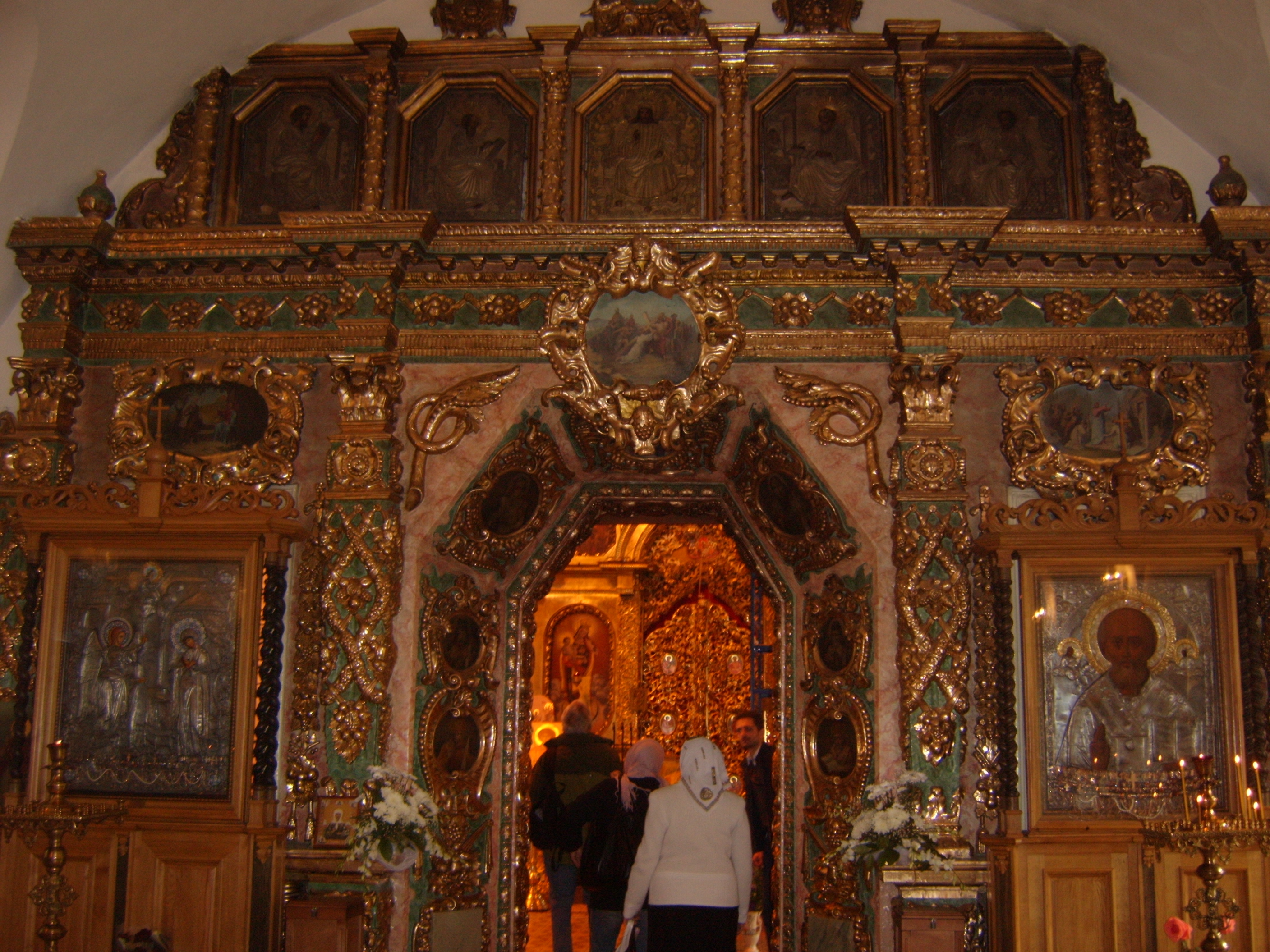
When Soviet authorities decided to destroy the Stroganov Church, Father Sergiy Veysov mounted a defense that was part scholarship, part bureaucratic guerrilla warfare. Serving as rector from 1915 to 1934, he collected photographs, historical documents, and anything else that could demonstrate the building's cultural significance. He lectured officials at the Ministry of Culture on the artistic importance of Stroganov Baroque, making the case that this was not merely a church but a monument to a uniquely Russian architectural style. His arguments prevailed. The demolition order was rescinded, though the church was repurposed -- during World War II it served as a pharmacy warehouse. The iconostasis, remarkably, survived intact. After the war, a Museum of Religion and Atheism occupied the building, remaining there until 1993, when the church was reconsecrated on July 3.
Baroque in White Stone
The architecture defies simple categorization. The church is built on two levels: the upper floor holds a three-apsidal altar, a prayer hall, a refectory, and a porch. Every surface, inside and out, is covered with carved white stone ornamentation -- a profusion of floral motifs, geometric patterns, and sculptural details that reflect Western European Baroque filtered through Russian sensibilities. The bell tower follows the traditional Russian "octagon on cube" form, its dome crowned with a cross and weather vane. On the stone slabs of the clock face, Slavic letters divide the circle into 17 parts according to the Old Russian calculation of time. The original clock mechanism has been lost; a modern replacement keeps the hours now. But the numerals remain as they were, counting time in a system that predates the one Peter the Great imposed on his empire.
From the Air
Located at 56.327N, 43.985E on Rozhdestvenskaya Street in Nizhny Novgorod's Lower Posad, below the Kremlin bluff. The church's ornate white facade and distinctive bell tower are visible from the air at lower altitudes. Recommended viewing altitude: 1,000-3,000 feet. Nearest airport: Nizhny Novgorod Strigino (UWGG), approximately 14 km southwest. The Oka and Volga rivers frame the surrounding district.