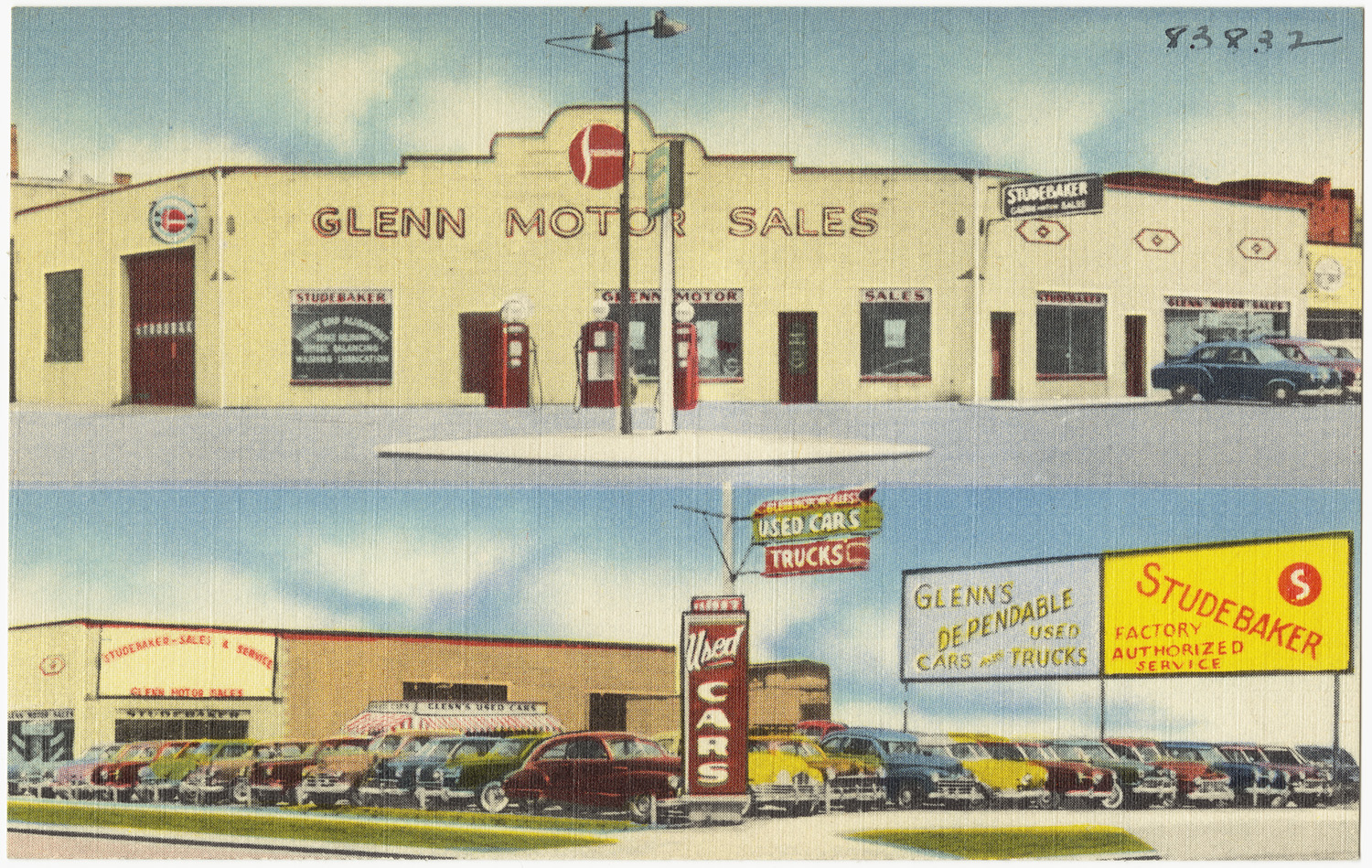
Studebaker
Somewhere in the woods near New Carlisle, Indiana, hidden inside the high-speed oval of a former proving ground, the skeletons of prototype automobiles rot in the open air. For decades, Studebaker engineers sent cars that never made it to production to this secret graveyard, where they lay in direct contact with the earth, slowly crumbling under fallen trees. Attempts to move them caused bodies to disintegrate under their own weight. The graveyard is the perfect monument to a company that spent 114 years building vehicles, from Conestoga wagons to the space-age Avanti, and whose story Thomas Bonsall described as "in microcosm, the story of the industrial development of America."
Five Brothers and a Wheelbarrow
The Studebaker family arrived from Solingen, Germany, landing in Philadelphia in 1736. By the 1740s, patriarch Peter Studebaker was forging steel and building wagons at a property called Baker's Lookout in Hagerstown, Maryland. His descendants carried the trade westward, generation by generation. In February 1852, Clement and Henry Studebaker Jr. set up as blacksmiths in South Bend, Indiana, making metal parts for freight wagons. Their brother John Mohler was in Placerville, California, building wheelbarrows for Gold Rush miners. By 1858, John had amassed $8,000 from his wheelbarrow enterprise and returned to South Bend to finance what would become one of the largest vehicle manufacturers on Earth. Henry, a devout Dunkard Brethren who believed war was evil, sold out rather than profit from military contracts. By century's end, the five Studebaker brothers had built an empire. In 1889, President Benjamin Harrison ordered a full set of Studebaker carriages and harnesses for the White House.
The Horseless Carriage Arrives
Studebaker built its first electric vehicles in 1902 and its first gasoline cars in 1904. By 1912, the first fully Studebaker-manufactured gasoline automobile rolled off the line, and within a decade the company was producing over 100,000 cars annually. The transition from horse to horsepower was not without family tension. John Mohler Studebaker, the patriarch who had bankrolled the business with Gold Rush wheelbarrow money, always viewed the automobile as complementary to the horse-drawn wagon, noting that maintaining a car might be beyond the resources of a small farmer. His son-in-law, Fred Fish, pushed the company into the automotive age. By 1918, the seven Studebaker plants had an annual capacity of 100,000 automobiles and 75,000 horse-drawn vehicles, the old and new worlds rolling off the same factory floors. Peak production came in 1950, when 268,226 vehicles carried the Studebaker badge.
Coming or Going?
After World War II, Studebaker bet on bold design. The company hired Virgil Exner and launched the slogan "First by far with a post-war car." The 1947 Starlight coupe introduced a flatback trunk and wraparound rear window that were so unconventional they spawned a running joke: nobody could tell if the car was coming or going. The design appeared influenced by the twin-boomed Lockheed P-38 Lightning fighter, a connection fitting for a company that had built Wright R-1820 aircraft engines during the war. Studebaker even attempted to build what might have been the largest aircraft piston engine ever created, a 24-cylinder H-configuration monster designated the H-9350. It was never completed. By the late 1950s, though, the Big Three automakers were squeezing independents out of the market. The compact Studebaker Lark provided a brief reprieve, but when GM, Ford, and Chrysler introduced their own compacts in 1960, the bleeding resumed.
The Last Day in South Bend
On December 9, 1963, Studebaker announced the closure of its South Bend plant, the city's largest employer. The last Larks and Hawks rolled off the line on December 20. The last Avanti followed on December 26. The closure devastated St. Joseph County; nearly a quarter of the plant's workforce was African American. Limited production continued at a plant in Hamilton, Ontario, which had always been profitable, but Studebaker's directors refused to fund new tooling for 1967 models. The last Studebaker, a turquoise-and-white Cruiser sedan, came off the Hamilton line on March 16, 1966. Those final Canadian-built cars used Chevrolet engines, their own powerplant no longer in production. The Studebaker name lingered through mergers with Wagner Electric and Worthington Corporation before disappearing from the American business scene entirely in 1979.
Ghosts and Groves
Studebaker's physical legacy still marks the Indiana landscape. In 1937, workers planted 5,000 trees on the company's proving grounds, spelling out the Studebaker name in living letters visible from the air and later from satellite photography on Google Earth. The grove still stands. The Studebaker National Museum in South Bend preserves the only example of a never-produced 1947 Champion wood-sided station wagon, rescued from the secret prototype graveyard. The South Bend plant itself was purchased by Kaiser Jeep, forming the nucleus of what became AM General, today the world's largest producer of tactical wheeled vehicles. Even Studebaker's truck design outlived the company: the designers of the 1993 Dodge Ram named the Studebaker E-series pickup as their primary inspiration, and the Studebaker US6 military truck became the basis for the Soviet GAZ-51, produced in Russia until 1975.
From the Air
Studebaker's headquarters and main factory were located in South Bend, Indiana, at 41.67N, 86.25W, along South Lafayette Boulevard. The former proving grounds with the tree-spelled Studebaker name are near New Carlisle, approximately 10nm north, and visible from altitude on satellite imagery. Best viewed at 3,000-5,000 feet AGL. Nearby airports: South Bend International (KSBN) 5nm northwest, Elkhart Municipal (KEKM) 15nm east. The Studebaker National Museum is located downtown near the St. Joseph River.