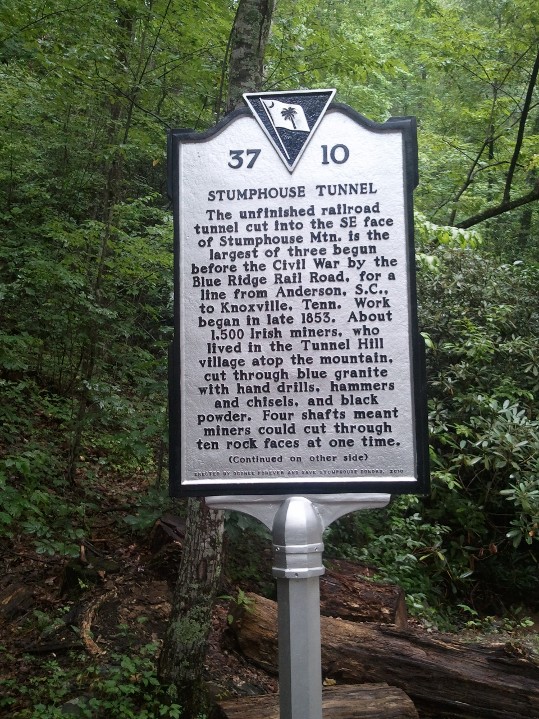
Stumphouse Mountain Tunnel
For two decades, Clemson University aged blue cheese inside an abandoned railroad tunnel in the mountains of Oconee County. The constant 50-degree temperature and 85 percent humidity deep inside Stumphouse Mountain turned out to be ideal conditions for cultivating the Penicillium mold that gives blue cheese its distinctive veining and sharp bite. The tunnel's builders -- Irish laborers who had crossed an ocean to blast through Appalachian granite -- never imagined their unfinished bore would find its highest purpose as a cheese cave. But then, almost nothing about Stumphouse Mountain Tunnel has gone according to plan.
A Million Dollars Into the Mountain
In 1852, the George Collyer Company of London dispatched Irish workers to the Blue Ridge foothills of South Carolina with an audacious assignment: punch a 5,863-foot railroad tunnel through Stumphouse Mountain for the Blue Ridge Railroad. The laborers built a settlement called Tunnel Hill atop the mountain and set to work with hand drills and black powder. The project was part of a grand scheme to connect Charleston's port with the commercial centers of the Ohio Valley, a route that required crossing the Blue Ridge through three separate tunnels. By 1859, the State of South Carolina had sunk over a million dollars into the project -- a staggering sum for the era. Yet only 1,617 feet of tunnel had been carved from the rock, barely a quarter of the planned length. The state refused to spend another cent. Work stopped. The laborers scattered. Where the tunnel was supposed to emerge on the far side of the mountain, the prepared earthen railbed now sits submerged beneath Crystal Lake during summer months, a ghost of infrastructure that never carried a single train.
Three Tunnels, Three Fates
Stumphouse was not alone. The Blue Ridge Railroad complex included two companion tunnels, each with its own story of incompletion. Middle Tunnel, a quarter mile from Stumphouse, was actually finished -- the only one of the three to reach completion. But time and neglect took their toll; the tunnel mostly collapsed and was partially sealed off in the mid-1900s, accessible today only on foot through what remains of its crumbling entrance. Saddle Tunnel, a mile and a half north of Middle Tunnel, barely got started before the money ran out. A small lake now floods most of its length, leaving only the entrance visible above the waterline. Together, the three tunnels form a monument to antebellum ambition -- a railroad grade still traceable across the terrain, connecting bores that were meant to usher South Carolina into the industrial age but instead became curiosities of the forest.
The Cheese Years
The tunnel sat dormant through the Civil War and for nearly a century afterward. Then, in 1941, food scientists at Clemson University realized that the tunnel's interior -- a steady 50 degrees Fahrenheit with 85 percent humidity -- replicated the natural cave environments used to age Roquefort in France and Stilton in England. Clemson began curing wheels of blue cheese deep inside Stumphouse Mountain, with wartime interruptions pausing the operation until it resumed in earnest in 1951, the fungal cultures thriving in conditions that Irish tunnel workers had cursed a century earlier. For roughly two decades, Clemson Blue Cheese aged in the tunnel's cool darkness, developing a following among cheese connoisseurs across the Southeast. The operation continued until the 1970s, when advances in refrigeration technology made it possible to duplicate the tunnel's climate in purpose-built, air-conditioned ripening rooms on Clemson's campus. The cheese moved out. The tunnel moved on to its next chapter.
Saved From the Auction Block
Today, Stumphouse Mountain Tunnel operates as a city park managed by Walhalla, paired with nearby Issaqueena Falls. Visitors walk a few yards from a gravel parking lot into the tunnel's mouth and feel the temperature drop sharply -- the interior holds at 50 degrees year-round regardless of the sweltering South Carolina summers outside. The tunnel's structural integrity remains solid after more than 160 years, with almost no visible cracking, though a rock slide in 1999 damaged an enlarged ventilation shaft halfway through. Walhalla re-excavated and reopened the tunnel the following year. The site's continued existence as public land was not guaranteed. In 2007, a developer attempted to purchase the property from the city. In response, Naturaland Trust, a conservation agency founded by C. Thomas Wyche, pledged roughly two million dollars to protect the surrounding acreage. A coalition of nonprofits, private citizens, and the State of South Carolina assembled the funding to preserve Stumphouse Mountain for public use -- ensuring that the tunnel the state once abandoned would never be abandoned again.
Into the Dark
The tunnel earned its place on the National Register of Historic Places in 1971, recognized not for what it accomplished but for what it attempted. It sits within Sumter National Forest, surrounded by the lush green canopy of the Blue Ridge escarpment, a landscape of waterfalls and mountain streams that makes the idea of boring through solid rock seem both heroic and slightly mad. The tunnel is open daily except Christmas and during inclement weather, from 10 a.m. to 5 p.m. Visitors who walk to the end of the excavated passage stand in front of a solid wall of rock -- the point where the money ran out and the drills went silent. Behind them, 1,617 feet of hand-carved tunnel stretches back toward daylight. It is a strange and affecting place: a monument to a railroad that never ran, a cheese cave that worked better than anyone expected, and a reminder that the most interesting destinations are sometimes the ones that never quite arrived.
From the Air
Stumphouse Mountain Tunnel is located at 34.81N, 83.12W in Oconee County, in the far northwestern corner of South Carolina near the Georgia and North Carolina borders. The site sits within Sumter National Forest along the Blue Ridge escarpment. From the air, look for the heavily forested mountain terrain with Issaqueena Falls nearby. The tunnel entrance itself is not visible from altitude, but the surrounding park and parking area may be identifiable at lower altitudes. Best viewed at 2,000-3,000 feet AGL. Nearest airports include Oconee County Regional Airport (KCEU) in Clemson, roughly 20 miles southeast, and Habersham County Airport (KAJR) in Georgia. The Blue Ridge Mountains create significant terrain considerations; weather can shift rapidly in this area.