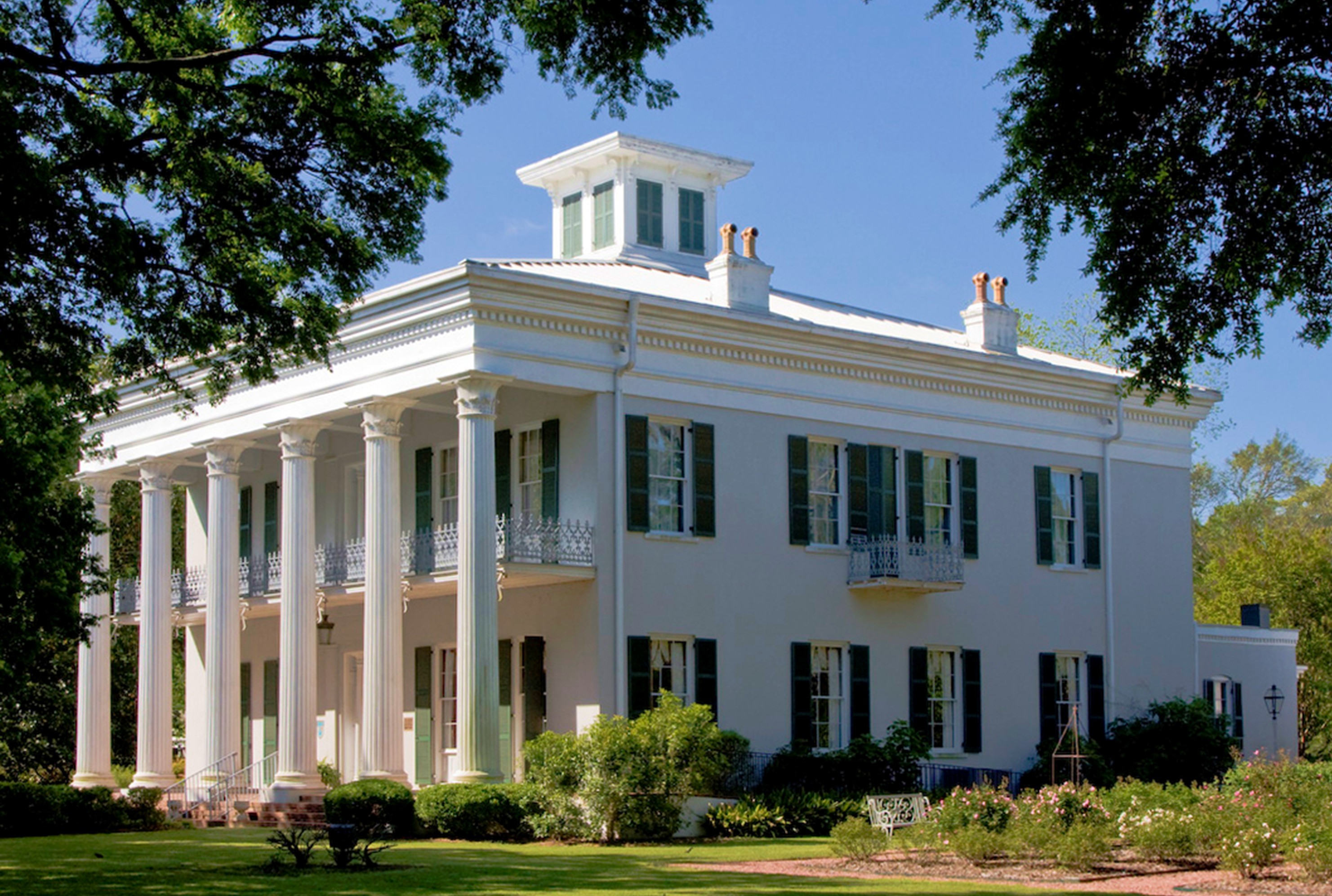
Sturdivant Hall
Six thirty-foot Corinthian columns hold up the facade like a dare. Sturdivant Hall stands on Mabry Street in Selma, Alabama, its stucco-covered brick scored to look like stone, its marble imported from Italy, its plasterwork executed by Italian artisans brought to the Deep South for the job. Completed in 1856 for Colonel Edward T. Watts, this 6,000-square-foot Greek Revival mansion cost $69,900 to build, a staggering sum in antebellum Alabama. Edward Vason Jones, the architect who later redesigned interiors at the White House during the 1960s and 1970s, called it one of the finest Greek Revival antebellum mansions in the Southeast. But the house's most persistent fame comes not from its architecture. It comes from a ghost.
Cotton, Columns, and Colonel Watts
Thomas Helm Lee designed the house for Colonel Edward T. Watts, and construction began in 1852. The project took four years to complete, an extravagance that reflected both Watts's ambitions and the wealth flowing through Selma from the cotton trade. The 60-foot-wide facade is dominated by those six Corinthian columns, each rising the full two-story height of the house. A cantilevered second-floor balcony extends over the front portico, its intricate cast-iron railing a testament to the craftsmanship poured into every detail. Inside, Italian marble and plasterwork fill the ten rooms. The effect is deliberate: a Southern planter's mansion meant to rival anything in Charleston or Savannah. Watts and his family lived in the house until 1864, when the upheaval of the Civil War drove them to sell and relocate to Texas.
The Banker Who Never Left
John McGee Parkman purchased the house from Watts on February 12, 1864, for $65,000. Parkman was a local banker, and the timing was disastrous. The Confederacy was collapsing, cotton speculation was bleeding fortunes dry, and Parkman's bank accumulated enormous losses. When Reconstruction came, the military governor of Alabama, Wager Swayne, had authorities seize the bank and arrest Parkman. On May 23, 1867, Parkman attempted to escape from prison with help from friends. He was killed in the attempt. The story should have ended there, but Selma had other ideas. Local legend holds that Parkman's ghost returned to the mansion he had lost, and the tale of the restless banker became one of Alabama's most enduring ghost stories. The book 13 Alabama Ghosts and Jeffrey, published in 1969, featured the story as "The Return of the Ruined Banker," cementing Sturdivant Hall's reputation as one of the state's most famously haunted houses.
From Parlor to Public Trust
After Parkman's death, the house was sold at auction in January 1870 for $12,500 to Emile Gillman, a prominent Selma merchant. The Gillman family maintained the mansion for nearly nine decades, an extraordinary span of single-family stewardship that helped preserve its architectural integrity. In 1957, the family sold the house to the City of Selma for $75,000. The purchase was made possible by a $50,000 bequest from the estate of Robert Daniel Sturdivant, who stipulated that the money be used to establish a museum in the city. The mansion was converted into a house museum and named in Sturdivant's honor. Today it is maintained jointly by the City of Selma, Dallas County, and the Sturdivant Museum Association. Its rooms hold period antique furnishings, porcelain collections, and artwork that evoke the world that built the house, even as the city around it tells a far more complicated story about what that world cost.
Selma's Other History
Sturdivant Hall sits barely a mile from the Edmund Pettus Bridge, where state troopers attacked civil rights marchers on Bloody Sunday in 1965. The mansion and the bridge are separated by more than distance. One represents the wealth and grandeur of the antebellum South; the other marks the place where that era's deepest injustice was confronted. Together they form a portrait of Selma that is more honest than either landmark alone. The mansion does not flinch from its origins. It was built by enslaved labor, decorated with European luxury goods, and financed by cotton. Visiting it today means reckoning with that context, just as walking across the bridge means reckoning with what came after. Selma holds both stories simultaneously, and Sturdivant Hall's Greek Revival columns frame one half of that conversation with unsettling elegance.
From the Air
Located at 32.4131N, 87.0289W in Selma, Alabama, approximately one mile north of the Edmund Pettus Bridge. The mansion's white columned facade and surrounding grounds are identifiable from low altitude, though the residential neighborhood context makes it harder to spot than the bridge. Look for the large white structure with a prominent portico along Mabry Street in Selma's historic district. Nearest airport is Craig Field (KSEM), 4 miles southeast of Selma. Montgomery Regional Airport (KMGM) lies approximately 50 miles east. Best viewed at 1,500-2,500 feet AGL in clear conditions, approaching from the east where the columned facade faces.