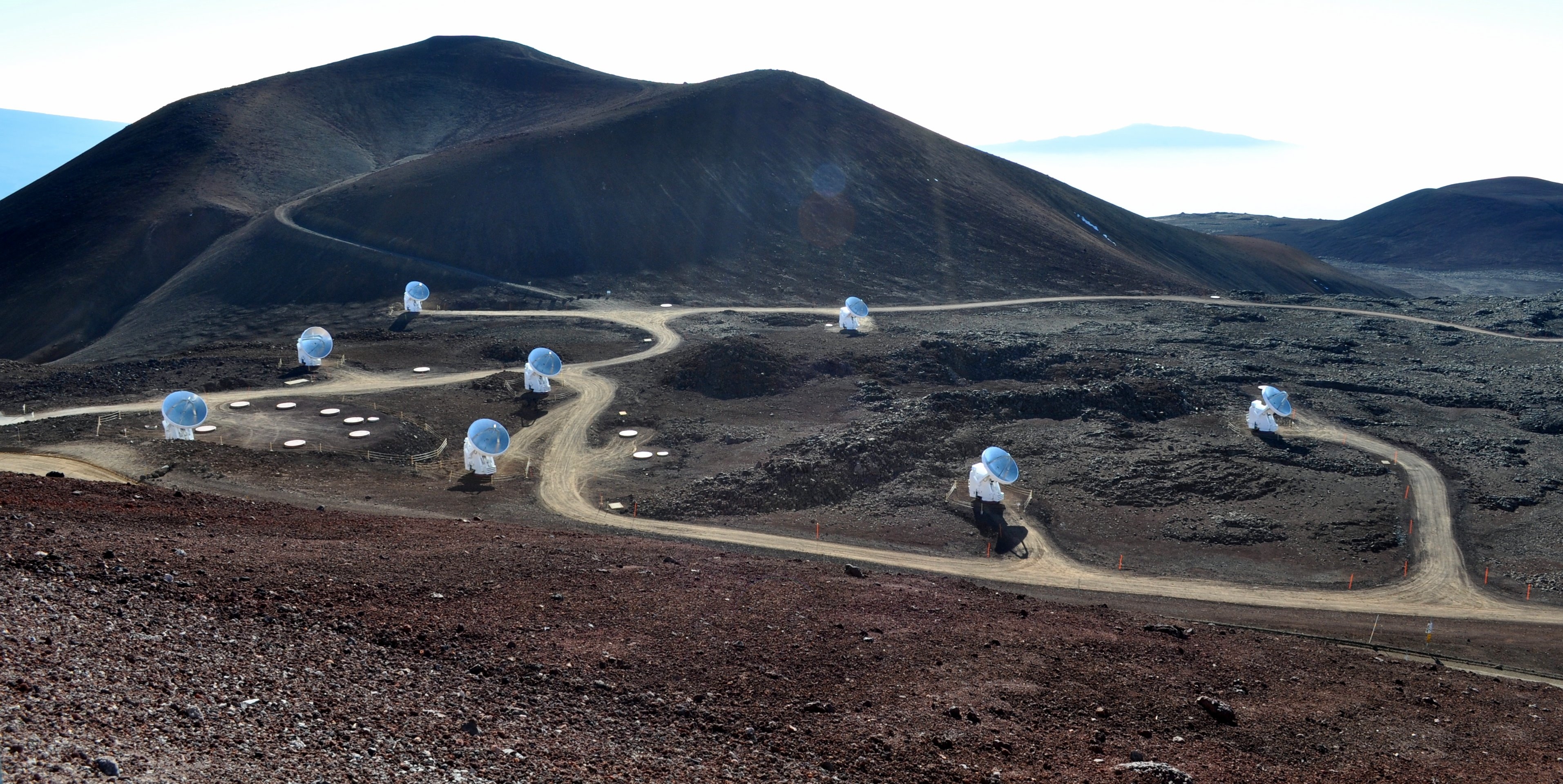
Submillimeter Array
The eight dishes of the Submillimeter Array do not look like typical telescopes. There are no gleaming optical mirrors, no massive domes. Instead, six-meter aluminum dishes sit on concrete pads scattered across a lava field just below Mauna Kea's summit, connected by fiber optic cables buried in conduits beneath the volcanic rock. They observe the universe not in visible light but in submillimeter wavelengths -- radiation emitted by the coldest objects in the cosmos, just a few tens of degrees above absolute zero. And in April 2019, these unassuming dishes contributed to one of the most extraordinary images in the history of science: the first photograph of a black hole.
Born in Massachusetts, Assembled on Lava
The SMA began as a 1983 initiative by Irwin Shapiro, the newly appointed director of the Smithsonian Astrophysical Observatory, who wanted to push high-resolution astronomy across the entire electromagnetic spectrum. The original design called for six antennas, but when Taiwan's Academia Sinica Institute of Astronomy and Astrophysics joined the project in 1996, two more dishes and a larger correlator were added. Competing sites included Mount Graham in Arizona, the Atacama Desert in Chile, and a location near the South Pole, but Mauna Kea won for its existing infrastructure and the possibility of linking the SMA with the James Clerk Maxwell Telescope and the Caltech Submillimeter Observatory already on the mountain. The antennas were constructed at Haystack Observatory in Westford, Massachusetts, then partially disassembled, trucked across the country, shipped to Hawaii by sea, and reassembled in a hangar at the summit.
The Shape of Perfect Hearing
Where a radio interferometer's antennas are placed relative to each other determines how cleanly it can construct images from the incoming signals. In 1996, Eric Keto studied this problem and found that the most uniform sampling of spatial frequencies -- and the cleanest images -- came when the antennas were arranged in the shape of a Reuleaux triangle, a curved triangle with constant width. The SMA's concrete pads were arranged to form four such triangles, sharing one corner pad on the eastern edge of the array. The lava field's rocky ridges prevented perfectly optimal placement, but the geometry is close enough. A custom-built transporter vehicle lifts each six-meter dish off its pad and drives it along dirt access roads to new positions, all while maintaining power to the cryogenic receivers so they never warm up. The array cycles through four configurations -- subcompact, compact, extended, and very extended -- roughly once per quarter.
Listening to the Cold Universe
The SMA's specialty is radiation from objects so cold they barely glow. Star-forming molecular clouds, dusty galaxies billions of light-years away, evolved stars shedding their outer layers, and the turbulent regions around the Milky Way's central black hole all emit most of their energy at submillimeter wavelengths. Each antenna's primary mirror is made of 72 machined aluminum panels, accurate to six microns -- aluminum was chosen over lighter carbon fiber because Mauna Kea's heavy snows and windblown volcanic dust would damage fragile panels. Heating units on the mirrors and their supports prevent ice formation. The cryogenic receivers, cooled by liquid helium, can now observe a continuous 44 GHz swath of radio frequencies without gaps, thanks to a recent wideband upgrade. The SMA was the first radio telescope to resolve Pluto and its moon Charon as separate objects, and it discovered that Pluto's surface is about 10 degrees Kelvin cooler than models predicted.
The Event Horizon's Witness
The SMA's most celebrated contribution came as part of the Event Horizon Telescope, a planet-spanning network of radio observatories that together function as a single dish the size of Earth. By combining signals from the SMA on Mauna Kea with telescopes in Chile, Mexico, Spain, the South Pole, and Arizona, the EHT achieved the angular resolution needed to image the shadow of a supermassive black hole. The resulting image of M87's black hole, published in April 2019, showed a glowing ring of superheated gas surrounding a dark void -- confirming a prediction of general relativity that had gone unverified for over a century. The SMA's SWARM correlator can also operate as a phased array, combining all eight dishes into what appears to be a single antenna for these very-long-baseline observations, maximizing the Hawaiian station's contribution to the global network.
From the Air
Located at 19.82N, 155.48W, approximately 140 meters below the summit of Mauna Kea, in a saddle between the cinder cones Pu'u Poli'ahu and Pu'u Hauoki. The eight 6-meter dishes are visible from the air as small white structures spread across a lava field, distinct from the larger observatory domes on the summit ridge above. Nearest airports: PHTO (Hilo International, 28 nm southeast), PHKO (Kona International, 40 nm west). The array is best spotted by looking for the cluster of smaller dishes below and northwest of the main summit telescope complex.