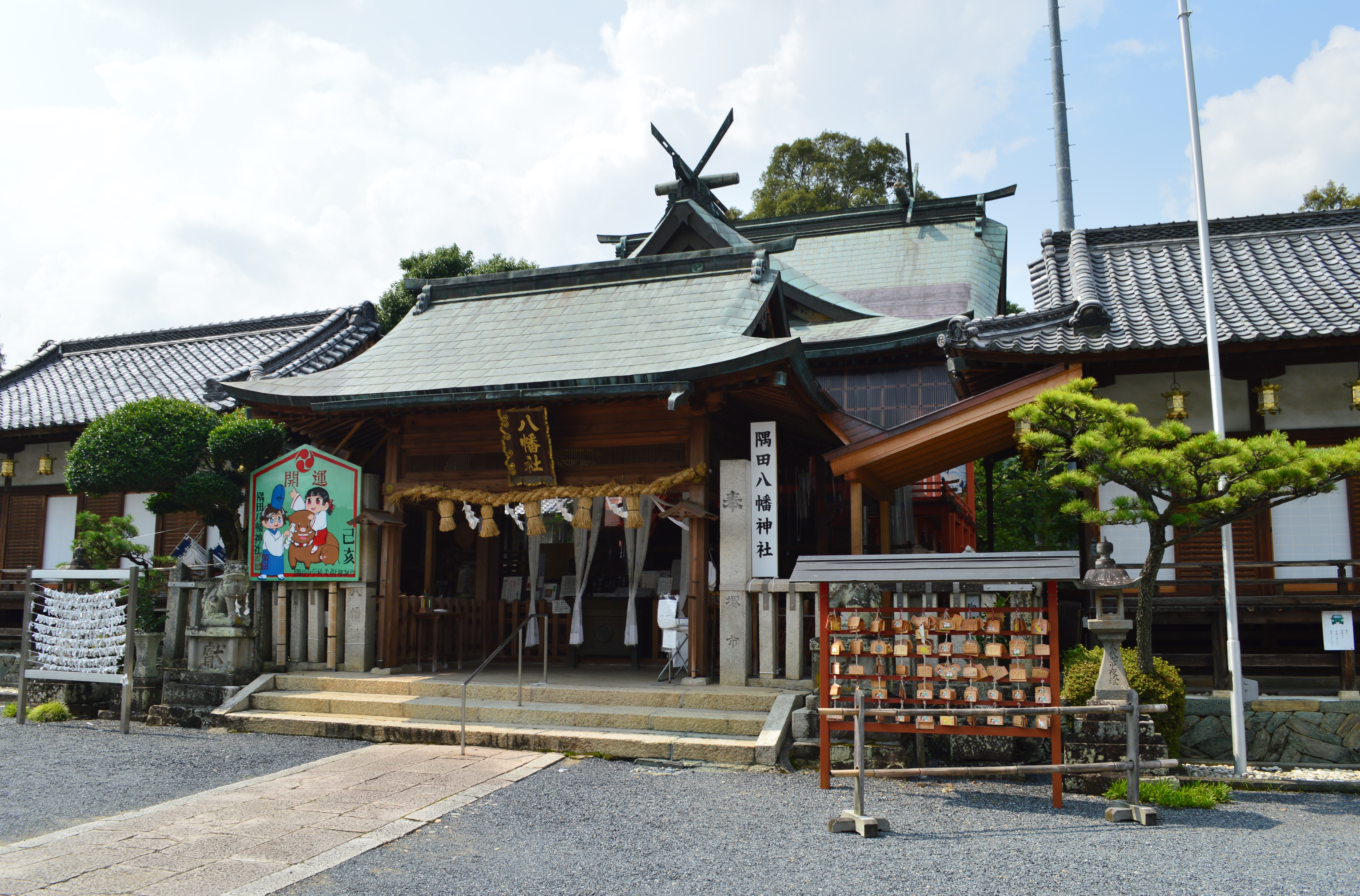
Suda Hachiman Shrine: A Mirror with Japan's Oldest Words
Forty-eight characters stamped into bronze more than fifteen hundred years ago changed what scholars understood about literacy in ancient Japan. The mirror that carries them -- 19.8 centimeters across, decorated with nine human figures including one on horseback -- sat for centuries inside a shrine in what is now Hashimoto City, Wakayama Prefecture, before anyone recognized what they were looking at. When the inscription was finally studied, it revealed a message from a man named Sima, who commissioned the mirror from 200 han of fine new bronze, wishing for longevity in the reign of a great king. The characters are written in a style that mixes Chinese forms with unmistakable Japanese influences. Some are reversed. The grammar stumbles. This is not the work of a Chinese scribe but of someone in Japan learning to bend an imported writing system to a new language. That imperfection is precisely what makes the Suda Hachiman Shrine Mirror a National Treasure.
The Shrine on the Estate
Suda Hachiman Shrine sits in Hashimoto City at the northern edge of Wakayama Prefecture, where the Kii Mountains begin their steep climb toward the interior of the peninsula. The shrine is dedicated to Hachiman, the Shinto deity of war and divine protection, and tradition dates its founding to 859. Historical evidence suggests the current shrine was established in the eleventh century as a branch of the powerful Iwashimizu Hachiman Shrine in Kyoto, built on an estate called the Suda no Sho. The shrine accumulated enough local authority that in 1355 it issued rules to protect teapickers working its lands from labor abuses -- a surprisingly modern concern for a medieval religious institution. The surrounding landscape of forested hills and river valleys has changed little in outline since those years, though the pilgrimage roads that once connected Hashimoto to the Kumano shrines to the south now carry commuter traffic.
Bronze, Characters, and a Puzzle
The mirror itself dates to roughly the fifth or sixth century and belongs to a category of cast bronze mirrors that show strong influence from Chinese metalwork of the Later Han and Six Dynasties periods. Nine human figures populate its decorated back -- warriors, courtiers, and a mounted rider arranged in a composition that echoes continental designs but carries distinctly Japanese touches. What sets this mirror apart from every other artifact of its era is the inscription: 48 Chinese characters running around the rim. A tentative translation reads that in the eighth month of a gui-wei year, a man named Sima sent two artisans to cast the mirror from 200 han of fine bronze, wishing for longevity during the reign of a great king while a prince called Wooto resided at the Osisaka Palace. The characters contain grammatical errors and reversed forms that indicate the writer was not a native Chinese speaker but someone in Japan adapting the writing system for local use.
Lost and Found
Nobody knows exactly when the mirror was placed in the shrine, or how it arrived there. Its first recorded mention appears in the nineteenth-century gazetteer Famous Places of Kii Province Illustrated, serialized in Wakayama City between 1811 and 1851. Some historians believe the mirror was unearthed during the Edo period (1615-1868) somewhere in the vicinity, along with other buried artifacts, and was subsequently enshrined. Others argue it belonged to an older shrine on the same site that predated Suda Hachiman. The debate over its provenance has lasted more than a century and shows no sign of resolution. What is beyond dispute is the mirror's importance: as one of the earliest examples of writing produced in Japan, it stands alongside the Inariyama Sword inscription and the Eta Funayama Sword inscription as evidence that literacy was taking root on the Japanese archipelago by the fifth century, well before the formal adoption of Chinese writing systems that traditional histories describe.
Sacred Ground, Quiet Afternoon
Today Suda Hachiman Shrine is designated as both a prefectural historic site and a cultural property of Wakayama Prefecture. The mirror itself, too fragile and valuable for permanent display, is held as a National Treasure. Visitors to the shrine grounds find a modest complex of traditional wooden buildings set among old-growth trees, with stone torii gates marking the approach. The atmosphere is one of deep provincial quiet -- this is not a shrine that draws the crowds of Kyoto or Nara. But the significance concentrated in this place is extraordinary. The mirror connects Hashimoto to the deepest layers of Japanese civilization: the moment when a borrowed alphabet began its transformation into something uniquely Japanese. The shrine that has guarded it for centuries continues to hold annual festivals, maintain its grounds, and serve the local community, as it has since the Heian era.
From the Air
Located at 34.33N, 135.65E in Hashimoto City, northern Wakayama Prefecture, in the foothills of the Kii Mountains. The shrine sits in a valley between mountain ridges near the Kinokawa River corridor. From altitude, the area appears as a mix of dense forest and small urban development where the Osaka Plain gives way to the mountainous Kii Peninsula. Best viewed at 2,000-4,000 feet AGL. Kansai International Airport (RJBB) lies approximately 25 nautical miles to the northwest. Nanki-Shirahama Airport (RJBD) is approximately 60 nautical miles to the south. The terrain rises steeply to the south and east; maintain awareness of mountainous terrain throughout the Kii Peninsula.