Sudbury: Where NASA Trained for the Moon
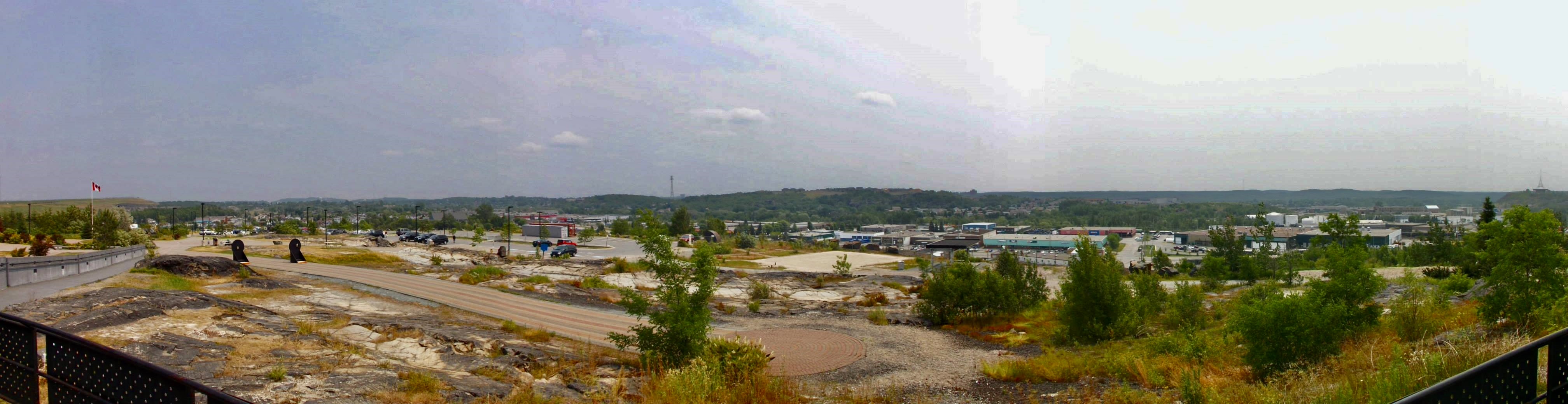
The moonscape was man-made and meteor-made both. Greater Sudbury sits in the Sudbury Basin, a 1.8-billion-year-old meteor impact crater that deposited the richest concentration of nickel ore on Earth. A century of mining and smelting stripped the landscape bare, created massive slag heaps, and left the hills so denuded that NASA sent Apollo astronauts here to practice lunar geology. The astronauts who walked on the moon trained in Sudbury first. Since the 1970s, environmental restoration has regreened the region, planting millions of trees, neutralizing acid, reclaiming what industry destroyed. The moonscape is mostly gone; the recovery is ongoing. Sudbury became famous for destruction and is becoming famous for restoration.
The Crater
The Sudbury Basin formed 1.85 billion years ago when a meteorite 10-15 km in diameter struck what is now northern Ontario. The impact was one of the largest ever to hit Earth, creating a crater originally 250 km wide and depositing metals from the impactor's core into the crater floor. Erosion and geological processes reduced the basin to its current 60 km by 30 km ellipse, but the mineral deposits remained - nickel, copper, platinum, gold. The geology that made Sudbury valuable was cosmic violence on a scale difficult to comprehend.
The Destruction
Mining began in the 1880s and intensified through the 20th century. Smelting operations released sulfur dioxide into the atmosphere; acid rain killed vegetation for miles around. Open roasting of ore created toxic fumes that stripped hillsides bare. By the 1970s, Sudbury's landscape was lunar: blackened rock, dead lakes, slag heaps, and the famous 'Sudbury moonscape' that attracted NASA attention. The environmental destruction was so complete it became educational - a worst-case demonstration of what unregulated industry could accomplish.
The Astronauts
NASA geologists recognized Sudbury's value: the impact crater provided structures similar to lunar craters, and the barren landscape resembled the moon's surface. Apollo astronauts trained here in the late 1960s and early 1970s, practicing geological sampling techniques, learning to identify impact features, and preparing for extraterrestrial fieldwork. The training was practical rather than theatrical - Sudbury offered genuine geological education. Astronauts who later walked on the moon had walked Sudbury's blasted hills first, learning from one catastrophic impact to understand another.
The Recovery
Sudbury's environmental restoration began in 1978 with liming and seeding programs. Over four decades, the region planted 10 million trees, neutralized thousands of hectares of acid-damaged soil, and watched ecosystems slowly recover. The program became a model for post-industrial restoration, demonstrating that even catastrophic damage could be partially reversed. The moonscape is largely gone; green has returned to hills that were black for generations. Lakes support fish again. Wildlife has returned. The recovery isn't complete - legacy contamination persists - but the trajectory is clear. Sudbury is becoming what it was before mining, slowly.
Visiting Sudbury
Greater Sudbury is located in northeastern Ontario, roughly 400 km north of Toronto via Highway 400 and Highway 69. The Big Nickel, a 9-meter replica of a 1951 Canadian nickel, marks Dynamic Earth, a science center focused on mining and geology. Science North, Northern Ontario's largest science center, offers interactive exhibits. The Sudbury Basin is visible from various viewpoints; the geological significance is interpretable with guidance. The region offers outdoor recreation including lakes, trails, and the restored landscape itself. Lodging is available in the city. The experience is seeing recovery: what was destroyed being slowly, deliberately reclaimed.
From the Air
Located at 46.52°N, 81.00°W in the Sudbury Basin, northeastern Ontario. From altitude, the basin's elliptical shape is visible - the ancient crater rim traceable in the topography. The city occupies the basin floor; mining operations and slag heaps are visible as industrial features. The restored vegetation is visible as green cover where black once dominated. Lakes dot the landscape, some still recovering from acidification. The Trans-Canada Highway passes through. The crater that drew astronauts is invisible as such - erosion has smoothed the original impact features - but the mineral wealth that justified a century of environmental destruction remains in place, now extracted more carefully than before.