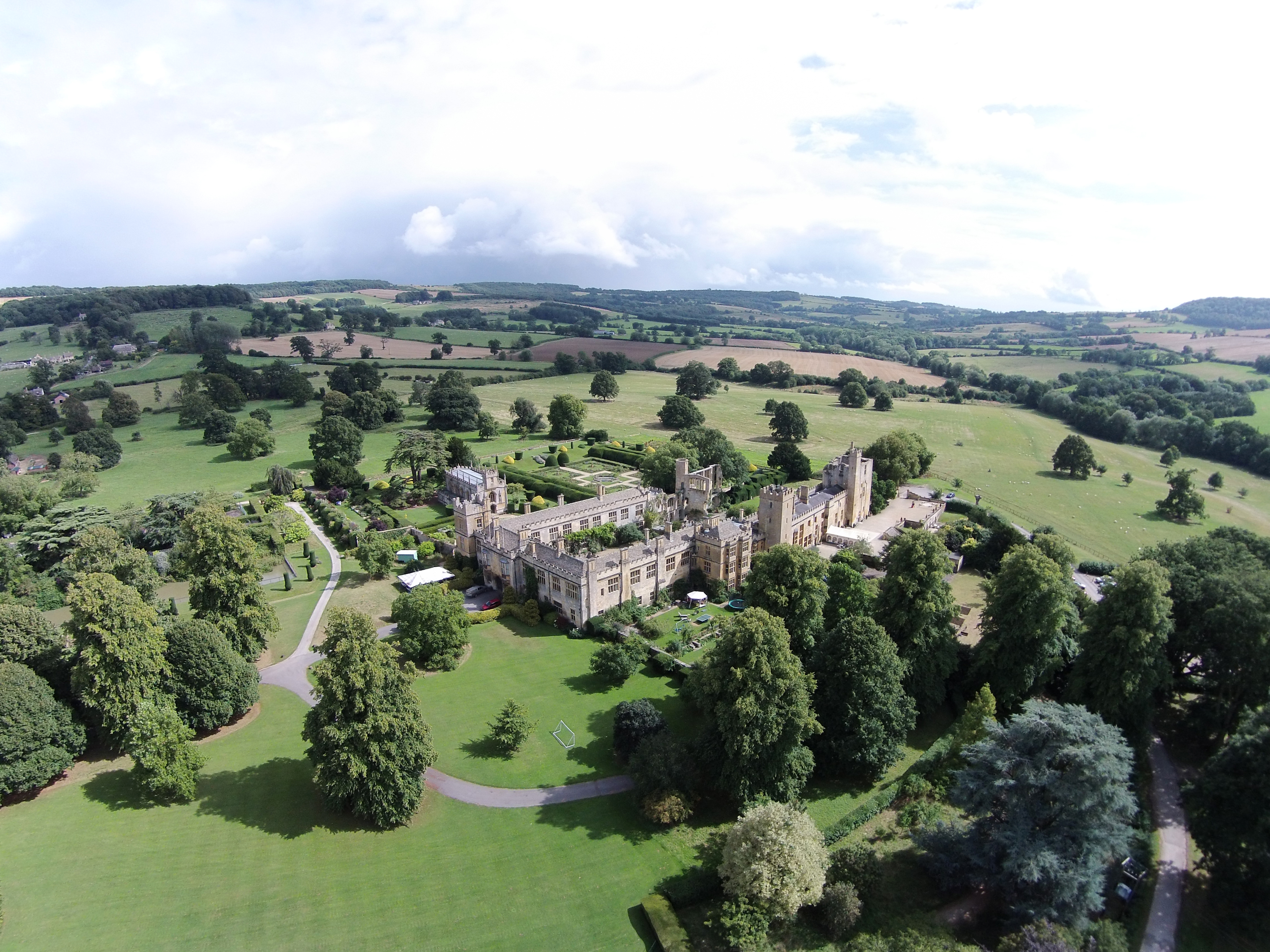
Sudeley Castle
Katherine Parr, the last of Henry VIII's six wives, is buried in a small chapel in the grounds of Sudeley Castle. It is the only private home in England that serves as a queen's final resting place. That distinction alone would make this Cotswolds estate remarkable, but Sudeley's story reaches much further -- through civil war, deliberate ruin, Victorian resurrection, and the quiet determination of one American woman who refused to let the castle die.
A Queen's Last Home
After Henry VIII's death in 1547, Katherine Parr married Thomas Seymour, who had been granted Sudeley Castle by Edward VI. Katherine moved to the Cotswolds estate, pregnant with her first child. The young Lady Jane Grey, future queen for nine days, came with her as a member of the household. Katherine gave birth to a daughter, Mary, in August 1548 but died of puerperal fever just six days later. She was buried in the castle's chapel of St Mary with full Protestant rites -- one of the first such royal funerals in England. Seymour's ambitions outlasted his wife; he was executed for treason the following year. The castle passed through several hands before becoming a Royalist stronghold during the English Civil War, after which Cromwell's forces slighted it, leaving the once-grand Tudor apartments as picturesque ruins.
Ruin and Resurrection
For nearly two centuries, Sudeley slept as a romantic ruin. George III visited in 1788 while taking the waters at nearby Cheltenham, admiring the overgrown shell that antiquarians Samuel and Nathaniel Buck had sketched as early as 1732. The castle's revival began in the 1830s when the Dent brothers, wealthy Worcester glovemakers, purchased the estate and began a painstaking restoration. They rebuilt the habitable sections while deliberately preserving the ruined banqueting hall as a monument to the castle's Tudor past. The chapel was reconstructed, and Katherine Parr's tomb -- whose coffin had been disturbed multiple times since the 18th century -- finally received a fitting monument. The Dents also assembled an extraordinary art collection, anchored by purchases from the legendary 32-day auction of Horace Walpole's Strawberry Hill House in 1842.
The Chatelaine of Sudeley
The American-born Elizabeth Dent-Brocklehurst arrived at Sudeley through marriage in 1962 and spent the following years preparing the castle for public opening, which finally came in May 1970. When her husband Mark died just two years later, she was left to manage the estate alone through three rounds of heavy death duties in under fifty years. The castle lost money -- by 2008, it was reportedly losing 100,000 pounds a year, and the family sold a J.M.W. Turner painting at auction to fund restorations. Elizabeth persisted. The exhibitions were redesigned in 2018 as "Royal Sudeley 1,000: Trials, Triumphs and Treasures," filling three floors of the 15th-century service wing. Today the castle remains her family home while also operating as a hotel, wedding venue, and public attraction, with Elizabeth still known as the chatelaine of Sudeley.
Gardens and Hidden Treasures
Sudeley sits at the heart of a 1,200-acre estate in the Cotswold valleys, crossed by the 102-mile Cotswold Way footpath. The fifteen acres of castle gardens are divided into ten distinct areas, the centrepiece being the Queens' Garden -- a Victorian replanting of an Elizabethan parterre discovered on the same site, enclosed by yew hedges dating to 1860. The Knot Garden, composed of more than 1,200 box hedges, takes its intricate design from the pattern on Elizabeth I's dress in the painting An Allegory of the Tudor Succession, which still hangs inside the castle. Beyond the formal gardens, Sudeley maintains one of the largest public collections of endangered pheasants in the world, working with the World Pheasant Association on breeding programs to save critically endangered species. The art collection ranges from works by Turner and Van Dyck to the Tudor Succession allegory commissioned by Elizabeth I for her spymaster Sir Francis Walsingham.
From the Air
Located at 51.95N, 1.96W in the Cotswolds near Winchcombe, Gloucestershire. The castle and its grounds are visible from moderate altitude amid the green Cotswold valleys. Nearest airports include Gloucestershire Airport (EGBJ) approximately 12nm south-southeast. The 102-mile Cotswold Way footpath passes through the estate. Best viewed at 2,000-3,000 ft AGL in clear conditions.