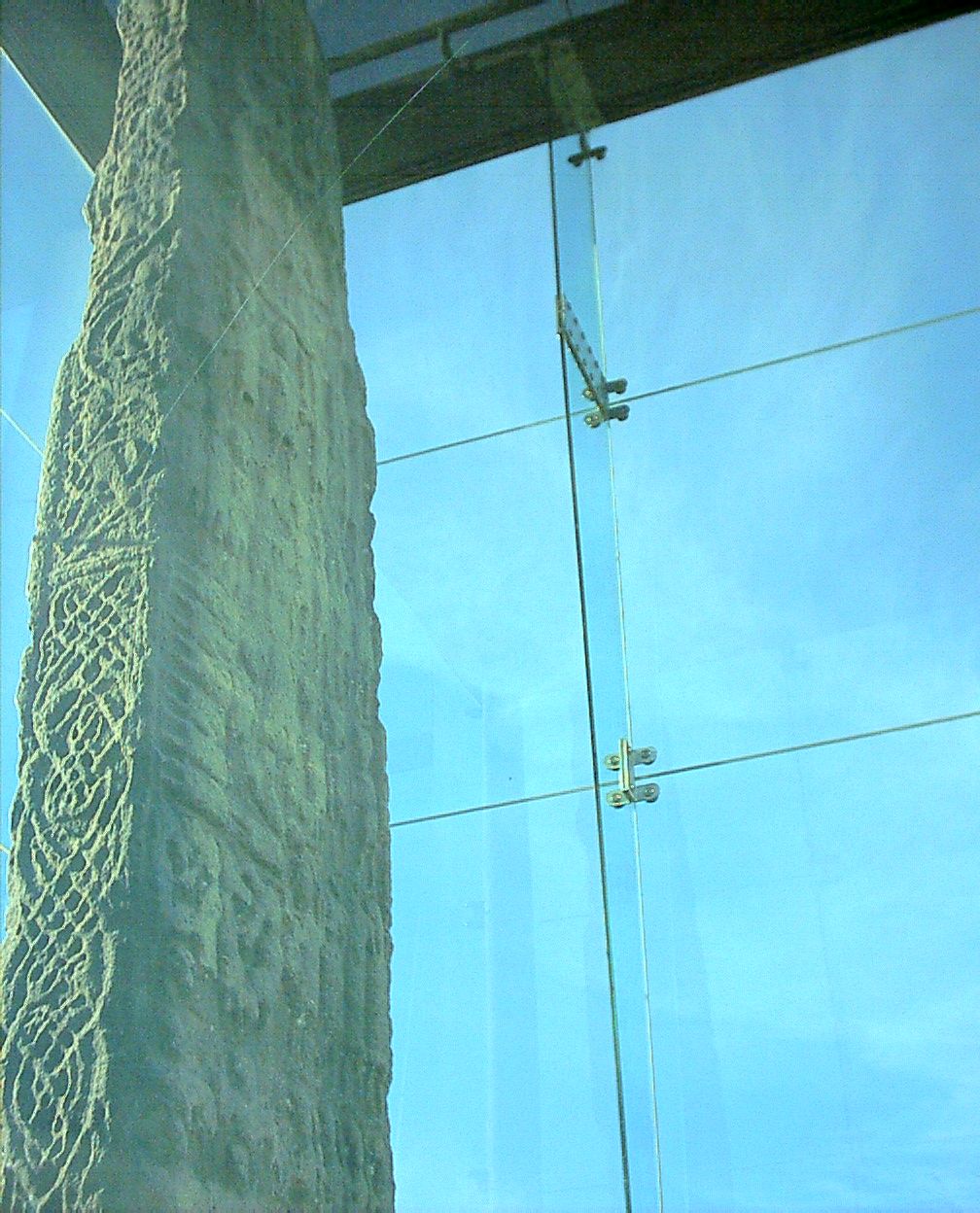
Sueno's Stone
It stands taller than a two-storey house. Carved from local yellow sandstone on the edge of the town of Forres in Moray, Sueno's Stone rises 6.5 metres above its stepped plinth -- the tallest surviving Pictish cross-slab in Scotland. One face bears an elaborately interlaced Celtic cross. The other face tells a story in stone: four panels depicting horsemen, foot soldiers, decapitated prisoners with their heads piled in heaps, and a victorious army departing the field. Someone, more than a thousand years ago, wanted this triumph remembered forever. They succeeded -- but they forgot to leave a caption, and nobody alive today can say with certainty who carved it, who won the battle, or who lost.
A Message Without a Sender
The stone was named after Sweyn Forkbeard, the Danish king, based on a tradition that it commemorated a victory by Malcolm II over Norse invaders in the early 11th century. This interpretation appeared in Alexander Gordon's Itinerarium Septentrionale of 1726 and was thought ancient even then. Historians no longer support it. Radiocarbon dating of charcoal fragments at the site produced dates between AD 600 and AD 1000, and the interlacing patterns on the side panels -- sinuous vine scrolls populated with human figures -- resemble work in the Book of Kells, suggesting a date between AD 800 and 900. The most widely accepted theory today holds that Sueno's Stone commemorates a victory by the men of Alba, the Gaelicised Picts south of the Mounth, over the men of Moray to the north -- a triumph in the long struggle to consolidate the kingdom of Scotland.
Carved in Violence
The battle scene on the east face is extraordinary in its detail and its brutality. The top panel, though weathered, shows rows of horsemen. Below them, armed foot soldiers advance in formation. The third panel is the most striking: the vanquished lie decapitated, their severed heads gathered in piles, while soldiers, archers, and horsemen surround what may be a broch or fortified structure. The bottom panel depicts the victorious army leaving the field. On the west face, the Celtic cross fills most of the surface, with elaborate knotwork decoration and a poorly preserved figural scene beneath it that may represent a royal inauguration. The edges carry more interlaced ornament. The whole effect is of a monument designed not merely to record a victory but to assert absolute authority -- a statement in stone that this land had a new master.
Witches, Witnesses, and a Vanished Twin
Local legend connects the stone to Macbeth, claiming this was the crossroads where he met the three witches, who were imprisoned inside the stone and would be released if it ever broke. The tale cannot predate Shakespeare's play, but it speaks to the uncanny presence of the monument. More intriguing is the evidence from early maps. Timothy Pont's map of Moray, along with military maps by Roy and Ainslie from 1750 and 1789, all show a second stone standing alongside Sueno's Stone. Ainslie inscribed 'two curiously carved pillars' on his map. Archaeological excavations in 1990 and 1991 found evidence supporting the existence of this vanished companion. James Ray, a soldier who fought for the Hanoverian side in the 1745 Jacobite rising, described seeing a single stone as the government army marched past the site, just days before the Battle of Culloden.
Armoured Glass and Open Questions
In the early 1990s, the stone was encased in a protective glass box to halt the erosion that had already softened some of the carving. The Countess of Moray, Lady Ann Campbell, had tried to stabilise the monument in the early 18th century by constructing stepped plinths around its base -- a repair still visible today. The glass enclosure is pragmatic but strange: a Pictish war memorial viewed through modern armour, the violence of the carvings sanitised behind a transparent shield. Standing beside it, you are looking at a message from people who controlled this territory before Scotland existed as a political concept. They had no written language, but they had sculptors of extraordinary skill, and they had a battle they wanted the world to remember. The world obliged -- it just forgot the details.
From the Air
Located at 57.62N, 3.60W on the northeastern edge of Forres in Moray. The stone is enclosed in a glass case on a raised bank beside the former road to Findhorn. RAF Lossiemouth (EGQS) is approximately 8 miles east. Best viewed at 1,500-2,500 ft AGL. The town of Forres is visible on the coastal plain south of the Moray Firth.