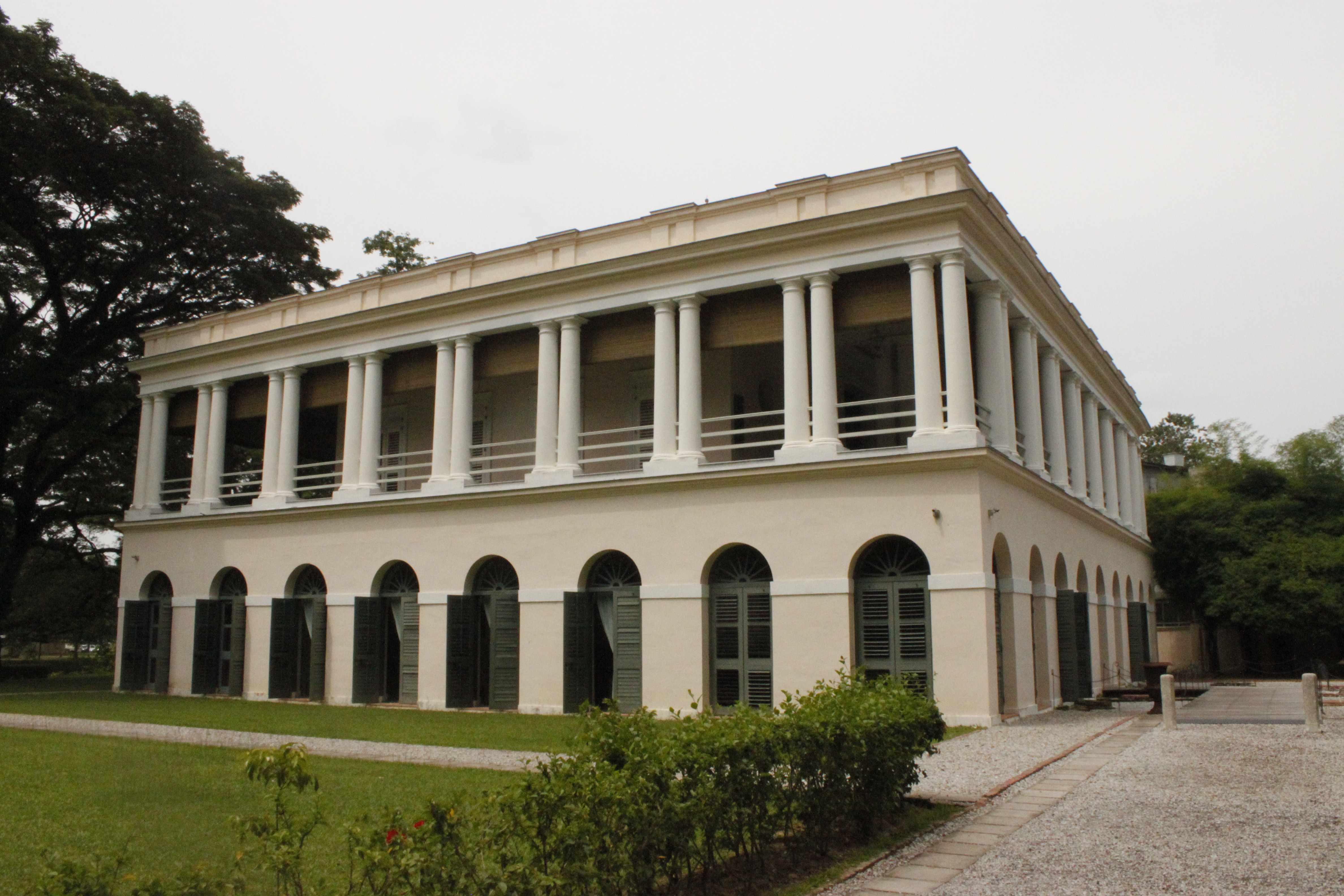
Suffolk House, Penang
The trajectory of Suffolk House reads like a parable about what empires build and what time does to their buildings. The mansion on the banks of the Air Itam River, four miles west of George Town, began as the pepper-estate home of Francis Light, the man who claimed Penang for the British in 1786. After his death, it was rebuilt as a Georgian governor's residence where Stamford Raffles discussed the founding of Singapore. It then became a schoolhouse, a canteen, a dental clinic, and finally a ruin whose roof and upper floor had collapsed into themselves. That it exists at all today is the result of a forty-year campaign to save it.
The Pepper Estate
Francis Light was a trader, adventurer, and opportunist who persuaded the Sultan of Kedah to cede Penang Island to the British East India Company in 1786. He established a pepper estate on the western side of the island, named it Suffolk, and built himself a house in the Anglo-Indian Garden House style: timber and attap, simple and functional, suited to a man who was more merchant than aristocrat. Light lived on the estate until his death in 1794, at which point he bequeathed it to his common-law wife, Martina Rozells, along with "the pepper gardens with my garden house, plantations and all the land by me cleared." The original house was modest. What replaced it was not.
A Mansion for 120 Europeans
In 1805, William Edward Phillips purchased the land from Light's estate and began constructing a Georgian-styled mansion he called Suffolk Park. At the time, Penang had barely 120 European residents, many of them traders and merchants, yet Phillips built as though the island were already the imperial capital it aspired to become. He would later serve as governor, but during construction he held no such title. The mansion became the official residence of several early governors, including Phillips's father-in-law, Governor Bannerman. During the 1810s and 1820s, it served as a Government House where critical political discussions took place, among them conversations with Stamford Raffles about the founding of Singapore. For less than a quarter century, this house on the Air Itam River was one of the most consequential rooms in Southeast Asian colonial history.
From Ballroom to Canteen
The mansion remained a governor's residence until The Residency was completed in 1890, after which it drifted through a series of diminishing roles. It passed into private ownership, then in 1928 was sold to Reverend P.L. Peach of the Methodist Church of Malaya for 40,000 Straits Settlement dollars. The Anglo-Chinese High School, later the Methodist Boys' School, moved in. For forty-six years under Methodist ownership, the building adapted to whatever was needed: classrooms for Standard Six students in 1931, the entire primary school by 1945, a dental clinic in 1953, and the Old Tuckshop, the school canteen, through 1975. During World War II, the Japanese administration occupied it briefly. By the 1950s, the building's deterioration was unmistakable, and in 1975 it was declared unsafe and vacated. Over the next twenty-five years, the roof caved in and the upper floor collapsed.
Forty Years to Rescue
The campaign to restore Suffolk House began in 1961, but complications kept derailing it: problematic land transfers, disappearing funding, and stretches of simple indifference. In 1993, the Penang Heritage Trust conducted structural studies with help from the SACON Heritage Unit in South Australia, a connection that carried a pleasing symmetry, since Adelaide, the capital of South Australia, had been surveyed and laid out by Francis Light's son, William Light. A Suffolk House Committee was formed by the Penang state government, and in 2000, the Methodist Boys' School received a neighboring plot of land in exchange for the site. Restoration began that November. State funds covered stabilization steelwork and roof repairs, but the full rehabilitation required outside help. HSBC contributed RM 2.5 million; other donors followed. An estimated RM 5 million was needed to restore and refit the mansion.
A House Reopened
Suffolk House finally opened its doors to the public in 2009, managed by the YKH Group of Restaurants under the supervision of Badan Warisan Malaysia, a heritage conservation organization. The restored double-storey building, with its Euro-Indian Georgian styling and first-floor colonnade terrace, now functions as a restaurant and heritage site. Guided tours walk visitors through rooms where governors once hosted balls and where, much later, schoolchildren ate their lunches. Historians still debate whether the current structure was truly built for Light or for Phillips. Light's will mentions a "garden house," not a mansion, and historian F. G. Stevens noted in 1929 that the road leading to the site was only "lined out but not made" in 1807, suggesting the grand house came after Light's time. What is not debated is the building's significance: a rare surviving Georgian mansion in Southeast Asia, saved from ruin by stubbornness and slow-moving generosity.
From the Air
Located at 5.411°N, 100.305°E on the banks of the Air Itam River, approximately four miles west of George Town's center, Penang, Malaysia. The house sits in a green setting near the Methodist Boys' School campus. Nearest airport is Penang International Airport (WMKP), approximately 8 nm to the south-southeast. From the air, the Air Itam River valley and nearby Penang Hill provide visual orientation landmarks.