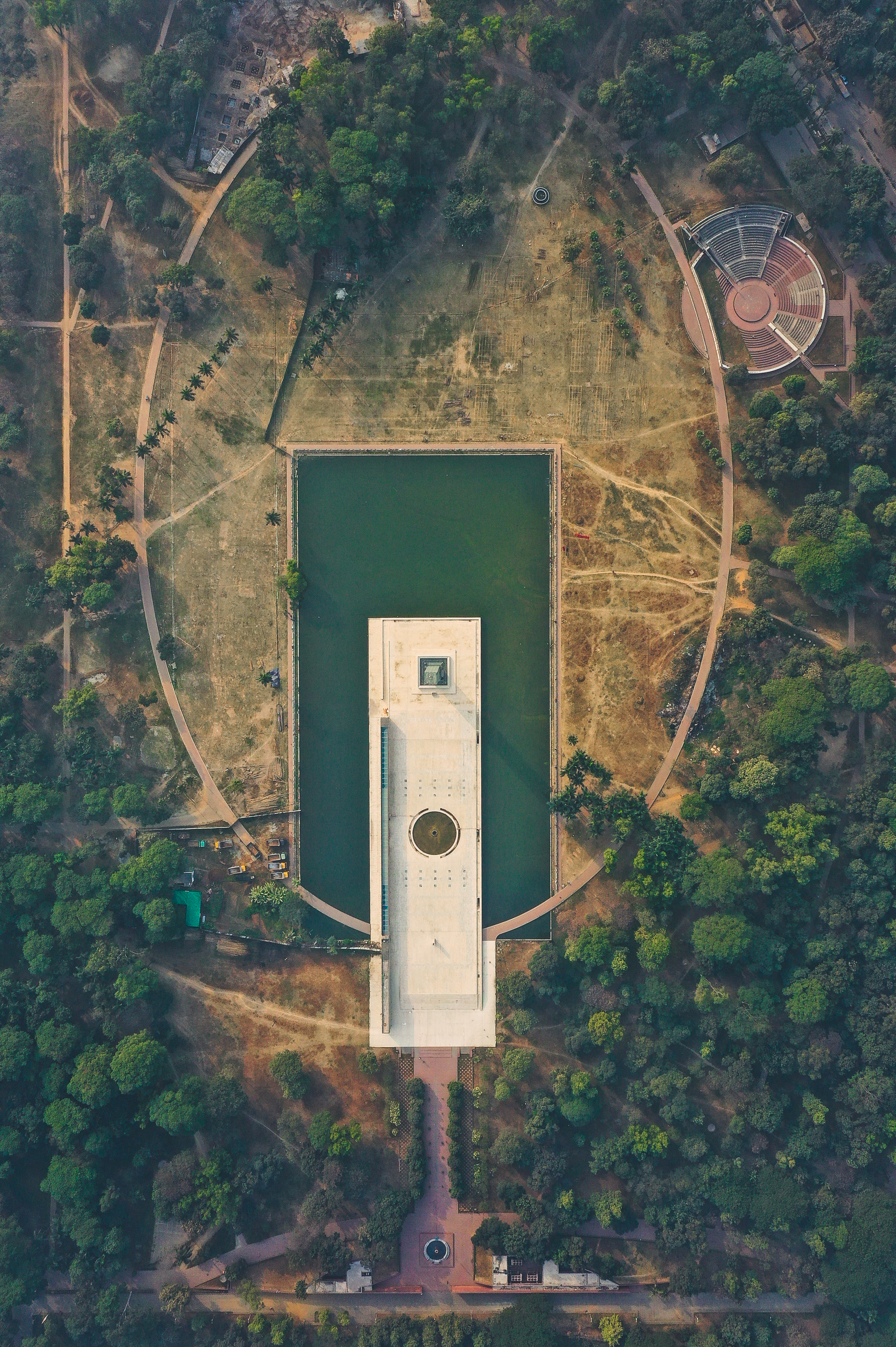
Suhrawardy Udyan
On 7 March 1971, over a million people packed into what was then called Ramna Race Course to hear Sheikh Mujibur Rahman deliver the speech that would set Bangladesh on its path to independence. Nine months later, on the same grounds, Pakistani forces formally surrendered, ending one of the bloodiest liberation wars of the twentieth century. Few public parks anywhere in the world can claim to have witnessed both the call and the answer to a nation's birth. Suhrawardy Udyan, renamed for the statesman Huseyn Shaheed Suhrawardy, carries that weight across its 95 acres in central Dhaka -- a place where history didn't merely happen but accumulated in layers, from Mughal gardens to colonial racetracks to the defining moments of a young republic.
From Imperial Gardens to the Racecourse
The site began as Bagh-e-Badshahi, a Mughal-era garden laid out in the 18th century in the Ramna quarter of Dhaka. When the British arrived, they repurposed the grounds as the Ramna Gymkhana, a military club for English soldiers, and added a horse-racing track that gave the area its colonial-era name: Ramna Race Course. On 21 March 1948, Muhammad Ali Jinnah, Pakistan's first governor-general, addressed a vast crowd here -- a speech remembered in part because it declared Urdu the sole national language, a pronouncement that sowed the seeds of the Bengali language movement and, ultimately, of Bangladeshi nationalism itself. The ground was never merely recreational. Under its flat, unassuming surface ran currents of political energy that would erupt repeatedly over the following decades.
The Speech and the Surrender
Two events define this park more than any others. On 23 February 1969, Sheikh Mujibur Rahman was honored here with the title "Bangabandhu" -- Friend of Bengal -- upon his release from prison. Two years later, on 7 March 1971, he returned to deliver what is now recognized as one of the most consequential political addresses in South Asian history, calling the Bengali people to struggle against Pakistani rule. The Pakistani army responded with brutal force, destroying the nearby Ramna Kali Temple on 27 March during the Ramna massacre. But the liberation war that followed ended here too. On 16 December 1971, Pakistani forces signed their instrument of surrender at this very site, an event now celebrated annually as Victory Day. Three months later, Indian Prime Minister Indira Gandhi and Mujibur Rahman jointly addressed the nation from the same grounds -- sovereignty confirmed, witnessed by the soil that had absorbed every step of the journey.
Glass Tower and Granite Memory
The Swadhinata Stambha, or Independence Monument, occupies 67 acres of the park. Designed to honor those who fell during the liberation war, the memorial includes murals tracing the struggle from 1948 to 1971, moving from the language movement through to the final surrender. Its centerpiece is a 150-foot glass tower, a structure whose transparency was intended as a metaphor for the openness of the democratic state the war was fought to create. Each year on 26 March, Independence Day, formal tributes are held at its base. The monument does not shy from the complexity of Bangladesh's road to nationhood -- the murals depict not triumph alone but the decades of political suppression, linguistic persecution, and military violence that preceded it.
A Nation Reads Here
Since 2014, the park has hosted the Amor Ekushey Grontho Mela, a month-long book fair dedicated to the protesters who died during the 1952 Bengali language movement. What began as a modest week-long event at the nearby Bangla Academy in the 1970s has grown into what organizers describe as the largest literary-cultural event in the country. The fair spills across Suhrawardy Udyan and the adjacent academy grounds, drawing publishers, poets, and hundreds of thousands of visitors who browse stalls, attend readings, and celebrate Bengali literature in the very space where the right to speak Bengali was once contested at gunpoint. The park has also hosted large-scale concerts and political gatherings, maintaining its role as Dhaka's preeminent arena for collective expression.
Sacred Ground, Living City
Suhrawardy Udyan exists in tension between its memorial function and the pressures of a megacity. Dhaka's density -- among the highest of any major city on Earth -- means the park serves needs its designers never anticipated. Approximately 200 homeless people shelter here nightly, and the open-air theatre at the park's center has struggled with neglect. The Ministry of Liberation War Affairs owns the grounds while the Ministry of Housing and Public Works manages the surrounding park, a split jurisdiction that complicates maintenance. Yet the park endures as the one place in Dhaka where the nation's founding story is physically present, embedded in monuments, in the soil beneath the book fair tents, and in the collective memory of a people who can point to a precise patch of green and say: this is where we became a country.
From the Air
Located at 23.7331N, 90.3984E in central Dhaka. The 95-acre park is a large green space visible amid dense urban surroundings. The 150-foot glass Independence Monument tower is the primary landmark. Best viewed below 3,000 feet. Nearest airport: Hazrat Shahjalal International Airport (VGHS), approximately 10 km to the north. Expect heavy haze year-round; winter months (November-February) offer the best visibility.