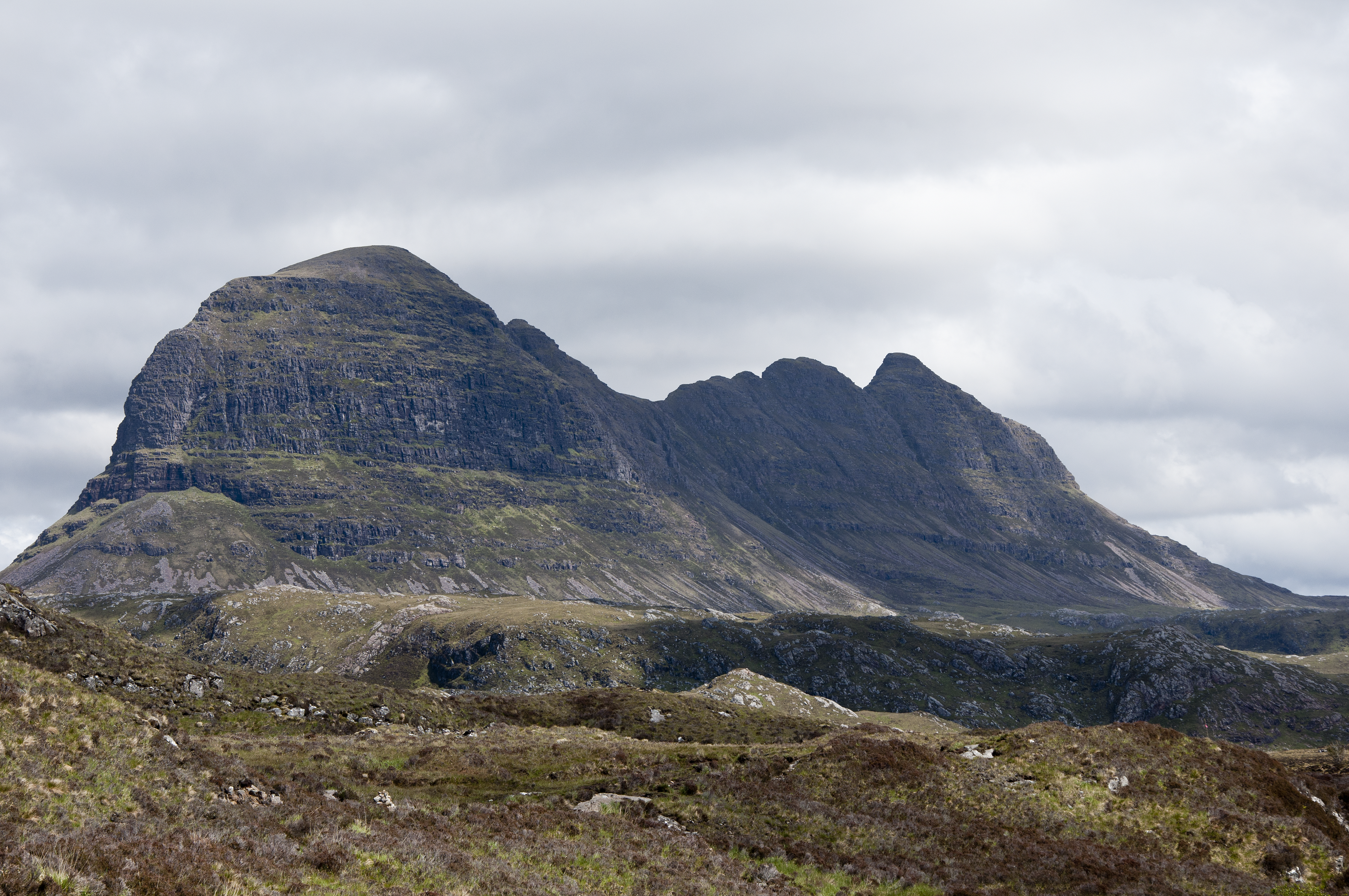
Suilven
The Vikings who sailed these coasts a thousand years ago called it sula fjell -- "pillar mountain" -- and their name stuck, softened over centuries by Gaelic into Suilven. From the west, the mountain appears as a near-perfect dome; from the south, it reveals itself as a steep-sided ridge two kilometres long, rising abruptly from a wilderness of moorland, bogs, and lochans in the Inverpolly National Nature Reserve. At 731 metres, Suilven is not especially tall. What makes it extraordinary is the way it stands: alone, vertical-walled, and defiant, a remnant of Torridonian sandstone perched on a platform of Lewisian gneiss that is among the oldest rock on Earth.
Sculpted by Ice
Suilven's geology is a study in contrasts. The mountain itself is Torridonian sandstone, roughly a billion years old, while the undulating platform it sits on is Lewisian gneiss, three times older. Glaciers carved the landscape during successive ice ages, scouring away the softer surrounding rock and leaving Suilven as an isolated remnant. Earlier researchers described it as a nunatak -- a peak that protruded above the ice sheet -- but cosmogenic isotope dating of boulders on the summit has since proven that the last British ice sheet covered even Suilven. Instead, the flow of ice created its distinctive teardrop plan, narrow when viewed from the side, while carving and scouring the near-vertical flanks that give the mountain its fortress-like appearance.
Three Peaks on a Knife-Edge
The ridge carries three summits. Caisteal Liath -- "Grey Castle" in Gaelic -- is the highest at 731 metres, standing at the northwest end. Meall Meadhonach, the "Middle Round Hill," rises to 723 metres at the ridge's centre. Meall Beag, the "Little Round Hill," occupies the southeastern end. The summit of Caisteal Liath is broad and grassy, a surprising contrast to the vertical cliffs that surround it on nearly every side. Getting there requires crossing exposed terrain that reveals itself gradually: what looks like a simple dome from a distance becomes a committing scramble when approached from certain angles.
The Long Walk In
No road reaches Suilven. Every route demands a round trip of roughly 25 kilometres over rough, roadless terrain. The most popular approach starts from a track near Glencanisp Lodge, about 1.5 kilometres from Lochinver, crossing undulating moorland before ascending steeply to Bealach Mor -- the Great Pass -- where boulder steps have been built to stabilise the eroding path. An alternative from Inverkirkaig, four kilometres south of Lochinver, passes Kirkaig Falls along the way. A third option from Elphin on the eastern side reaches the ridge without the Great Pass but requires exposed scrambling between the central and southeastern summits. The remoteness is part of the point. Suilven rewards those willing to work for it.
A Community Mountain
In 2005, the local community bought Glencanisp estate, which includes Suilven, along with the neighbouring Drumrunie estate, with support from the John Muir Trust. The Assynt Foundation now manages the land with the aim of creating local employment while safeguarding its natural and cultural heritage. The mountain has also found its way into popular culture: the 2017 film Edie featured a widowed pensioner climbing Suilven to fulfil a lifelong ambition, and Suilven and nearby Stac Pollaidh appeared in the Disney+ Star Wars series Ahsoka. The poet Norman MacCaig, who spent decades in Assynt, returned to Suilven again and again in his verse. For MacCaig, the mountain was not scenery to be described but a presence to be reckoned with.
From the Air
Located at 58.115N, 5.137W in Assynt, Sutherland. The mountain's distinctive isolated profile is unmistakable from the air -- a narrow sandstone ridge rising sharply above flat gneiss moorland. Summit elevation 731m (2,398 ft). Maintain safe altitude above 3,500 ft AMSL. Nearest airport: Inverness (EGPE) 55 nm southeast. Lochinver harbour visible on the coast to the west.