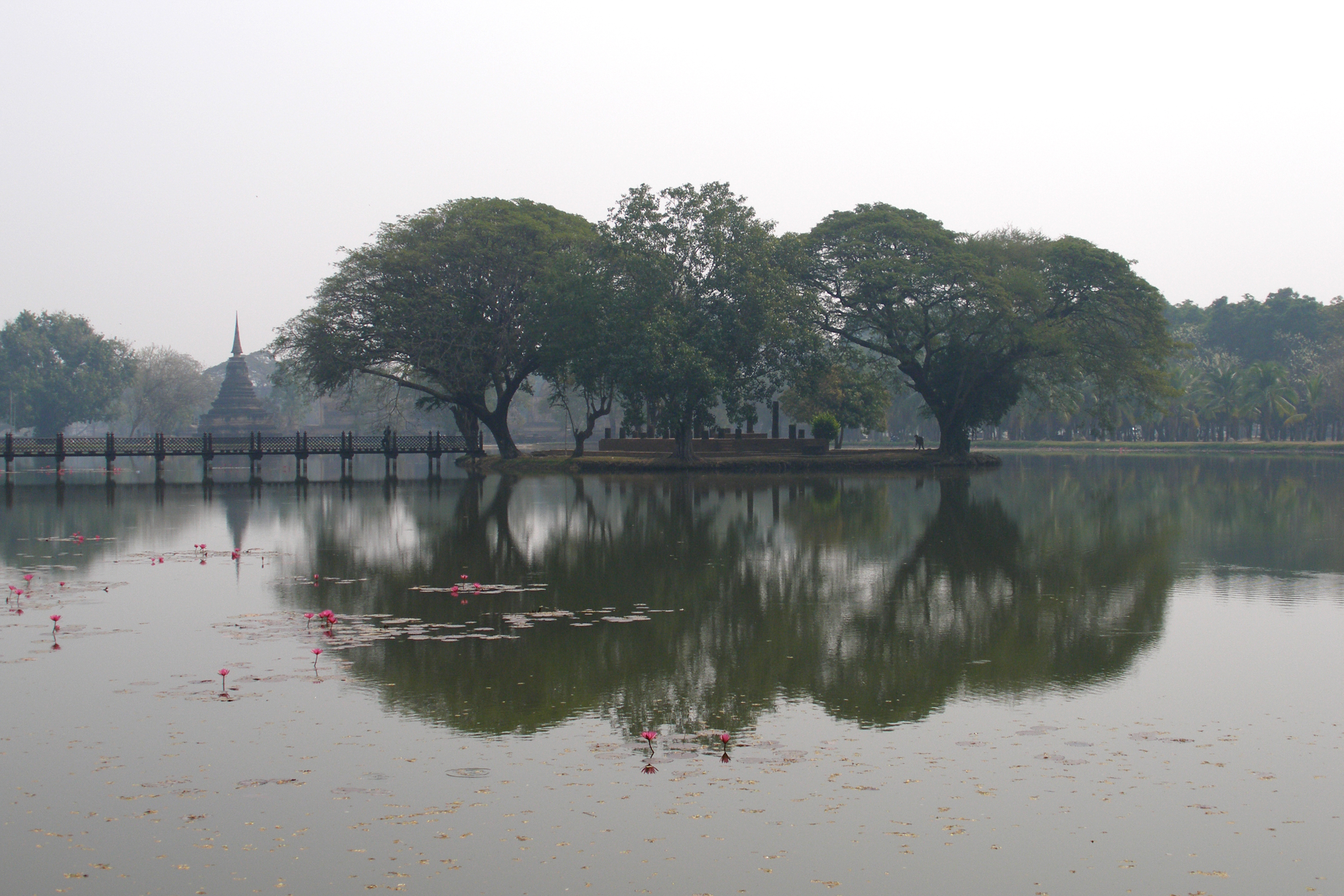
Sukhothai Historical Park
The name means "dawn of happiness," and it was not given lightly. Sukhothai was the capital where the Tai people, after centuries under Khmer rule, first governed themselves. Walking among its 193 ruins today, spread across a plain in north-central Thailand, you move through the birthplace of Thai identity itself -- a place where script was invented, Theravada Buddhism took root as the state religion, and the architectural language of an entire civilization found its earliest expression.
A Kingdom Born from Rebellion
Before there was a Thai kingdom, there was a Khmer outpost called Sukhodaya. The empire from Angkor built monuments here -- the Ta Pha Daeng shrine, Wat Phra Phai Luang, Wat Sisawai -- leaving behind the angular geometry of their Hindu-inflected architecture. In the mid-13th century, the Tai tribes under Si Indradit rebelled against the Khmer governor and established Sukhothai as an independent state. Sri Indraditya, as he became known, founded the Phra Ruang dynasty and expanded the kingdom until it covered the entire upper valley of the Chao Phraya River. Traditional Thai historians long considered this founding as the beginning of the Thai nation. Modern scholarship points further back, but the symbolic weight remains: Sukhothai is where the idea of Thailand first took shape.
The Lotus-Bud Stupas
Wat Mahathat, the largest temple in the park, anchors everything. Founded between 1292 and 1347, its design follows a mandala representing the universe -- a principal stupa surrounded by smaller ones in eight directions. The main stupa rises in the shape of a lotus bud, the signature form of Sukhothai architecture. Around its base, 168 stuccoed figures of Buddhist disciples walk with hands clasped in salutation. The eight surrounding stupas reveal the cultural crossroads Sukhothai occupied: four corners in Mon-Lanna style, four sides showing Khmer influence. Nearby, Wat Si Sawai tells an older story still. Founded in the late 12th or early 13th century as a Hindu shrine for Vishnu, its three laterite prangs once represented the Hindu trinity before being converted to Buddhist use around the 14th century. Shiva statues and Chinese porcelains unearthed here speak to a faith landscape far more layered than any single tradition.
Ramkhamhaeng's Mark on Stone
Under King Ramkhamhaeng, Sukhothai reached its zenith. He pushed the kingdom south to Tambralinga, north to Luang Prabang, and opened trade missions to Yuan dynasty China. Sukhothai potters produced Sangkalok ceramics in the Chinese style -- the only period Siam ever did so. But Ramkhamhaeng's most enduring legacy may be the script he reportedly invented in 1283, carved into a stele that would not be discovered for another 600 years. In 1833, Prince Mongkut -- then a monk on pilgrimage -- found the Ramkhamhaeng Stele at the ruins of the royal palace, alongside a gray stone slab decorated with lotus petals called the Manangasila Throne. He carried both back to Bangkok. The stele, now inscribed on UNESCO's Memory of the World Register, remains one of the most studied and debated artifacts in Southeast Asian history.
Abandonment and Rediscovery
Sukhothai's dominance was brief. After Ramkhamhaeng died in 1298, tributaries broke away within a generation. By 1378, the armies of the expanding Ayutthaya Kingdom had forced Sukhothai to submit. Successive Burmese-Siamese wars further depopulated the region, and in 1793, Rama I founded New Sukhothai twelve kilometers east, abandoning the old capital to the forest. The ruins lay largely forgotten until Crown Prince Vajiravudh led a two-month archaeological expedition in 1907, publishing his findings to encourage public interest. When the historical park formally opened in November 1988, followed by UNESCO World Heritage inscription in December 1991, Sukhothai finally received the attention its layers of history demanded.
Giants in Stone and Shadow
Wat Si Chum holds perhaps the park's most arresting sight: Phra Achana, a seated Buddha eleven meters wide and fifteen meters tall, enclosed within a massive mandapa whose walls are three feet thick. Hidden inside the south wall, a narrow staircase passage leads to the roof, and along its length more than fifty engraved slates depict scenes from the Buddha's life -- the oldest surviving examples of Thai drawing. At Wat Saphan Hin, perched two hundred meters above the plain, a twelve-and-a-half-meter standing Buddha named Phra Attharot gazes eastward. A slate pathway climbs the hill to reach it, giving the temple its name: "Stone Bridge Monastery." Below, Wat Traphang Thong sits on an island in a lake, the only temple in the park where an active community of monks still lives. A Buddha footprint carved from dark gray stone in 1359 remains its most revered artifact -- a mark of faith pressed into rock nearly seven centuries ago.
From the Air
Sukhothai Historical Park sits at 17.02N, 99.70E in the broad Yom River plain of north-central Thailand. From the air, the rectangular city walls and moats are clearly visible, with Wat Mahathat's central stupa cluster at the geometric center. Sukhothai Airport (VTPO) lies 27 km north. The nearby city of Phitsanulok (VTPP) offers a larger field. Best viewed at 2,000-4,000 feet AGL in morning light when the lotus ponds and reflecting pools catch the sun.