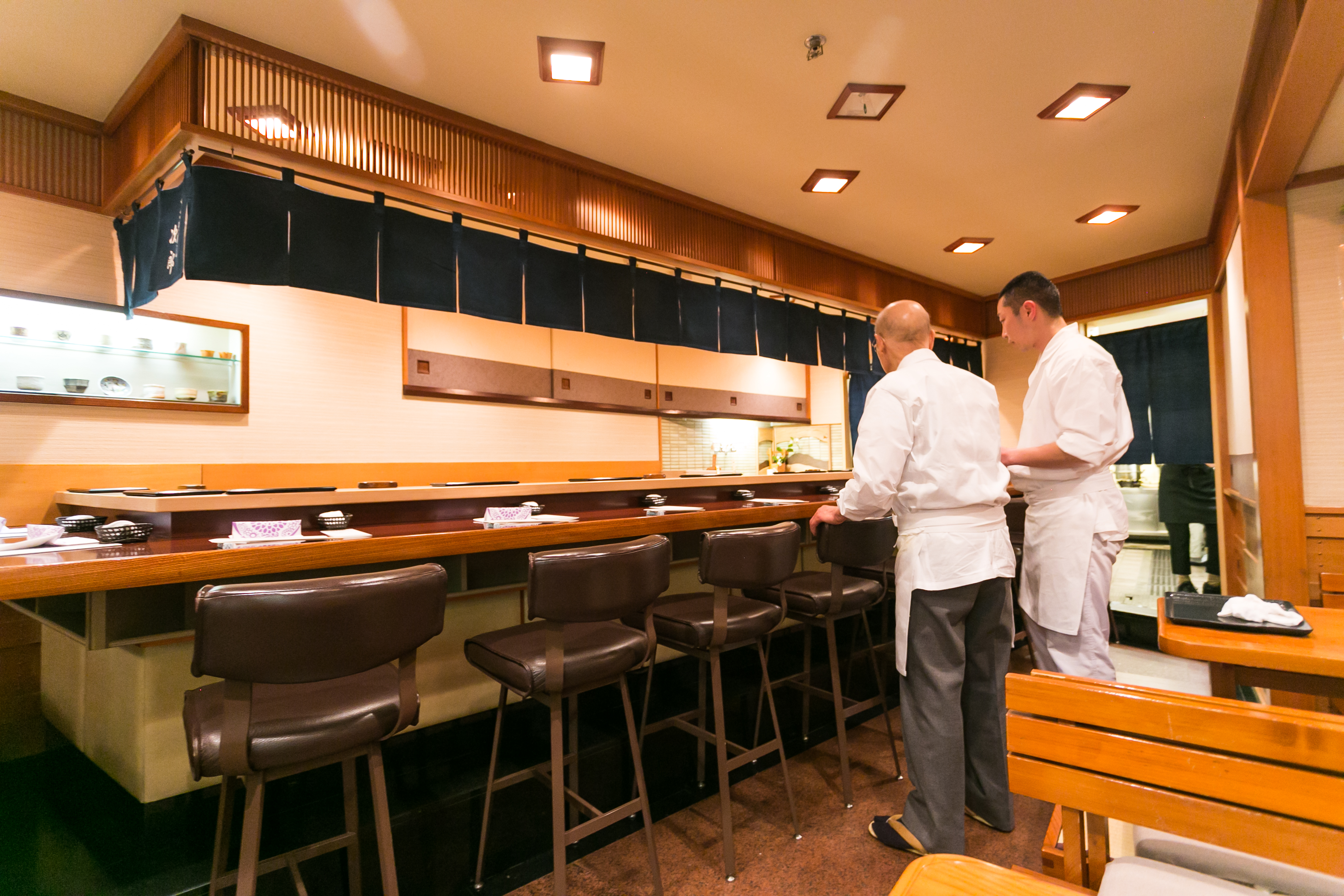
Sukiyabashi Jiro: Ten Seats, One Lifetime
There are ten seats. No menu. No appetizers, no side dishes, no dessert. You sit at a counter made of hinoki cypress, and for approximately thirty minutes, a chef places roughly twenty pieces of nigiri sushi in front of you, one at a time, each shaped and seasoned with decades of accumulated precision. This is Sukiyabashi Jiro, a restaurant that occupies the basement level of the Tsukamoto Sogyo Building in Ginza, one of Tokyo's most expensive neighborhoods. It is the kind of place where the world's most powerful people have eaten, and where the world's most famous food guide once decided it could no longer grant stars -- not because the quality dropped, but because ordinary diners could no longer get a reservation.
The Boy from Hamamatsu
Jiro Ono was born in 1925 in Hamamatsu, a city roughly 150 miles southwest of Tokyo. At seven years old, he began working as an apprentice at a local inn's restaurant. By nine, he had left home entirely. He moved to Tokyo and trained under various masters, becoming a sushi chef at twenty-five. Fifteen years later, in 1965, he opened his own restaurant in the basement beneath Ginza's Sukiyabashi crossing. He was forty years old. The concept of shokunin -- a Japanese word meaning artisan or craftsman, carrying connotations of relentless devotion to one's craft -- would come to define both the man and the restaurant. Ono did not diversify, did not expand, did not pivot. He made sushi, the same way, in the same ten seats, for the next six decades.
Three Stars and the Art of Refusal
When the Michelin Guide expanded to Tokyo in 2007, Sukiyabashi Jiro received the highest possible rating: three stars. It was the first sushi restaurant in history to earn the distinction. The French chef Joel Robuchon, holder of more Michelin stars than any chef in the world, called it one of his favorite restaurants and said it taught him that sushi is an art. But in November 2019, Michelin removed Sukiyabashi Jiro from the guide entirely. The restaurant had stopped accepting reservations from the general public, requiring instead that bookings be made through the concierge of a select number of luxury hotels. Michelin's logic was straightforward: a restaurant inaccessible to ordinary diners could not be rated as a public establishment. Ono and his team seemed unbothered. The seats stayed full.
A Documentary and a President
In 2011, American filmmaker David Gelb released Jiro Dreams of Sushi, a documentary that transformed a basement sushi counter into a global phenomenon. The film captured Ono's philosophy of perpetual improvement -- his belief that mastery is not a destination but a horizon that recedes with each step forward. Three years later, on April 23, 2014, President Barack Obama sat at that same counter alongside Japanese Prime Minister Shinzo Abe. Accounts of the meal diverge: some reports suggest Obama did not finish his sushi, while Abe later said the President proclaimed it the best he had ever eaten. The diplomatic ambiguity suited the restaurant perfectly -- a place where precision matters, but mystique matters more.
The Next Generation
In 2023, Jiro Ono stepped aside as head chef due to declining health, handing the counter to his eldest son Yoshikazu. The transition had been decades in the making. Yoshikazu had worked alongside his father since the restaurant's early years, absorbing the exacting standards that defined Sukiyabashi Jiro. Ono's younger son Takashi operates a separate branch in Roppongi Hills that holds two Michelin stars. On October 27, 2025, Jiro Ono turned one hundred years old. The restaurant he built continues in its basement beneath the office tower, ten seats arranged along a cypress counter, serving roughly twenty pieces of sushi per person in thirty quiet minutes -- a monument to the idea that doing one thing with total devotion, in the same small room, for an entire lifetime, can become something extraordinary.
From the Air
Located at 35.673°N, 139.764°E in the Ginza district of Chuo, central Tokyo. The restaurant sits in the basement of a commercial building near the Sukiyabashi crossing, invisible from the air but situated within one of Tokyo's most recognizable shopping districts. From altitude, the Ginza grid pattern is visible between the Imperial Palace gardens to the north and the Tsukiji/Toyosu waterfront to the east. Best viewed at 2,000-4,000 feet AGL. Tokyo International Airport / Haneda (RJTT) lies approximately 8 nautical miles south-southwest. Narita International Airport (RJAA) is approximately 35 nautical miles east-northeast.