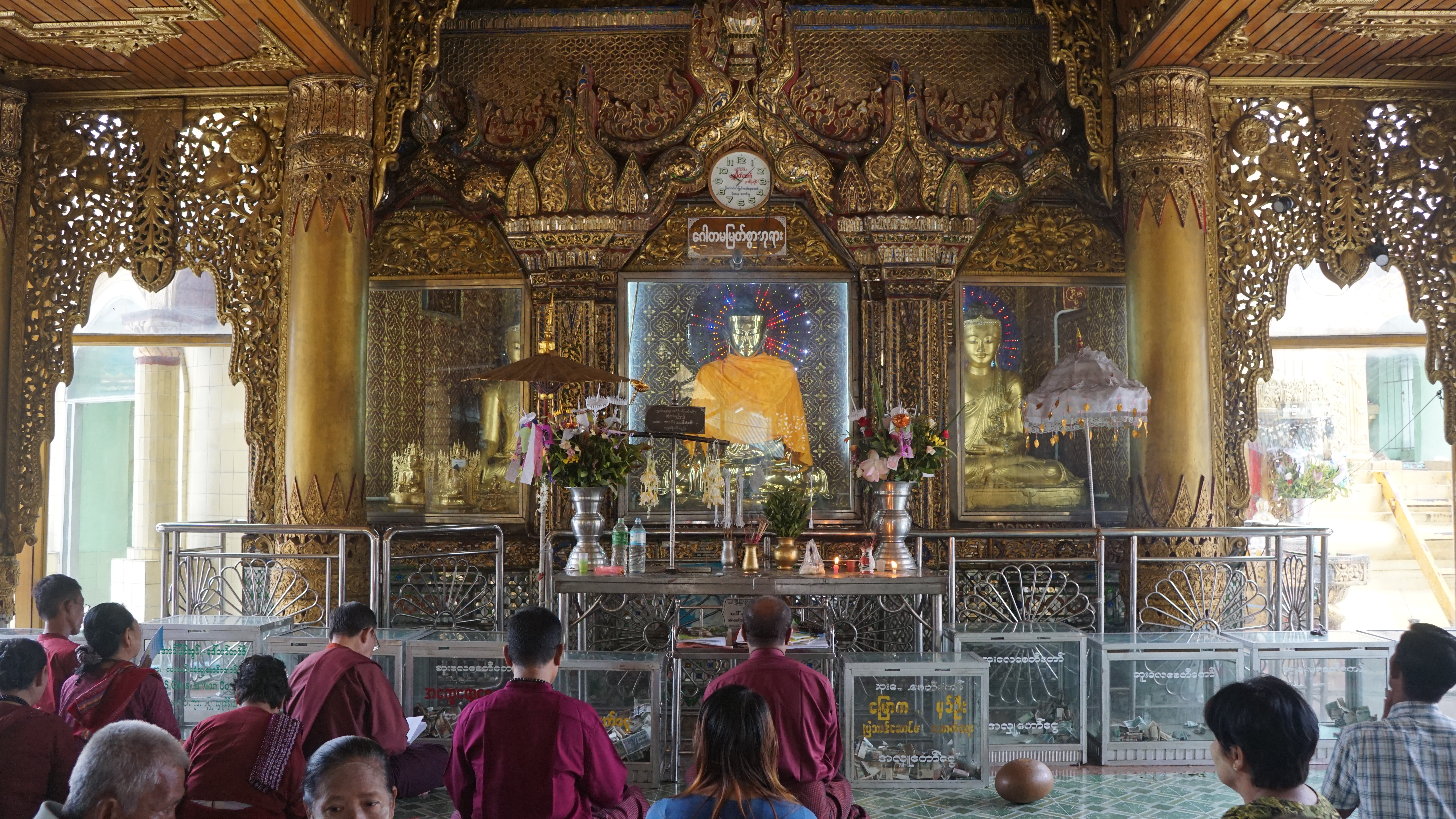
Sule Pagoda
The old spirit's eyelids had to be propped up with trees. According to Burmese legend, a nat named Sularata had lived so long that he could barely stay awake, but he alone remembered where three previous Buddhas had buried sacred relics in ages past. When the king of the nats, Sakka, needed to locate that site to help the legendary King Okkalapa build a shrine for a strand of the Buddha's hair, every divine and human being in the kingdom gathered around the ancient Sularata and waited. He remembered. The Sule Pagoda was built to mark both the place and the gathering -- its very name may derive from su-way, meaning "gather around." Two and a half millennia later, people are still gathering at this golden stupa in the heart of downtown Yangon, though now for reasons the legend's authors could not have imagined.
Where the City Begins
When Lieutenant Alexander Fraser of the Bengal Engineers laid out the modern street grid of Yangon after the British occupation in the mid-19th century, he made the Sule Pagoda its center point. The octagonal Mon-style chedi became the hub from which roads radiated outward, a geographic anchor that persists today. Fraser also lent his name to what is now Anawrattha Street, one of Yangon's main thoroughfares. The pagoda itself was enlarged to its present size by Queen Shin Sawbu between 1453 and 1472, and nothing else at the site is more than about a century old. Ten bronze bells of various sizes surround the chedi, each inscribed with the names of donors and dedication dates. The golden spire rises above the traffic roundabout, its dome marking the cityscape like a compass needle pointing upward. Around it, Yangon's economic and public life flows in an unbroken stream -- market stalls, office workers, monks in saffron robes, all orbiting this ancient point of reference.
Hair of the Buddha
The pagoda's religious significance reaches back to its founding legend. It is believed to enshrine a strand of hair given by the Buddha himself to two Burmese merchant brothers, Trapusa and Bahalika. This relic tradition connects the Sule Pagoda to the broader network of sacred Buddhist sites across Myanmar, most notably the Shwedagon Pagoda, which according to legend was built after the Sule Pagoda's nat revealed the location of Singattura Hill. The stupa's architecture tells a story of cultural evolution: it began with the Indian relic-mound form but gradually absorbed distinctly Burmese architectural elements as local culture asserted its independence from Indian influences. The dome structure, topped with its golden spire, represents this hybrid -- ancient Indian purpose expressed through Burmese aesthetic sensibility. Whether the relic within is authentic matters less than what the belief has sustained: continuous veneration at this site for what tradition claims is more than 2,600 years.
The Rallying Point
Three times in living memory, the Sule Pagoda has become something more than a place of worship. On August 8, 1988, during what became known as the 8888 Uprising, students and protesters chose the pagoda as an organizing point and destination -- selected deliberately for both its central location and its symbolic weight. Hundreds of thousands took to the streets to demand an end to military rule. The army, under General Saw Maung, crushed the movement. The military government claimed around 350 deaths; independent estimates from human rights organizations and foreign diplomats put the toll between 3,000 and 10,000. In 2007, during the Saffron Revolution, thousands of Buddhist monks gathered around the pagoda to pray and to protest, their saffron robes transforming the traffic circle into a sea of color and conviction. Again, the military responded with force. In 2021, during the Spring Revolution following the coup, the pagoda served once more as a rallying point. Each time, the same golden stupa that legend says was built to commemorate a gathering became the site where Burmese citizens gathered to demand their future -- and each time, the pagoda witnessed the government's brutal response.
Gold Above the Roundabout
Today the Sule Pagoda sits at the intersection of commerce and devotion, traffic and tradition. Listed on the Yangon City Heritage List, the octagonal structure remains the fixed point around which the city pivots. Vendors sell flowers and incense at its base. Office towers rise on every side. The name itself carries multiple possible meanings: su-way for "gather around," su-le for the wild brambles that once overgrew the site, or the Pali words cula and ceti -- "small pagoda." None of these etymologies has been definitively settled, and the ambiguity feels appropriate for a monument that has meant different things to different generations. For the devout, it is a reliquary housing a hair of the Buddha. For the politically aware, it is the place where Myanmar's democratic aspirations have been declared and suppressed. For the pilot approaching Yangon from the west, it is a golden point of light at the exact center of a sprawling city -- the place where everything in Yangon begins.
From the Air
Located at 16.77°N, 96.16°E at the center of downtown Yangon. The golden stupa is visible as a bright point in the middle of the city's grid street pattern, sitting in a traffic roundabout. Recommended viewing altitude 2,000-4,000 feet for best perspective on the pagoda's relationship to the surrounding urban grid. Nearest airport: Yangon International (VYYY), approximately 10 nm north. The Shwedagon Pagoda, much larger, is visible about 2 km to the northwest.