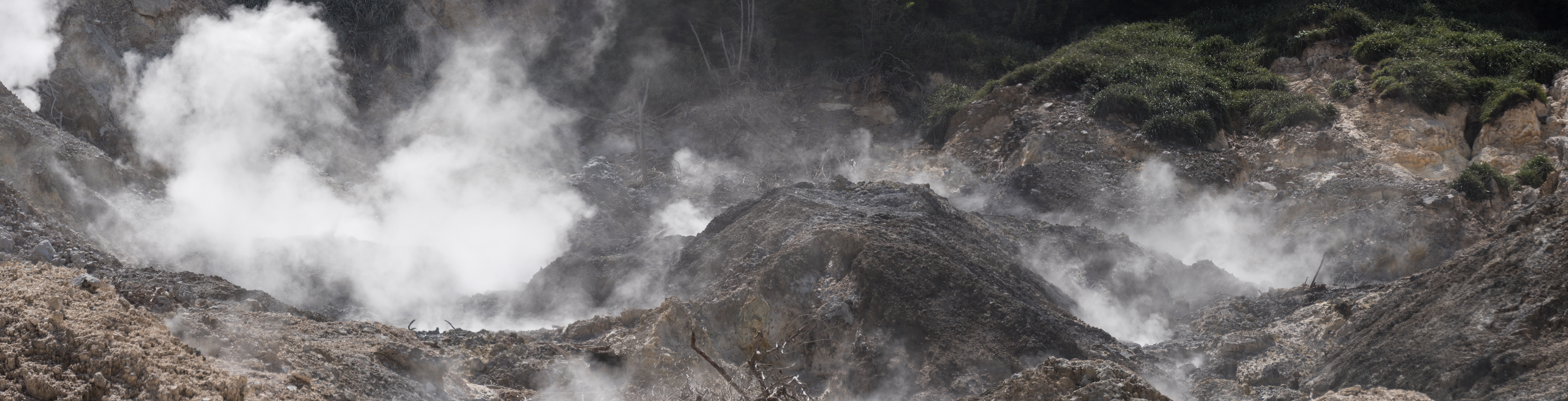
Sulphur Springs, Saint Lucia
A tour guide named Gabriel gave his name to a hole in the earth. In the mid-1990s, at a geothermal site where tourists once walked freely to the edge of boiling, tar-colored pits, Gabriel stepped where the crust was thin and fell through. He survived with second-degree burns from the waist up, and the fissure that swallowed him became Gabriel's Hole -- a permanent reminder that this is not a theme park dressed up to look dangerous. Sulphur Springs, near the town of Soufriere on Saint Lucia's southwestern coast, is the real thing: an active volcanic field where the earth's interior vents through cracks in a collapsed caldera, boiling water at 100 degrees Celsius and sending plumes of sulfurous steam into the tropical air. It draws roughly 200,000 visitors a year, making it the most popular tourist destination on the island, and it carries a nickname that is both a marketing stroke and a geological fact: the world's only drive-in volcano.
Three Hundred Thousand Years of Heat
The geothermal field at Sulphur Springs sits inside an enormous collapsed crater formed roughly 300,000 years ago, when a volcanic upheaval tore through the earth's crust. The most recent eruption -- recorded as a minor explosion -- occurred in 1766, but the system has never gone quiet. Sulfur billows continuously from cracks in the caldera floor. Boiling mud pits bubble and churn. The water at the center of the springs reaches 100 degrees Celsius, producing dense plumes of steam visible from a distance. The blackened color of the spring water comes from a chemical reaction between the high concentrations of sulfur and iron; the water also contains deposits of copper, iron oxide, alkaline lead, calcium oxide, and carbon. The French who settled this coast named the nearby town Soufriere -- meaning "sulphur mine" -- because the stench of rotten eggs was the area's defining characteristic long before anyone built a road to the crater's edge.
When Sulphur Was Currency
Before the springs became a tourist attraction, they were an industrial operation. From 1836 to 1840, a sulphur mine operated by Bennett and Wood extracted the mineral from the caldera for export. Peak production came in 1836, when 540 tons of sulphur left Saint Lucia for markets overseas. The mine operated for only four years -- a brief chapter in a geological story measured in hundreds of millennia -- but it established the site as something more than a natural curiosity. The French name stuck. Soufriere became the town built beside a mine, even after the mining stopped and the springs returned to being simply what they had always been: a place where the planet's interior breaks through to the surface.
Driving to the Edge
The "drive-in volcano" label is not poetic license. A road leads directly to the caldera's rim, allowing visitors to park within view of the steaming vents and boiling pools. Until Gabriel's accident in the mid-1990s, the experience was even more immediate -- tourists walked right up to the tar-colored pits with nothing between them and water hot enough to cause severe burns. After the accident, a viewing platform was built several hundred feet back from the most active areas, and access to the caldera floor was restricted. The change made the site safer without diminishing its visceral impact. Standing on the platform, you can feel the heat rising, smell the sulfur sharpening the air, and watch the ground itself seem to breathe as mud bubbles and collapses in slow, heavy rhythms.
The Mud Bath Downstream
A couple of hundred yards downstream from the boiling springs, the water temperature drops to around 45 degrees Celsius -- still hot, but bearable. Here, visitors wade into mineral-rich pools and coat themselves in volcanic mud that locals and tourists alike credit with medicinal properties. The mud baths have become as much a part of the Sulphur Springs experience as the crater itself. Whether the minerals actually heal anything is debatable, but the sensation is distinctive: warm, silky sediment against the skin, the smell of sulfur in your hair, and the knowledge that the heat soaking into your muscles originates miles below, in the same magmatic system that built the Pitons visible on the horizon. Sulphur Springs sits within the broader volcanic complex that shapes this entire stretch of Saint Lucia's coast -- a landscape where the earth is visibly, tangibly alive.
From the Air
Located at 13.84°N, 61.05°W in the Soufriere district of Saint Lucia's southwestern coast. The geothermal field is identifiable from the air by steam plumes rising from the caldera and the lighter, barren ground amid the surrounding tropical vegetation. The town of Soufriere sits on the coast just to the west, with the Pitons visible to the south along the shoreline. Nearest airports: Hewanorra International Airport (TLPL) at the island's southern tip, approximately 18km southeast; George F. L. Charles Airport (TLPC) near Castries to the north. Recommended viewing altitude: 2,000-4,000ft to spot the steam vents. The volcanic terrain creates thermal updrafts; expect turbulence at lower altitudes near the caldera.