Thirty Kilometers to Rejoin a Country
For 130 years, getting from one half of Brunei to the other required leaving the country. The Limbang district of Malaysia -- seized from Brunei by Rajah Charles Brooke of Sarawak in 1890, with the British looking the other way -- cuts the sultanate cleanly in two, stranding the Temburong District as a semi-exclave on the far side of Brunei Bay. Before 2020, residents of Temburong who needed to reach the capital faced a choice: a 45-minute speedboat ride across open water, or a two-hour drive through Malaysia requiring four international passport checks and a ferry crossing. Then, on 17 March 2020 -- one day after Brunei sealed its borders against the COVID-19 pandemic -- a 30-kilometer bridge opened and made the drive take half an hour.
A Nation Split by a Victorian Land Grab
To understand the bridge, you have to understand the wound it heals. Brunei was once the dominant power on Borneo, its sultanate controlling most of the island's northern coast. By the 19th century, that territory was hemorrhaging. The Brooke family -- the "White Rajahs" of Sarawak -- carved away chunk after chunk, and in 1890, Charles Brooke annexed the Limbang River region. The British, who held Brunei as a protectorate, formally recognized the seizure. What remained of Brunei was two disconnected parcels separated by a strip of what is now Malaysian Sarawak. Temburong, the eastern fragment, had its own rivers, its own rainforests, and its own sense of isolation. It was Bruneian in every legal sense but practically detached from the national life that centered on Bandar Seri Begawan, the capital in the western half.
Building Across the Bay
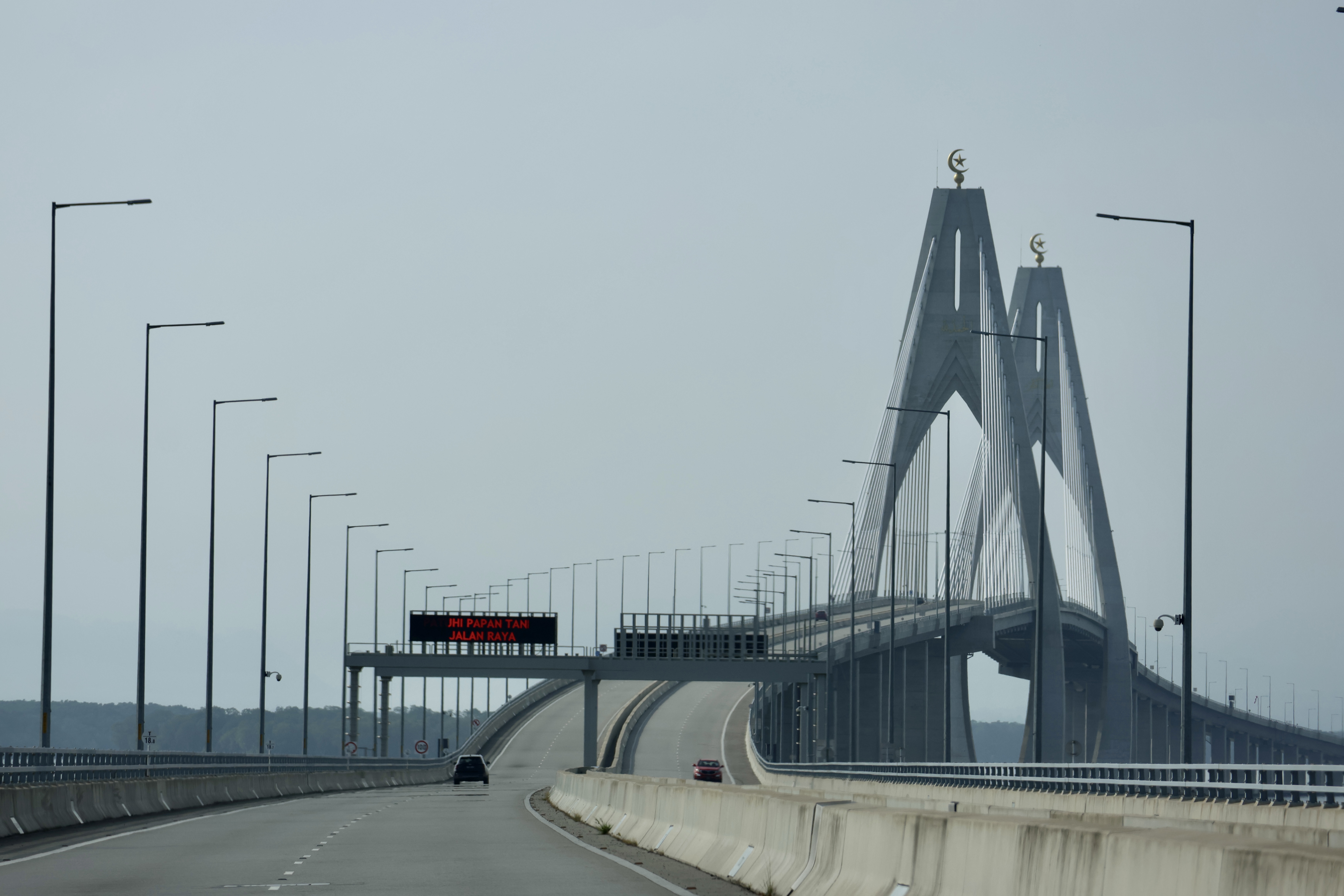
The 2006-2025 National Land Use Master Plan identified Temburong's geographic isolation as a constraint on development and called for a fixed link. A 2012 feasibility study by the Public Works Department confirmed the project was technically possible, fiscally viable, and environmentally manageable. Construction began in 2014 and was divided into six contract packages. CC1 punched twin tunnels through the Mentiri Ridges to connect a controlled-access dual carriageway with the coastal road at Kota Batu. CC2 and CC3, awarded to South Korean firm Daelim, built a system of marine viaducts and two cable-stayed navigation bridges across Brunei Bay -- the 14.5-kilometer heart of the crossing. CC4, handled by China State Construction Engineering, constructed an 11.8-kilometer land viaduct traversing the mangrove swamp of Labu Forest Reserve to reach Temburong's road network. The total cost reached 1.6 billion Brunei dollars, roughly US$1.2 billion.
A Pandemic Opening
The bridge was supposed to open at the end of 2019. Delays pushed the date into 2020, and then a global pandemic gave the project an unexpected urgency. On 16 March 2020, Brunei barred most non-resident foreigners from entering the country and restricted citizens and residents from leaving. Without the bridge, those border closures would have effectively severed Temburong from the rest of the nation -- the overland route ran through Malaysian territory that was now inaccessible, and speedboat service across the bay faced its own restrictions. The bridge opened to traffic the next day, 17 March 2020, ahead of the revised schedule. A piece of infrastructure planned for economic development became, overnight, a lifeline against national fragmentation.
Steel, Stars, and the Architect of Modern Brunei
The bridge carries more than traffic. At its highest points, star and crescent symbols crown the structure, marking Brunei as a Muslim state in the same visual language used atop mosque domes. Road signs featuring the three kalimahs -- Islamic declarations of faith -- are spaced along the route, a reminder to drivers to remember Allah while traveling. The triangular, gem-like form of the main spans, described as resembling two hands clasping firmly, symbolizes national resilience. A dome-like element represents the unity of Brunei's four districts. On 14 July 2020, Sultan Hassanal Bolkiah's 74th birthday, the bridge received its formal name: the Sultan Haji Omar Ali Saifuddien Bridge, honoring the Sultan's late father, widely regarded as the architect of modern Brunei. The naming turned an infrastructure project into a monument -- a 30-kilometer tribute to the man who guided the sultanate from colonial protectorate to independent nation.
The View from Above
From the air, the bridge reads like a line drawn across water with a ruler -- 30 kilometers of concrete and steel stretching from the Mentiri Ridges on the western shore, across the shallow green-brown expanse of Brunei Bay, past the tips of small islands like Pulau Berambang and Pulau Pepatan, and into the mangrove forests of Temburong's coast. The marine viaduct section traces a gentle curve that follows the bay's bathymetry, threading between islands on pilings driven into the seabed. Where the bridge meets Temburong at Tanjung Kulat, the elevated roadway continues overland through the Labu Forest Reserve, the pylons rising above a canopy of mangrove and nipah palm that has reclaimed every square meter the construction crews temporarily cleared. The drive that once required a passport now requires only patience with the speed limit. For Temburong, 30 kilometers of bridge undid 130 years of separation.
From the Air
Located at 4.89°N, 115.08°E spanning Brunei Bay from the Brunei-Muara District to Temburong District. The 30-km bridge is clearly visible from 5,000-10,000 feet as a dramatic linear structure crossing the open water of Brunei Bay. The cable-stayed navigation bridges at the center are the most prominent features. Nearest airport is Brunei International Airport (WBSB), approximately 12 km to the northwest. The bridge connects to the Mentiri Tunnels on the western end and the Labu Forest Reserve on the eastern end, both visible landmarks. Look for the bridge's distinctive star and crescent symbols at the high points of the cable-stayed sections.