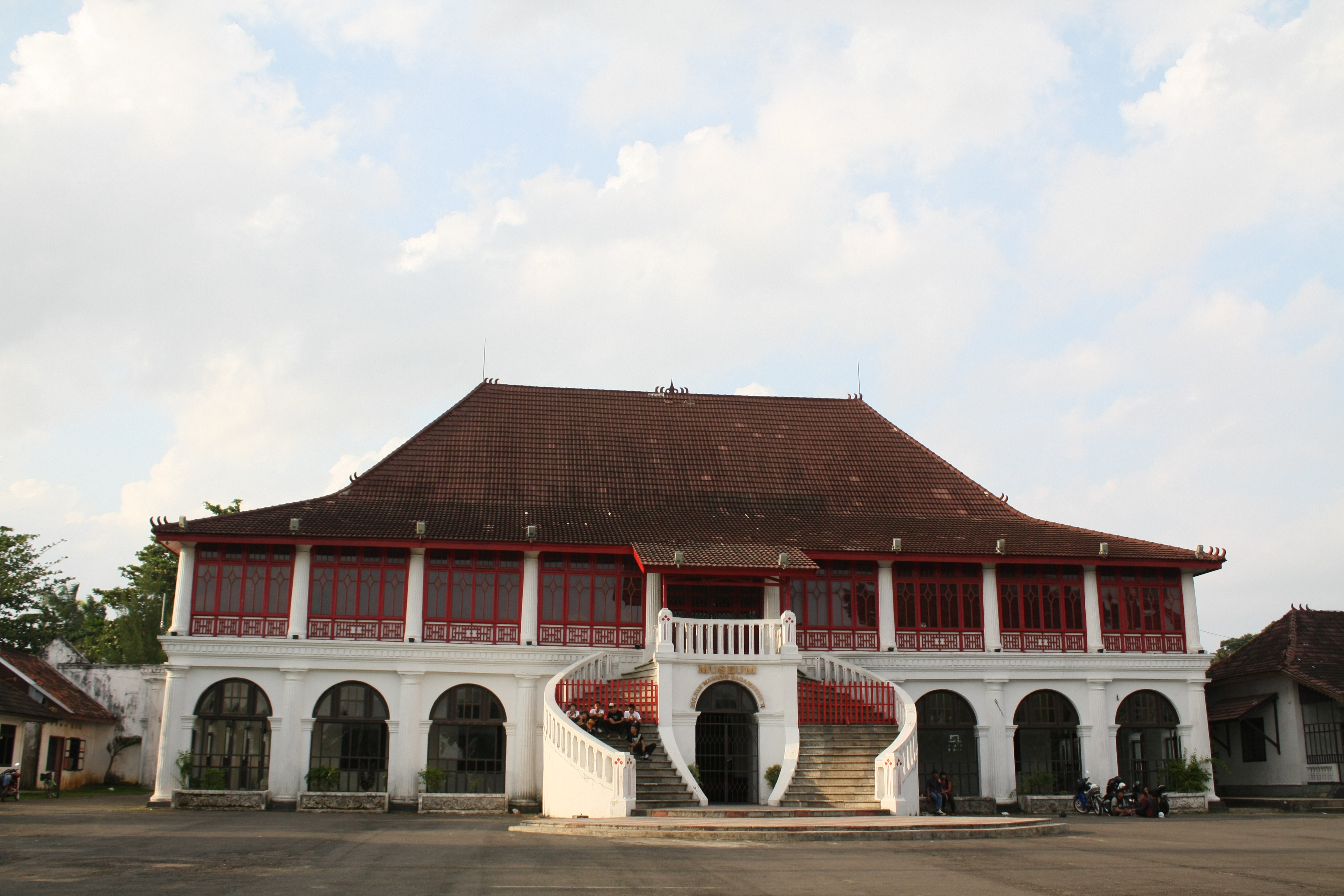
Sultan Mahmud Badaruddin II Museum
On October 7, 1823, British soldiers demolished the Kuta Lama, the old palace of the Palembang Sultanate, as punishment for a massacre at the Dutch lodge on Sungai Alur. Within months, a new building rose from the rubble. The colonial authorities called it the Gedung Siput -- the "snail building" -- and what followed was two centuries of reinvention on a single patch of ground along the Musi River. Today that building is a museum named for Sultan Mahmud Badaruddin II, but the story it tells goes far deeper than anything in its display cases.
A Palace Razed, a Colony Built
The land beneath the museum carries memory. Sultan Mahmud Badaruddin I ruled from the Kuta Lama between 1724 and 1758, presiding over a sultanate that controlled the trade flowing through Palembang's waterways. When the British destroyed the palace in 1823, the act was officially retribution -- but it was also strategic, a move to sever the sultanate's hold on the city. The Palembang Sultanate was abolished, and in place of the royal complex, colonial administrators built their own seat of power. The Gedung Siput gave way to a more permanent structure: a two-story stone building that blended European architectural conventions with the tropical logic of the Indies. Its designers borrowed from the traditional rumah bari style found in Palembang, with its pyramidal limas roof adapted to the equatorial humidity. By 1825, the building served as the office of the colonial resident of South Sumatra, a foreign administrator presiding from a throne room's former footprint.
Occupiers and Inheritors
The building's tenants tell the story of Southeast Asian power shifts in miniature. Dutch colonial residents worked behind its walls for more than a century. In the 1920s, the structure received a renovation -- more glass, more light -- as if the colonial project might last forever. It did not. During World War II, Japanese forces seized the building for their military headquarters in Palembang, part of the broader occupation of the Dutch East Indies that upended the colonial order across the archipelago. When Indonesia declared independence in 1945, the building changed hands again, becoming the headquarters for Kodam II/Sriwijaya, an Indonesian Army division whose name deliberately invoked the ancient Srivijaya kingdom that had once made Palembang the center of a maritime empire. The military eventually moved on, and the city government inherited a building with no clear purpose -- until 1984, when it became a museum.
What the Walls Hold
The museum's collection spans the cultural breadth of South Sumatra, though the building itself may be the most compelling artifact. Inside, visitors find the expected inventory of a regional Indonesian museum: textiles woven in local patterns, traditional weapons, ceremonial dress, handcrafted goods, and colonial-era coins. But step into the gardens and the timeline deepens dramatically. Stone statues of Ganesha and Buddha stand among the greenery, relics of the Srivijayan period when Palembang was a thriving center of Malay Buddhist civilization. These are not replicas. They are fragments of a world that flourished here more than a thousand years ago, when merchants and monks from India, China, and the Malay world converged on the Musi River's banks. The museum shares its origin story with the nearby Balaputradeva Museum -- in 1984, an authentic rumah bari, one of Palembang's traditional limas houses, was physically relocated to Balaputradeva, and some of the collections that had been housed within it were transferred to this museum instead.
Layers Along the Musi
Palembang is a city defined by its river, and the museum sits where the Musi has witnessed the most turbulent episodes of local history. The same stretch of riverbank that hosted the sultan's palace, the colonial residency, and the Japanese command post now welcomes school groups and tourists. Across the water, the Ampera Bridge -- a mid-twentieth-century landmark -- frames the skyline. The museum building itself, with its hybrid architecture of European stone and tropical Palembang design, is a physical record of cultural collision. Every renovation, every change of occupant, left its mark. The glass additions from the 1920s sit alongside the original Indies-style facades. The building also houses the tourist department of Palembang, a bureaucratic function that feels almost whimsical given the weight of what has unfolded within these walls. A palace was destroyed so this building could exist. A sultanate ended so a colony could begin. And now the colony's administrative office preserves the memory of the very sultan it displaced.
From the Air
Located at 2.99S, 104.76E on the north bank of the Musi River in central Palembang. The museum building is near the Ampera Bridge, a prominent visual landmark spanning the river. Sultan Mahmud Badaruddin II International Airport (WIPP) serves the city approximately 12 km to the north. From cruising altitude, Palembang is identifiable by the Musi River's wide course through the urban center. Best viewed at 2,000-3,000 feet for riverbank detail.