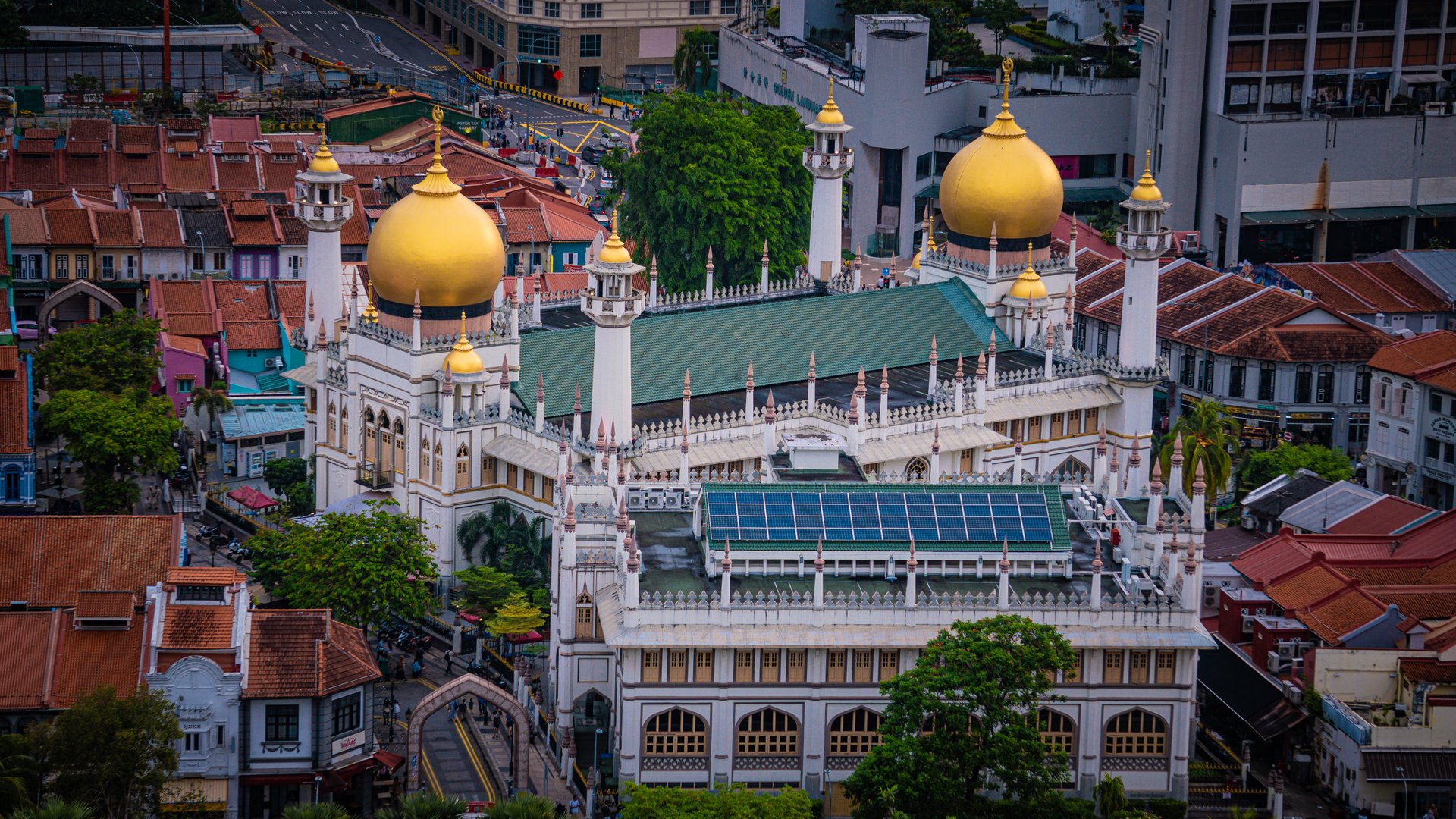
Sultan Mosque
In 1936, a microphone and loudspeaker were installed inside the Sultan Mosque on Muscat Street, and for the first time the muezzin's call to prayer carried more than a mile across Singapore. Some worshippers were skeptical of the new technology. Most, however, accepted the practical reality: a human voice alone could no longer rise above the noise of a growing city. That tension between tradition and adaptation has defined this mosque since its founding, when a Malay sultan and a British colonial administrator -- with competing motives and overlapping interests -- agreed that a house of worship should stand at the edge of a royal compound in what would become one of the most layered neighborhoods in Southeast Asia.
A Sultan's Request, a Company's Coin
The mosque exists because of a treaty and a favor. The 1819 Singapore Treaty between Hussein Shah of Johor and Stamford Raffles of the British East India Company formalized British control of the island as a trading settlement. Shortly after signing, Sultan Hussein asked that a mosque be built beside his royal residence, the Istana Kampong Glam, to serve the local Muslim community. Raffles agreed and contributed 3,000 Spanish dollars from the East India Company toward construction. It was a shrewd gesture -- supporting the sultan's religious authority cost the Company little and bought goodwill among the Malay and Muslim population. The original mosque, completed by 1826, stood on the same site the current building occupies today. For over a century it served the faithful before being replaced by the structure that now dominates the Kampong Glam skyline.
The Mosque That Replaced Itself
By the early 20th century, the original building was no longer adequate. A new mosque was commissioned, designed to be grander in scale and more permanent in construction. The rebuilt Sultan Mosque was completed in 1932, rising at the intersection of Muscat Street and North Bridge Road with twin golden domes and a broad prayer hall. The architects -- from the colonial firm Swan & Maclaren, the same practice that designed structures across Singapore's civic landscape -- blended Saracenic, Moorish, and classical elements into a composition that reads as both distinctly Islamic and unmistakably Singaporean. The base of each dome features a distinctive decorative band made from glass bottle ends, a detail sometimes attributed to the architect's desire to incorporate contributions from the poorer members of the community who could not afford monetary donations. Whether apocryphal or not, the story captures something true about the mosque's relationship with its neighborhood.
Kampong Glam's Anchor
The mosque sits at the heart of Kampong Glam, a precinct whose name derives from the gelam trees that once grew in the area and whose history is inseparable from Singapore's Malay royal heritage. The Istana Kampong Glam, Sultan Hussein's former palace, stands nearby, now housing the Malay Heritage Centre. Bussorah Street, the pedestrian lane leading to the mosque's main facade, is lined with carpet shops, textile merchants, and restaurants serving Middle Eastern and Malay cuisine -- a commercial ecosystem that has orbited the mosque for generations. Arab Street, one block over, extends the neighborhood's character with its fabric shops and perfumeries. The mosque anchors all of it, its domes visible from several blocks in every direction, a geographic and spiritual center that gives the precinct its coherence.
Monument and Living Institution
On 8 March 1975, the Sultan Mosque was gazetted as a national monument, joining Sri Mariamman Temple and St Andrew's Cathedral on Singapore's roster of protected religious landmarks. Unlike a museum piece, however, the mosque remains a fully active place of worship. Only minor repairs have been made to the main hall since 1932, with an annex added in 1993 to accommodate growing needs. The building is managed by its own board of trustees rather than a government body, preserving a degree of communal self-governance that traces back to the sultan's original request. During Ramadan, the mosque's facade comes alive with light shows projected onto its white walls, drawing crowds of tourists and worshippers alike to Muscat Street. The call to prayer still carries across Kampong Glam, amplified now not by a single microphone but by a modern sound system -- technology that the skeptics of 1936 could scarcely have imagined, serving a purpose as old as the faith itself.
From the Air
Located at 1.3021N, 103.8590E in the Kampong Glam district of Singapore's Rochor planning area. The mosque's twin golden domes are visible from low altitude, particularly along the axis of Bussorah Street. Nearest airport is Singapore Changi Airport (WSSS), approximately 15 km east. Paya Lebar Air Base is about 8 km northeast. Best viewed below 2,000 feet in clear conditions, where the domes contrast with the surrounding low-rise heritage shophouses.