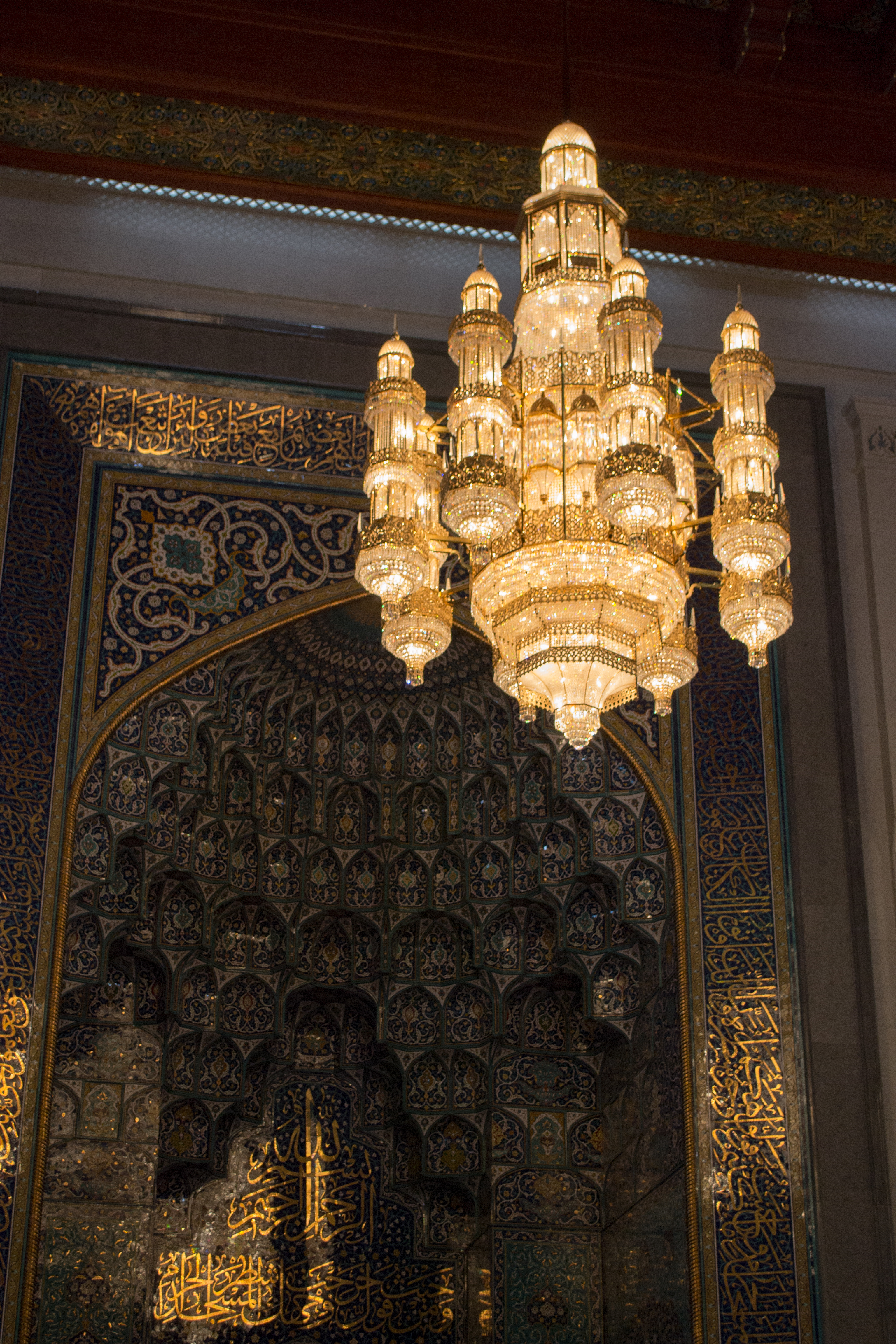
Sultan Qaboos Grand Mosque
The carpet took four years to weave. More than 600 workers tied 1.7 billion knots, blending the classical Persian traditions of Tabriz, Kashan, and Isfahan into a single piece that covers the prayer hall floor. Twenty-eight colors were drawn mostly from vegetable dyes, and the finished carpet weighed 21 tons. Until 2018, it was the largest single-piece carpet in the world. It remains one of the most extraordinary objects ever placed inside a mosque -- and it is only one of the treasures housed within the Sultan Qaboos Grand Mosque in Muscat.
A Sultan's Vision in Sandstone
In 1992, Sultan Qaboos bin Said directed that Oman should have a Grand Mosque. A design competition followed in 1993, and construction began in December 1994 on a site at Bausher. The project took six years and seven months to complete. Approximately 300,000 tons of Indian sandstone were imported for the building, shaped into a contemporary Islamic design that honors tradition without imitating any single historical style. The site covers 416,000 square meters. Five minarets define its skyline: the main minaret rises 90 meters, while four flanking minarets reach 45.5 meters each. Completed in 2001, the mosque can accommodate 20,000 worshippers across its prayer halls, courtyards, and passageways.
Light and Crystal
Hanging from the central dome, 50 meters above the prayer hall floor, is a chandelier manufactured by the German company Faustig. It stands 14 meters tall, weighs 8.5 tons, and contains 600,000 crystals illuminated by 1,122 halogen bulbs fitted with a dimming system. A maintenance staircase is built inside the chandelier itself. When the mosque first opened, this was the largest chandelier in the world. Thirty-four smaller chandeliers of the same design are suspended throughout the building, creating a constellation of light within the stone and sandstone structure.
Where Prayer Meets Geometry
The main prayer hall is a square space of 5,476 square meters crowned by the central dome. The dome's interior is elaborately decorated, drawing visitors and worshippers alike to pause and look upward. The main musalla holds over 6,500 worshippers, while the women's musalla accommodates 750. The outer sahn -- the traditional Islamic courtyard -- holds another 8,000. Every surface rewards attention: the mihrab niche indicating the direction of Mecca, the carved woodwork of windows and doors, the glass embellishments that catch the Omani light. The building contract was awarded to Carillion Alawi LLC, a partnership that brought international engineering to local materials and methods.
Oman's Gathering Place
The Sultan Qaboos Grand Mosque functions as both a Friday congregational mosque and one of Muscat's primary tourist attractions. Non-Muslim visitors are welcome during designated hours, a practice that reflects the Ibadi tradition of Omani Islam, which has historically emphasized tolerance and openness. The mosque sits at the intersection of several things Oman values: craftsmanship, hospitality, and a measured modernity that draws from the past without being confined by it. Prince Harry toured the mosque in 2014. India's Prime Minister Narendra Modi visited in 2018 and noted the India connections woven into the building's history -- from the sandstone shipped from the subcontinent to the carpet traditions of Persian workshops with deep Indian ties.
From the Air
Located at 23.58N, 58.39E in the Bausher district of Muscat, Oman. The mosque's five minarets and large white dome complex are visible from altitude against the arid landscape. Nearest airport is Muscat International (OOMS), approximately 15 km to the northwest. Best viewed at 3,000-5,000 feet.