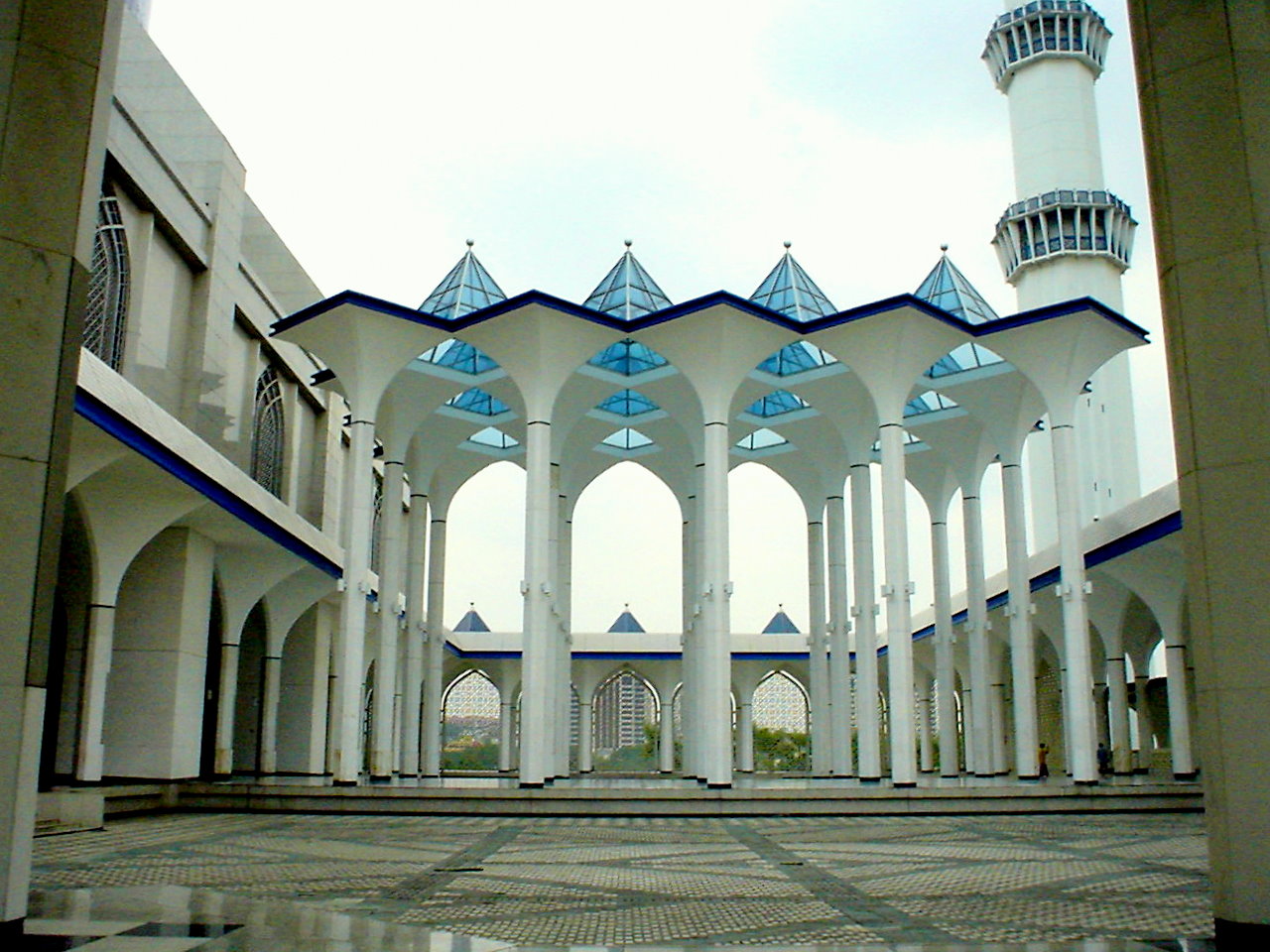
Sultan Salahuddin Abdul Aziz Mosque
The dome appears first. Rising above the rooftops of Shah Alam, it catches the equatorial light and throws it back in shades of blue and silver -- a hemisphere of aluminium clad in vitreous enamel panels inscribed with verses from the Quran. At 51.2 meters in diameter and 106.7 meters above ground, it is one of the largest religious domes on earth, and the building beneath it is the largest mosque in Malaysia. Locals simply call it the Blue Mosque, and from the air, you understand why: it dominates its surroundings the way a great cathedral dominates a medieval city, impossible to miss and impossible to ignore.
A Capital Demands a Landmark
When Sultan Salahuddin Abdul Aziz declared Shah Alam the new capital of Selangor on 14 February 1974, the young city needed a building to match its ambitions. The mosque he commissioned would take 14 years to realize -- construction began in 1982 and finished on 11 March 1988 -- but the result justified the wait. Four minarets rise from the corners of the complex, and in its early years the mosque held a Guinness World Record for the tallest minaret on the planet. That distinction passed to the Hassan II Mosque in Casablanca in August 1993, whose single minaret reaches 210 meters, and subsequently to the Djamaa el Djazair in Algiers, whose minaret reaches 265 meters and opened in 2019. But the Shah Alam mosque retains a record of its own: its four minarets remain the tallest group of minarets in the world, and they rank third tallest individually, behind the Djamaa el Djazair and the Hassan II Mosque.
Where Light Turns Blue
Step inside and the scale shifts from imposing to intimate. Blue stained glass fills the windows, filtering the fierce Malaysian sunlight into something softer, cooler -- a bluish ambiance that the architects designed to evoke serenity. The high ceiling overhead is paneled in red balau and ramin timber arranged in crisscrossing triangular patterns, warm wood tones set against the pervading blue. Along the walls and curving beneath the dome, fine Arabic calligraphy -- the work of Egyptian calligrapher Sheikh Abdel Moneim Mohamed Ali El Sharkawi -- inscribes Quranic verses in gold. Intricate aluminium grillwork frames the doorways and windows. The main prayer hall spans two levels, fully carpeted and air-conditioned, and ranks among the largest prayer spaces anywhere. Women worship in the upper gallery, while the ground floor houses administrative offices, conference rooms, a library, and lecture halls.
Malay Roots, Modern Form
The mosque's design fuses Malay architectural tradition with Modernist principles, a combination that reads as both rooted and forward-looking. Traditional Malay elements appear in the building's ornamentation and spatial organization, while the clean geometric lines and the sheer engineering ambition of the dome belong unmistakably to the late twentieth century. The approach proved influential: the Jami Al-Azhar Jakapermai Mosque in Kalimalang, Bekasi, Indonesia, later adapted the design for its own congregation. At the foot of the mosque stretches the Garden of Islamic Arts, 14 hectares of landscaped park inspired by Jannah, the Quranic Garden of Paradise. Nine galleries within the garden exhibit Islamic calligraphy, sculpture, painting, and architectural models. The grounds occasionally host traditional Islamic performances, and the combination of open green space, art, and spiritual architecture makes the complex a destination for visitors well beyond its congregation.
The Blue Dome from Above
From the air, the mosque reveals its full geometry: the massive dome centered among four symmetrical minarets, the gardens radiating outward, the grid of Shah Alam spreading to every horizon. Built on flat ground in a planned city, the mosque has no competing skyline -- no hills, no older monuments, no rival towers -- and the result is a structure that organizes the landscape around itself. At dusk, when floodlights illuminate the dome and minarets against the darkening sky, the Blue Mosque becomes the brightest point in the Selangor lowlands. It is a building designed to be seen, and from a flight path over the Klang Valley, it delivers on that promise.
From the Air
Located at 3.08°N, 101.52°E in Shah Alam, Selangor, within the Klang Valley west of Kuala Lumpur. The blue dome is a prominent landmark visible from 10,000+ ft, especially striking at dusk under floodlights. Nearest airport is Sultan Abdul Aziz Shah Airport (WMSA) in Subang, approximately 8 km east. Kuala Lumpur International Airport (WMKK) lies 45 km south. The flat terrain of Shah Alam makes the mosque the dominant vertical feature in the area.