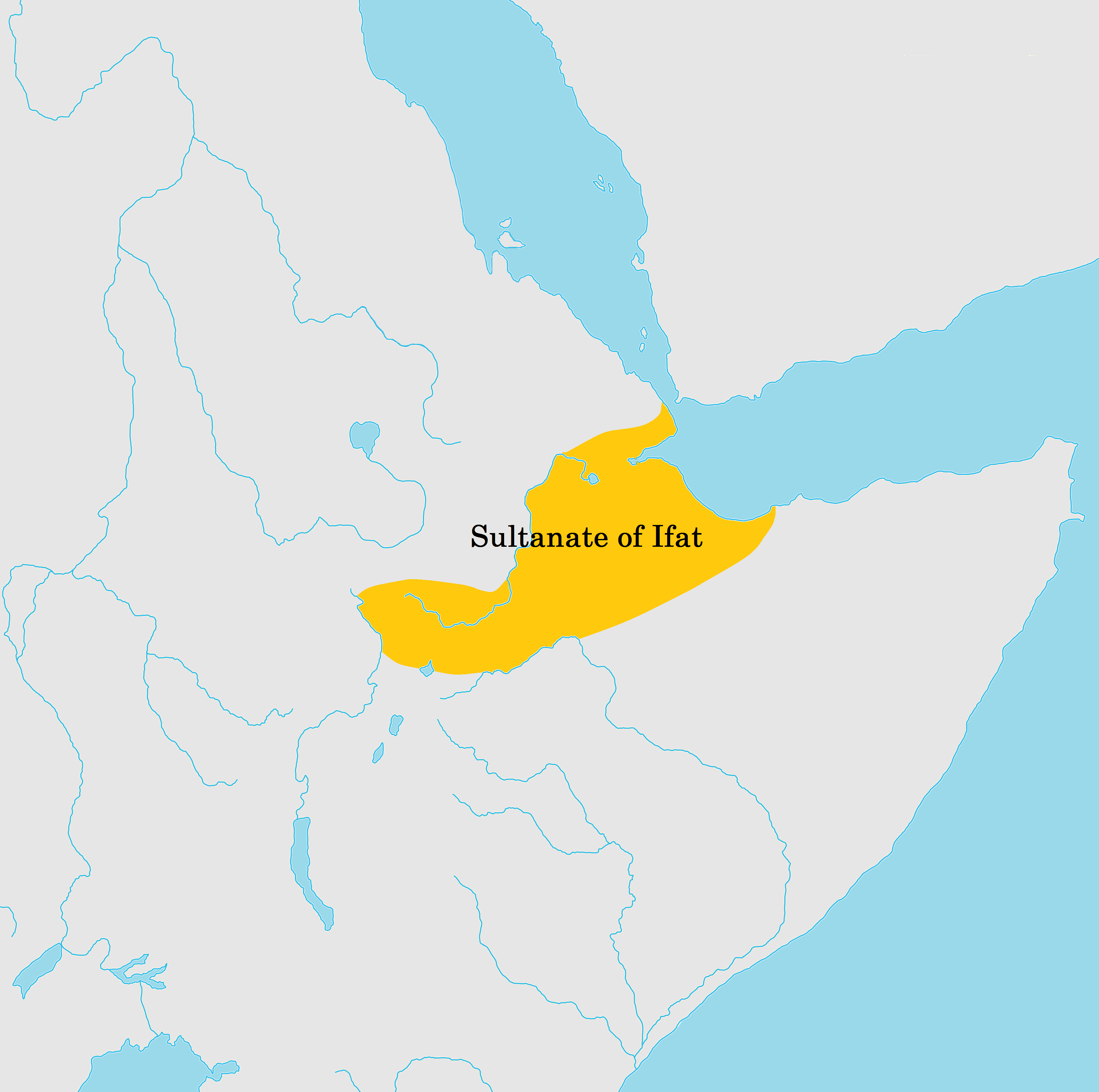
Sultanate of Ifat
The threat arrived in the form of a diplomatic letter. In 1320, Emperor Amda Seyon I of Ethiopia warned the Mamluk ruler of Egypt that if he did not stop persecuting Coptic Christians, Ethiopia would divert the course of the Nile. It was an idle bluff, but it set in motion a chain of wars between the Christian highland empire and the Muslim sultanate that controlled the lowlands to its east. That sultanate was Ifat, and for more than a century it would be the most powerful Islamic state in the Horn of Africa, commanding trade routes, fielding armies of 20,000 infantry and 15,000 horsemen, and threatening to plant khat in the Christian capital as a sign of Muslim dominion.
Where the Highlands Meet the Sea
Ifat occupied one of the most strategically consequential corridors in East Africa. Centered on what is now eastern Shewa in Ethiopia, the sultanate stretched from the slopes of Mount Zuqualla down through the Awash River valley to the ancient port city of Zeila on the Gulf of Aden. This was the funnel through which trade goods passed between the Ethiopian highlands and the Red Sea world. Whoever held it controlled the flow of gold, ivory, enslaved people, and grain to the markets of Yemen and Egypt. The Walashma dynasty, Ifat's ruling family, understood this perfectly. They claimed Arab descent from the Quraysh, though scholars believe they were most likely of local origin, adopting prestigious lineage for political advantage. Beneath them lived a diverse population of Somalis, Afars, Argobba, Hararis, and Harla, speaking Cushitic and Ethio-Semitic languages with Arabic serving as the lingua franca of commerce. The capital, described by the Arab geographer Ibn Sa'id al-Maghribi, sat on an elevated place in a valley beside a river, where inhabitants cultivated banana and sugar cane.
The Sultan Who Threatened an Empire
Ifat first emerged around 1275 under Sultan Umar Walasma, who conquered the earlier Sultanate of Shewa and gradually extended his rule over neighboring Muslim states. By 1288, the Walashma dynasty controlled Zeila and the surrounding territories. But it was Sabr ad-Din's rebellion in 1332 that transformed a regional power struggle into something resembling a holy war. Sabr ad-Din divided his army into three columns, sending one northwest to attack the Amhara heartland, one north toward Angot, and leading the third himself westward into Shewa. He appointed governors over distant provinces and made his intentions unmistakable by threatening to plant khat, a stimulant used by Muslims but forbidden to Orthodox Christians, in the emperor's own capital. The neighboring Muslim provinces of Dewaro and Hadiya joined his cause. Emperor Amda Seyon showered his reluctant soldiers with gold, silver, and fine clothing to motivate them, but many still refused to march into Ifat's inhospitable mountains. Those who did eventually destroyed the capital, though Sabr ad-Din himself escaped.
A Conflict Woven Through Continents
The wars between Ifat and Abyssinia were never simply local. They were tangled into the geopolitics of the medieval world, with Egypt as the thread connecting them. When the Mamluks persecuted Coptic Christians, Ethiopia threatened retaliation against its own Muslim subjects. When Egypt arrested the Coptic Patriarch in 1352, Ethiopia arrested every Egyptian merchant within its borders. The Ifat Sultanate and its wars with the Christian emperors were, as historian Mordechai Abir argues, one theater in the broader Muslim-Christian conflicts stretching from Cairo to the Horn of Africa. After Amda Seyon's campaigns, the conflict did not end. His successors continued to fight Ifat's sultans through more than twenty battles spanning the decades to 1370. Haqq ad-Din II died fighting in 1376. His successor Sa'ad ad-Din II adopted hit-and-run tactics that infuriated the Abyssinian emperors but could not prevent the inevitable reckoning.
The Fall and the Scattering
Sa'ad ad-Din II's end came at Zeila itself, sometime around 1403 or 1410. The medieval sources disagree on whether Emperor Dawit I or Emperor Yeshaq pursued him to the coast and killed him there. What they agree on is the aftermath. The Egyptian chronicler al-Maqrizi records that after Sa'ad ad-Din's death, the strength of the Muslims was broken. The Amhara settled in the conquered lands, and from the ravaged mosques they made churches. The followers of Islam were harassed for more than twenty years. The Argobba people fled Ifat and settled around Harar, where a city gate still bears their name. But Ifat's collapse was not the end of Muslim power in the region. From the ruins of the sultanate, the Walashma dynasty's descendants would establish the Adal Sultanate, with its capital at Harar, which would become the leading Muslim principality in the Horn of Africa by the late fifteenth century. Today, Ifat's name survives in the Ethiopian district of Yifat, in North Shewa of the Amhara region, a quiet echo of the sultanate that once commanded armies and threatened empires.
From the Air
Located at 8.57N, 39.61E in the Ethiopian highlands east of Addis Ababa. The terrain is mountainous and arid, descending eastward toward the Awash River valley. Fly at 8,000-12,000 feet for a sense of the highland-to-lowland corridor that defined Ifat's strategic importance. Nearest major airport is Addis Ababa Bole (HAAB), approximately 50 miles to the southwest. Clear weather typical outside the June-September rainy season.