Sultanate of Singora
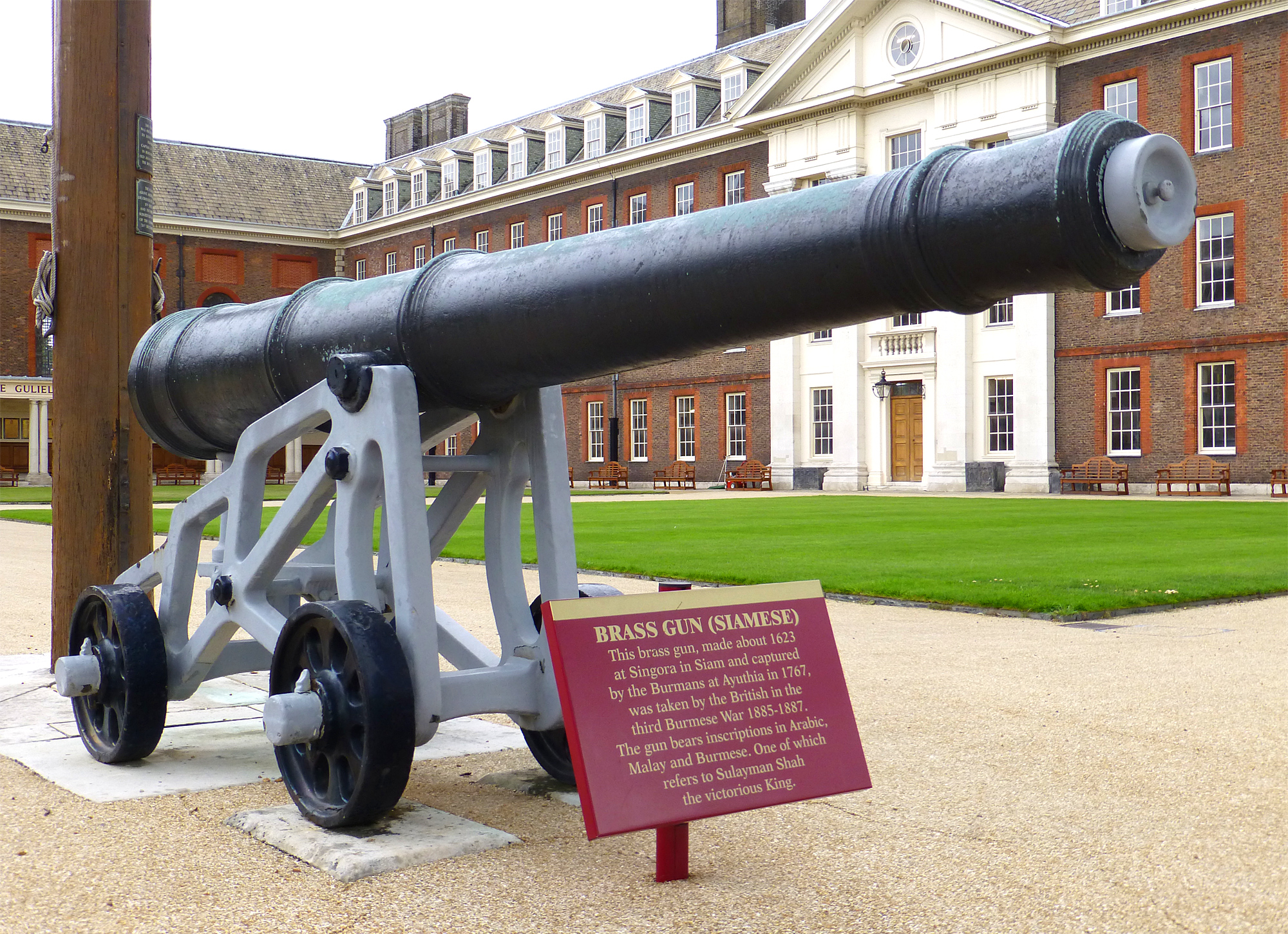
An inscribed cannon stands next to the flagpole at the Royal Hospital Chelsea in London. Carved in Arabic script and inlaid with silver, one of its eleven inscriptions reads: "The seal of Sultan Sulaiman Shah, the Victorious King." The gun's journey to that English courtyard traces one of Southeast Asia's more improbable histories -- from a fortified port city on Thailand's southern coast, to the Siamese capital at Ayutthaya, to Burma after the sack of 1767, and finally to England as a trophy of the third Anglo-Burmese War. The city that made it, the Sultanate of Singora, has been ruins for more than three centuries. But the cannon endures, a bronze witness to a place that refused to submit quietly.
A Persian on the Malay Peninsula
Singora was founded in the early 17th century by Dato Mogol, a Persian Malay-Muslim who accepted Siamese suzerainty and paid tribute to the Kingdom of Ayutthaya. The city rose on the foothills of Khao Daeng Mountain, near the southern tip of the Sathing Phra peninsula, in what is now Singha Nakhon district. European traders knew it by various names -- the British and Dutch called it Sangora, the Japanese Shinichu, the French Singor or Cingor. Whatever the language, the descriptions agreed: this was a major port. Jeremias van Vliet, director of the Dutch East India Company's trading post in Ayutthaya, called it one of Siam's principal cities and a major exporter of pepper. French gem merchant Jean-Baptiste Tavernier wrote of its abundant tin mines. The harbour could accommodate more than eighty large vessels, and overland routes linked it to the Sultanate of Kedah on the peninsula's western coast, making Singora a hub for trans-peninsular trade.
The Sultan Who Declared Independence
Dato Mogol died in 1620, and his eldest son Sulaiman inherited a city caught in the turbulence of Siamese politics. When the Queen of Pattani denounced Siam's new king, Prasat Thong, as a usurper, the region erupted. Ayutthaya blockaded Pattani with 60,000 troops and enlisted Dutch help. Singora was damaged and its pepper crop destroyed. But Sulaiman survived -- and in 1642, after receiving a diplomatic letter from the Siamese official responsible for foreign affairs, he made his intentions clear. Later that year he declared independence, appointed himself Sultan Sulaiman Shah, and set about transforming Singora into a fortress. He ordered city walls and moats built, constructed a network of forts stretching from the harbour to Khao Daeng's summit, and modernized the port. Dutch and Portuguese merchants traded freely. Ayutthaya attacked at least three times during his reign. Each assault failed. One naval campaign ended in embarrassment when the Siamese admiral simply abandoned his post.
Siege and Ruin
Sultan Sulaiman died in 1668 and was succeeded by his son Mustapha, who inherited both the city's independence and its enemies. War with Pattani erupted, but Singora -- outnumbered four to one -- rejected mediation by the Sultan of Kedah and trusted its experienced soldiers and cannoneers. The Greek adventurer Constance Phaulkon, newly arrived in Siam, attempted to smuggle arms to the city on behalf of the British East India Company but was shipwrecked before he could deliver them. In 1679, Ayutthaya mounted its final offensive. Samuel Potts, a British trader stationed in Singora, recorded the city bracing for war. After a siege lasting more than six months, Singora fell in 1680. French sources described the destruction vividly: one official wrote that the city's "tres bonne citadelle" had been razed after a war of more than thirty years. A missionary noted the King of Siam sent his finest ships to destroy the sultanate "de fond en comble" -- from top to bottom. Siam even offered the ruins to France in 1685, hoping the French East India Company might rebuild and counter Dutch influence. France's response was blunt: Singora was ruined and of no further use.
What the Mountain Remembers
Khao Daeng Mountain still holds the evidence. Thailand's Ministry of Culture has documented the remains of fourteen forts on and around its slopes. Forts 4, 8, and 9 are well preserved: one is reached by steps behind an archaeological information center, another via a stairway near the Sultan Sulaiman Shah mosque, a third atop a small motte near the road to Ko Yo Island. Higher up, forts 5 and 6 offer panoramic views across Songkhla Lake and the Gulf of Thailand. A kilometer north of the mountain, Sultan Sulaiman's tomb sits in a Muslim graveyard, housed in a small Thai-style pavilion beneath large trees. It remains a pilgrimage site where the sultan is revered by Muslims and Buddhists alike. Nearby, a Dutch cemetery known as the Vilanda Graveyard lies within a petroleum complex -- ground-penetrating radar surveys in 1998 revealed subsurface lime coffins belonging to the city's 17th-century Dutch community. The layers keep accumulating: fort and tomb, cannon and coffin, each artifact a fragment of a city that existed for barely eighty years but left marks across three continents.
From the Air
The Sultanate of Singora ruins are located at approximately 7.22N, 100.57E on Khao Daeng Mountain in Singha Nakhon district, at the southern tip of the Sathing Phra peninsula along Songkhla Lake's eastern shore. From the air, the peninsula and Songkhla Lake's southern outlet to the Gulf of Thailand are clearly visible. Nearest major airport is Hat Yai International Airport (VTSS), approximately 30 km to the west. Songkhla city lies just north along the coast. Best viewed at 3,000-5,000 ft to pick out the mountain, the lake shore, and the narrow strait connecting lake to sea. The area is flat coastal terrain with Khao Daeng as a notable rise.