Sultanate of Ternate
The legend begins with a figure called Jafar Sadik, an Arab descendant of the Prophet, who arrived on a volcanic speck in the eastern Indonesian archipelago and encountered a nymph from heaven named Nurus Safa. Their four sons became the dynastic ancestors of four kingdoms -- Bacan, Jailolo, Tidore, and Ternate -- binding the rival sultanates in a mythic kinship that persists in cultural memory to this day. Historical reality is less celestial but no less remarkable: from a tiny island dominated by the volcano Gamalama, the Sultanate of Ternate built a commercial empire that, at its peak under Sultan Baabullah in the late 16th century, stretched from Sulawesi to Mindanao to Papua.
Cloves and Crowns
The Sultanate began as the Kingdom of Gapi, founded traditionally in 1257 by Momole Cico, the first leader of Ternate, who bore the title Baab Mashur Malamo. The island's basic social unit was the soa, a territorial group tracing descent from a common ancestor. Four groups of soa -- Soa Sio, Soa Sangaji, Soa Heku, and Soa Cim -- divided into 43 sub-soa, formed the social fabric around the Sultan's palace, the kadaton. The houses of Marsaoli, Tomaito, Tomagola, and Tamadi, collectively known as the Fala Raha or Four Houses, held the highest rank. Cloves were the commodity that transformed this social order into an empire. Growing wild on the volcanic slopes of the northern Maluku islands, cloves were worth more than gold in European markets, and Ternate controlled their supply.
The European Entanglement
Portuguese ships arrived in 1512, the first Europeans to reach the source of the spice trade. What followed was a century and a half of entanglement that reshaped both the sultanate and the colonial powers. The Portuguese built forts and attempted to convert the Muslim population, earning deep resentment. When Sultan Hairun was murdered by the Portuguese in 1570, his son Baabullah besieged their fortress for five years until the garrison capitulated in 1575. The Spanish came from Manila, the Dutch from Batavia. Ternate played the newcomers against each other with considerable skill: Sultan Hamzah (r. 1627-1648) used Dutch military support to expand Ternate's territory while ceding peripheral regions in exchange. The island was literally divided between the Dutch and Spanish, each allied with a different sultanate, until Spain abandoned the Moluccas in 1663.
The Kadaton Endures
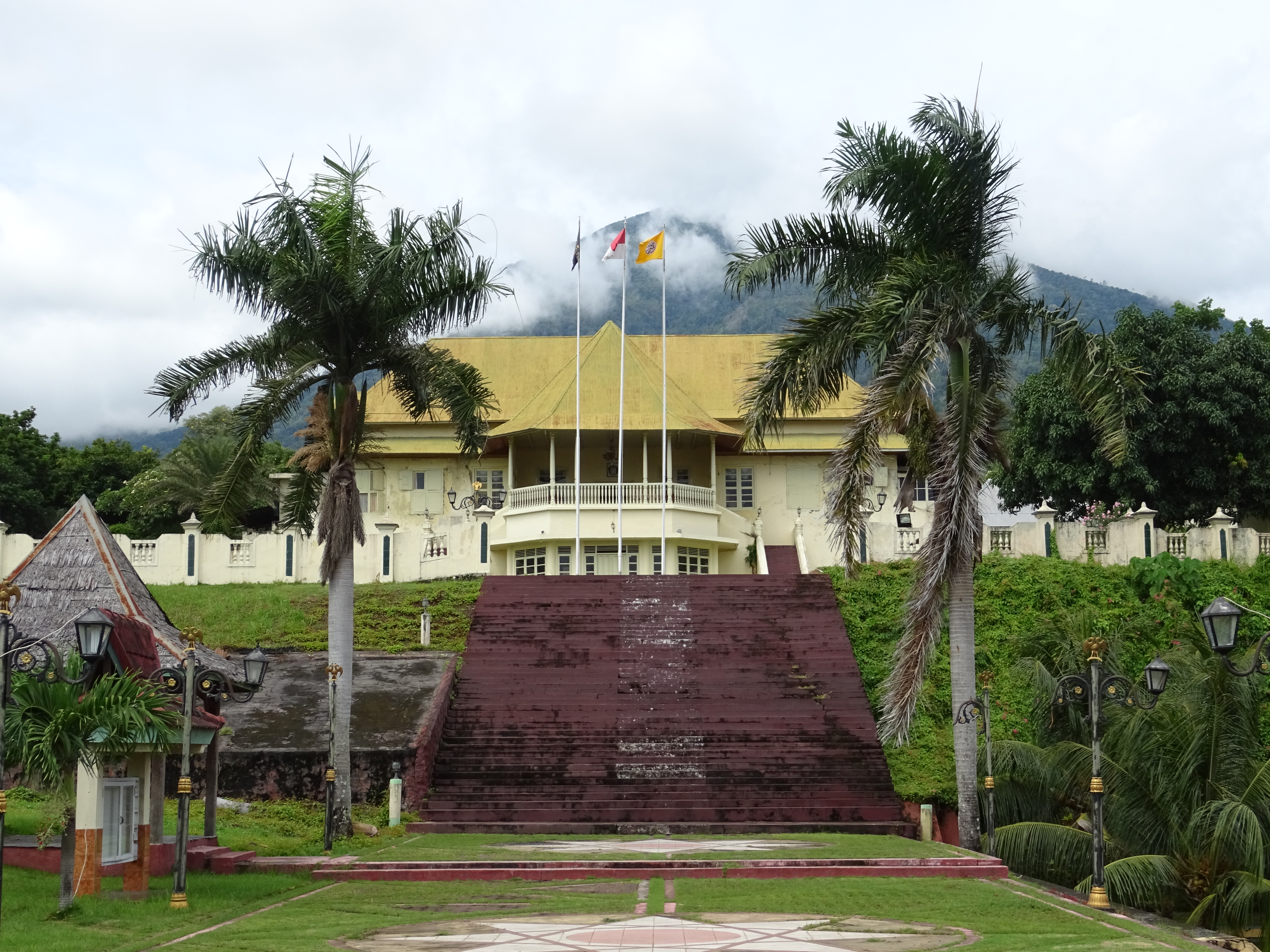
The old sultan's palace was abandoned between 1781 and 1813, when construction of the current kadaton began. Restored in a semi-colonial style, it now functions partly as a museum, displaying the genealogy of the Ternatean royal family stretching back to 1257, alongside Portuguese and Dutch helmets, swords, and armor collected over centuries of contact and conflict. The sultanate's territorial empire had collapsed by the mid-17th century under Dutch pressure, but the institution itself survived. The Dutch East India Company, and later the Dutch colonial government, found it useful to rule through the sultan rather than replace him. The Sultanate of Ternate persisted through Dutch colonization, Japanese occupation, and Indonesian independence, evolving from a sovereign power into a cultural institution.
A Kingdom That Refuses to End
Today, the Sultanate of Ternate has no political authority, yet its cultural weight remains substantial. The Sultan still presides over traditional ceremonies, and the Malam Qunut ritual at the Sultan of Ternate Mosque continues a practice that predates European contact. The genealogical unity of the Moloku Kie Raha -- the Four Mountains of Maluku -- still carries meaning in a province that was carved from the larger Maluku in 1999. What began as four villages on a volcanic hillside, ruled by a chief with the title of Momole, became a maritime state that shaped the global spice trade, survived colonization by three European empires, and outlasted them all as a living cultural tradition.
From the Air
Centered on Ternate Island at approximately 0.78°N, 127.37°E. The Sultanate's heartland is the small volcanic island dominated by Mount Gamalama (1,715 m), visible from considerable distance as a near-perfect cone rising from the sea west of Halmahera. Sultan Babullah Airport (ICAO: WAMN) serves the island. The Sultan's kadaton palace is visible in the coastal settlement on the eastern shore. Tidore, the rival sultanate's island, lies immediately to the south.