Sumatra Railway
The average age at death was thirty-seven years and three months. That statistic, recorded by American survivor George Duffy, belongs to the 700 prisoners of war who perished building a railway through the jungles of central Sumatra between 1943 and 1945. Known as the Pekanbaru Death Railway, the 220-kilometer line connecting Muaro in West Sumatra to Pekanbaru in Riau was finished on August 15, 1945 -- Victory over Japan Day. The war ended the same hour the last spike was driven. Not a single military train ever ran on it.
A Plan Twice Born
The idea of a cross-Sumatra railway long predated the war. Dutch colonial engineers first proposed it in 1898, envisioning a link between the island's east coast and west coast ports. In 1920, surveyor W.J.M. Nivel charted a route through the mountainous interior and published his findings two years later. But the economics never worked. By 1930, the colonial administration of the Staatsspoorwegen ter Sumatra's Westkust cancelled the project as financially unviable. The survey maps were filed away and forgotten -- until the Imperial Japanese Army, having conquered the Dutch East Indies, rediscovered them after the Battle of Midway in 1942. What Dutch accountants had rejected on the balance sheet, Japanese military planners revived out of desperation. The railway would allow troop and coal movements from the Strait of Malacca, via the Siak River, to the port of Padang without risking Allied warships patrolling the coastal waters.
Built on Suffering
Construction began in March 1943 under the direction of Rikuyu Sokyuku, the Japanese military railway bureau. The workforce was assembled through coercion. Thousands of romusha -- conscripted Indonesian laborers -- were rounded up alongside prisoners of war. The POWs were mainly Dutch Indo-Europeans, but the camps also held roughly 1,000 British servicemen and about 300 Americans, Australians, and New Zealanders. Among the fifteen Americans was George Duffy, a survivor of a hellship sinking, who later documented the railway's horrors. Malaria, dysentery, pellagra, and beriberi ravaged the camps, compounded by overwork and systematic mistreatment. The jungle itself was an adversary: dense tropical growth, swampy ground, and relentless heat made every kilometer of track a brutal ordeal. Seven hundred POWs died. The toll among romusha laborers, whose deaths were less meticulously recorded, was far higher.
Completed and Abandoned
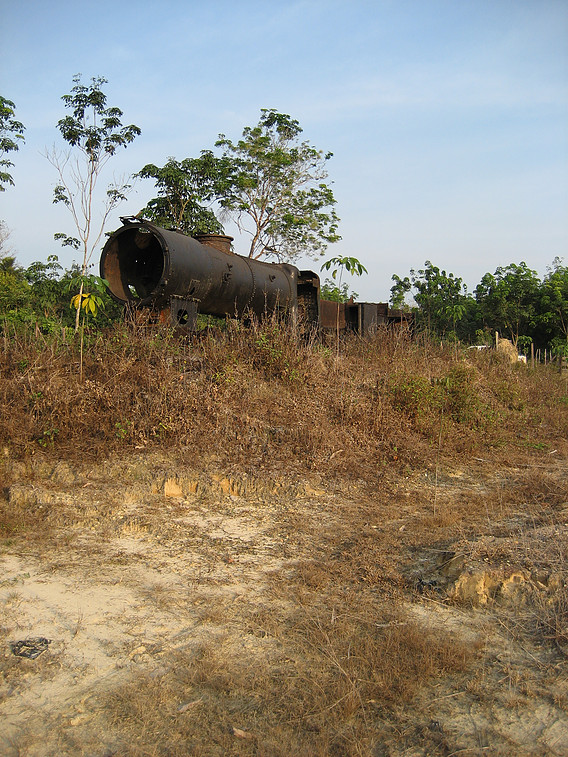
The full Muarakalaban-Muaro-Pekanbaru line stretched 246 kilometers, though the wartime segment between Muaro and Pekanbaru accounted for 220 of those. It was designed to connect four separate railway networks across Sumatra, linking the Strait of Malacca to the Indian Ocean coast via existing track from Muaro to Padang Station. The engineering was crude but functional -- narrow-gauge rail laid as fast as human hands could manage. On August 15, 1945, the day Emperor Hirohito announced Japan's surrender, the railway was declared complete. Its only service was hauling the surviving prisoners of war out of the jungle camps. Within months, the equatorial forest began reclaiming the right-of-way. Today, the line remains in an advanced state of decay, swallowed by the vegetation it was carved through.
Echoes in Stone and Memory
The Sumatra Railway occupies the same grim category as the Burma Railway and the Kra Isthmus Railway -- projects where Imperial Japan turned captive human beings into expendable construction material. Among the dead was August Kop, a Dutch Olympic medallist who perished in Pekanbaru on April 30, 1945, just months before the war's end. On VJ Day 2001, a memorial was unveiled at the National Memorial Arboretum in Alrewas, Staffordshire, England. It stands beside the Far East Prisoners of War Memorial Building, commemorating both the POWs and the conscripted romusha laborers who built the line. The memorial's placement in a quiet English village underscores the railway's reach: men from across the world were brought to the Sumatran interior to build something that would never serve its purpose, and many of them never left.
The Jungle Reclaims
From the air, the railway's route is invisible. The jungle canopy over central Sumatra is unbroken, and the narrow-gauge tracks have long since rusted into the earth. The Siak River still winds northward to Pekanbaru, and the existing railway from Muaro still connects to Padang, but the wartime segment between them exists only on old maps and in the memories of families who lost someone in those camps. Periodic proposals to reactivate the corridor surface in Indonesian media, but nothing has come of them. The railway that cost so many lives remains exactly what it was on the day the war ended: a line through the jungle that led nowhere.
From the Air
Centered at approximately 0.53N, 101.45E in Riau province, Sumatra. The railway route ran from Muaro (West Sumatra) northeast to Pekanbaru. From altitude, the corridor is dense tropical jungle with no visible rail remnants. Sultan Syarif Kasim II Airport (WIBB) serves Pekanbaru. Minangkabau International Airport (WIEE) near Padang is to the southwest. Approach from the east over the Siak River floodplain for context on the terrain the railway crossed.