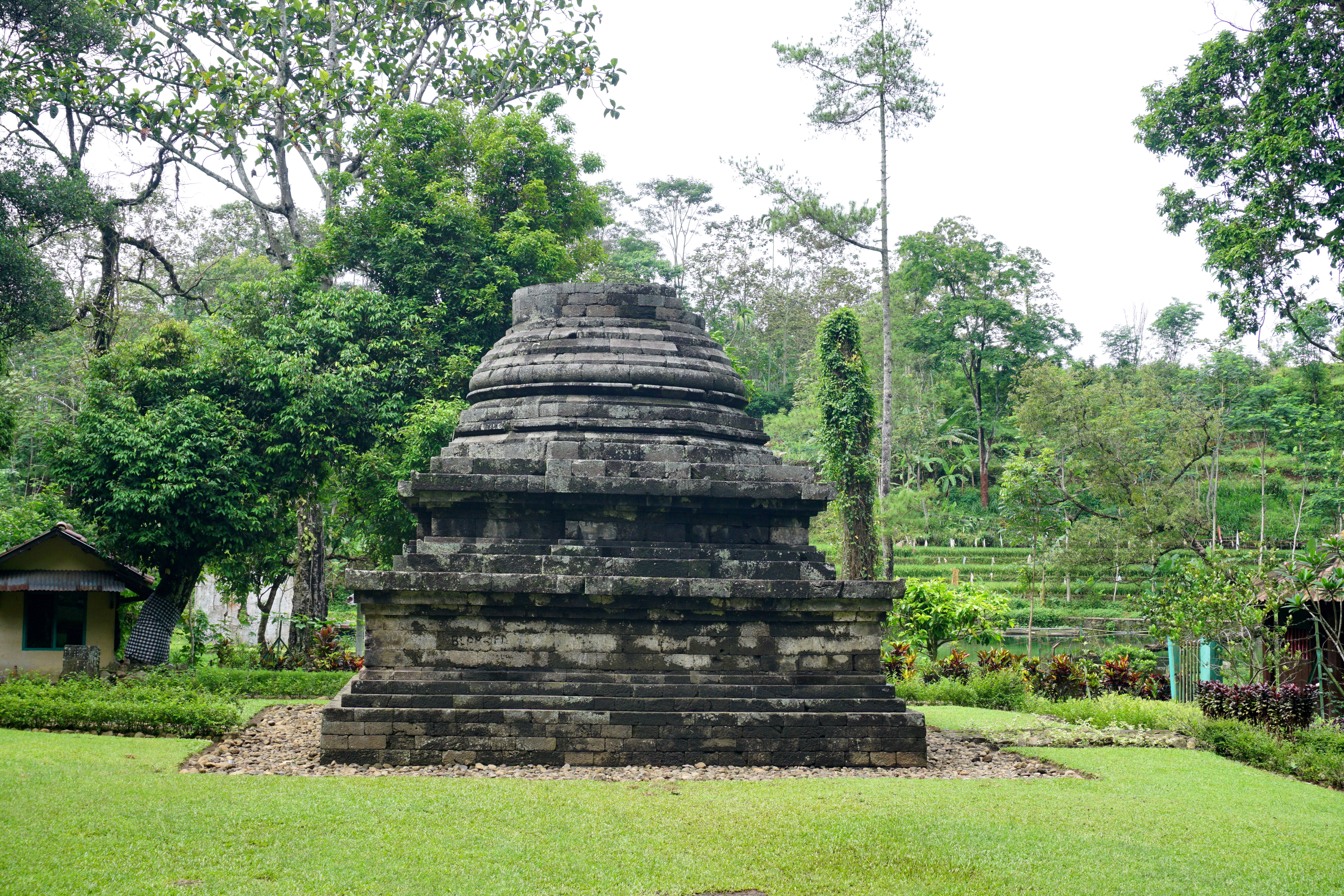
Sumberawan
The name translates loosely as 'the garden of the heavenly nymphs.' Kasurangganan, the medieval Javanese called it, and standing among the freshwater springs that bubble from the volcanic slopes of Mount Arjuno, surrounded by forest canopy that filters equatorial light into shifting green patterns, you begin to understand why. Sumberawan is a Buddhist stupa hidden in the highlands of East Java's Malang Regency, about six kilometers north of the more famous Singhasari temple. It is small, quiet, and easy to miss on most maps. But this bell-shaped stone monument, rising modestly from its square andesite base, carries the weight of two empires and six centuries of silence.
The Only One of Its Kind
What makes Sumberawan remarkable is not its size but its singularity. Across East Java, Buddhist shrines were built in the candi style -- stepped pyramid temples with intricate relief carvings, like those at Singhasari, Jago, Brahu in Trowulan, and Jabung in Paiton. Sumberawan broke with that tradition entirely. Its builders chose instead to construct a stupa: a bell-shaped dome atop an octagonal pedestal, a form borrowed from Central Javanese architecture and ultimately from the great Borobudur itself. Nobody built another like it in East Java. The structure stands 5.23 meters tall, with a square base measuring 6.30 meters on each side. The cylindrical body sits on a lotus-shaped cushion, an echo of the hundreds of perforated stupas that crown Borobudur's upper terraces. The chattra, the tiered parasol that would have topped the stupa as a symbol of spiritual sovereignty, is missing. So are many of the original stones. What remains is a reconstruction, modest but evocative, of what once stood here.
A King's Royal Progress
In 1359, King Hayam Wuruk of the Majapahit empire set out on a royal tour of his East Javanese domains. The Nagarakretagama, a court poem composed by the poet Mpu Prapanca in praise of his king, records the journey in detail -- the villages visited, the ceremonies performed, the sacred sites honored. Among them was a place the poem calls Kasurangganan, the garden of the heavenly nymphs, which scholars have identified with the site at Sumberawan. Hayam Wuruk ruled during the golden age of Majapahit, when the empire's influence stretched across the Indonesian archipelago. That he came here, to this highland clearing on Arjuno's slopes, suggests Sumberawan held significance beyond its modest dimensions. The springs that surround the stupa were likely considered sacred -- sources of purification in both Buddhist and Hindu-Javanese practice. Whether the stupa was already ancient when the king arrived or was built during his era remains debated, but architectural analysis points to the late fourteenth or early fifteenth century, squarely within the Majapahit period.
Lost and Found
The Majapahit empire collapsed in the early sixteenth century under pressure from the Islamic Sultanate of Demak. As Java's political and religious landscape shifted, sites like Sumberawan lost their patrons and their purpose. The forest reclaimed them. For roughly four hundred years, the stupa sat buried under centuries of volcanic soil and tropical vegetation, unknown to anyone beyond the local villagers who likely passed its stones without understanding what they were. In 1904, during the Dutch East Indies period, surveyors rediscovered the site. Three decades later, in 1935, researchers from the Archaeological Service made a formal visit. Restoration began in 1937, but the work was necessarily incomplete. The base and pedestal were reassembled from stones found scattered across the hillside, while the bell-shaped body was reconstructed from what could be recovered. Most of the stupa's upper stones and the entire chattra pinnacle were gone, consumed by time, gravity, and the forest's patient work.
Springs and Silence
Sumberawan today is a place defined by water and quiet. The springs that gave the site its modern name -- sumber means 'spring' in Javanese -- still flow from the volcanic slope, feeding streams that run down through the village of Toyomarto. The air at this altitude carries a coolness absent from the lowland heat of Malang city, and the surrounding forest creates a sense of enclosure that amplifies the stupa's contemplative atmosphere. Visitors who make the trip, mostly domestic tourists and occasional archaeology enthusiasts, find a monument that rewards patience more than spectacle. There are no grand relief panels to decipher, no soaring towers to photograph against the sky. Instead there is a single stone form, compact and geometric, sitting in a clearing as it has for six hundred years. The forest hums. Water moves over rock. Whatever the heavenly nymphs of Kasurangganan were guarding, they chose this place well.
From the Air
Located at 7.86S, 112.65E on the southern slopes of Mount Arjuno in East Java. The stupa sits at approximately 800 meters elevation amid dense forest cover, making it difficult to spot from the air -- look for the cleared area near the village of Toyomarto. Mount Arjuno (3,339 m) rises prominently to the north and serves as the primary visual landmark. Malang's Abdul Rachman Saleh Airport (WARA) lies approximately 20 km to the south. Surabaya's Juanda International Airport (WARR) is about 80 km to the northwest. Approach from the south over Malang for the best view of the Arjuno massif and the highland terrain where the stupa is located.