Sumiyoshi Taisha: Where the Gods Set Sail
The shrine is completely landlocked now. Apartment blocks and shopping streets surround it on every side, deep in the residential fabric of southern Osaka. But until the Edo period, the grounds of Sumiyoshi Taisha opened directly onto the sea, its riding grounds framing a view of white sand and green pines so iconic that the Japanese named an entire design tradition after it. This disconnect between past and present defines Sumiyoshi Taisha: a place where sea gods are worshipped miles from the nearest wave, where the oldest international port in Japan lies buried beneath a modern city, and where an architectural style so ancient it predates Chinese influence on Japanese building still stands as a designated National Treasure.
Three Gods from the Sea Floor
Sumiyoshi Taisha enshrines the Sumiyoshi sanjin -- three sea deities whose names translate roughly as the gods of the ocean bottom, the ocean middle, and the ocean surface. According to Shinto mythology, these three kami emerged when the god Izanagi purified himself in the sea after visiting the underworld. Alongside them, the shrine also enshrines Empress Jingu, the semi-legendary warrior-empress said to have led a military campaign to the Korean peninsula in the 3rd century. The shrine was founded in the 11th year of her reign -- traditionally dated to 211 AD -- by Tamomi no Sukune, a local nobleman who was commanded by an oracle from the sun goddess Amaterasu to establish a place of worship for these maritime deities. The Tsumori clan, descendants of Tamomi no Sukune's son, served as hereditary head priests from the reign of Emperor Ojin onward, maintaining an unbroken line of priestly succession across centuries.
Gateway to the Silk Road
South of the shrine, the Hosoe River once flowed to the port of Suminoe no Tsu, opened by Emperor Nintoku and regarded as the oldest international port in Japan. This was where the Silk Road entered the Japanese archipelago. Imperial embassies to Tang Dynasty China departed from this harbor, and the head priests of Sumiyoshi -- the Tsumori clan -- boarded these embassy ships as spiritual protectors. The shrine thus stood at the intersection of religion and diplomacy, guarding the voyages that carried Japanese ambassadors, Buddhist monks, and cultural artifacts across the East China Sea. The shrine's role as protector of maritime safety was not symbolic; it was operational. Every ship that sailed for the continent from Suminoe no Tsu departed under the watch of the Sumiyoshi gods, and every safe return was credited to their protection.
Gods of War and Poetry
The shrine's spiritual portfolio expanded far beyond ocean safety. Because Empress Jingu was the mother of Emperor Ojin -- who was deified as Hachiman, the god of war -- Sumiyoshi Taisha became the ancestor shrine of Japan's most powerful war deity. Hachiman governed war on land; the Sumiyoshi gods governed war on the sea. Together they served as patrons of the Minamoto clan's Kawachi bloodline, one of medieval Japan's most powerful warrior families. In 965, Emperor Murakami designated Sumiyoshi as one of 16 shrines to receive imperial messengers reporting important events to the guardian kami of Japan. The shrine was also named the chief shrine of the former Settsu Province and, from 1871 through 1946, held the highest rank among government-supported shrines. Perhaps most surprisingly, the Sumiyoshi kami also became associated with waka poetry, making the shrine one of only three in Japan dedicated to the gods of verse.
Architecture Before Chinese Influence
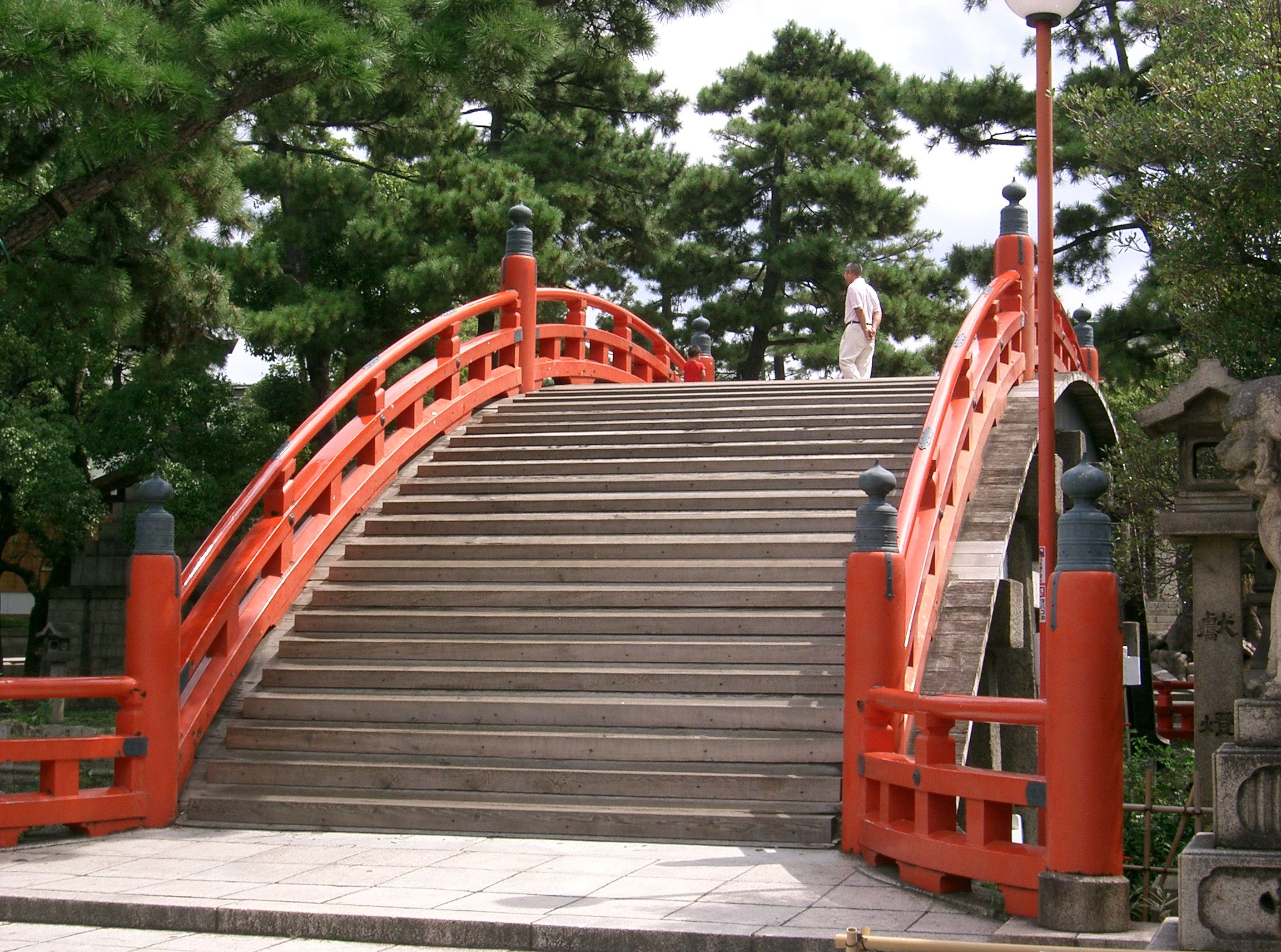
The main hall is built in the Sumiyoshi-zukuri style, an architectural form so distinctive that it gave its name to an entire category of shrine design. The style is recognized as the oldest of its type in Japan, predating the wave of Chinese-influenced temple architecture that reshaped Japanese sacred buildings. The hall features a forked finial on the roof and five square wooden billets placed horizontally along the ridge. There are no corridors around the sanctuary. The pillars are round, standing on stone foundations, with horizontal planks between them. One of the stone torii near the main hall is equally distinctive: its crossbar does not extend beyond the vertical posts, and all pieces have square edges rather than the rounded forms common at most shrines. This unusual gate type is known as the Sumiyoshi torii. The iconic Taiko-bashi, a dramatically arched bridge at the shrine entrance, has become the most photographed feature of the complex.
Woven into Story and Legend
Sumiyoshi Taisha has threaded itself through Japanese literature for over a thousand years. In Murasaki Shikibu's The Tale of Genji, written around the year 1000, the shrine serves as a pivotal setting in the chapters concerning the Akashi Lady. In the folktale Issun-boshi -- the story of a one-inch boy who grew into a hero -- a childless couple prayed at Sumiyoshi Taisha and received their miraculous son. When the boy set out on his adventure, he departed from Sumiyoshi harbor, sailed the Hosoe River to Osaka Bay, then traveled up the Yodo River to Kyoto. Today, millions of visitors flood the shrine each New Year's Day for hatsumode, the first shrine visit of the year, making it one of the most visited sites in Japan during the holiday. Locals still call it Sumiyoshi-san, the familiar honorific suggesting not a distant monument but a living part of the neighborhood.
From the Air
Located at 34.613N, 135.493E in the Sumiyoshi ward of southern Osaka, fully embedded in the city's urban grid. From altitude, the shrine compound is identifiable as a large green space amid dense residential blocks, roughly 3 kilometers inland from the Osaka Bay waterfront. The distinctive arched Taiko-bashi bridge and the arrangement of four main shrine buildings aligned in a row may be visible at lower altitudes. Kansai International Airport (RJBB) lies approximately 18 nautical miles to the south-southwest. Osaka Itami Airport (RJOO) is about 10 nautical miles to the north. Best viewed at 2,000-3,000 feet AGL approaching from the bay side to appreciate how completely the city has enveloped what was once a seaside shrine.