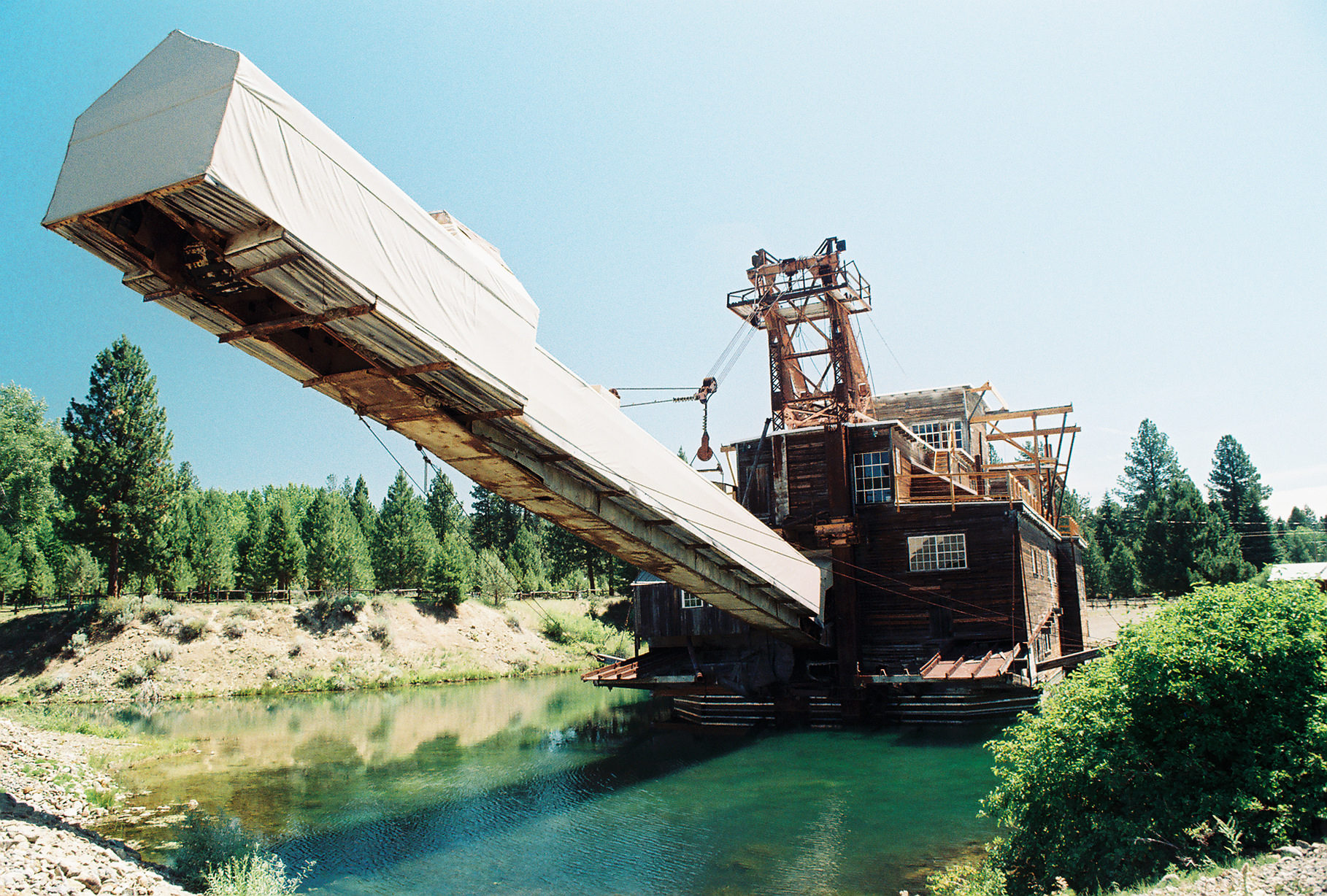
Sumpter Valley Gold Dredge
Dredge workers called them the night sounds: creaking timbers, phantom footsteps, the whisper of a man named Joe Bush who supposedly haunted the machine when it fell silent. The Sumpter Valley Gold Dredge sits in its own pond in the Blue Mountains of eastern Oregon, a 1,200-ton floating factory that spent decades chewing through the valley floor in pursuit of flecks of precious metal. Gold was discovered here in 1862, but it took the dredges, arriving between 1912 and 1934, to transform small-time prospecting into industrial-scale earth processing. The machine visible today, preserved as the centerpiece of Sumpter Valley Dredge State Heritage Area, stands as one of the most intact gold dredges in America, a mechanical monument to human ambition and the restless hunger for wealth that reshaped entire landscapes.
The Floating Factory
The dredge operated on a deceptively simple principle. Giant electrically powered buckets scooped earth from below the waterline, pulling gold-bearing soil into the machine's innards at a rate of over twenty buckets per minute, consuming more than seven cubic yards of earth every sixty seconds. Inside, the dirt passed through a scaled-up version of the same equipment prospectors had used during the gold rush: sluice boxes and riffles that allowed heavy gold to settle while lighter material washed away. The waste, known as tailings, emerged from the back through a long conveyor called a stacker, creating the distinctive mounded landscape still visible from the air today. Built on a shallow hull, the dredge needed surprisingly little water because it carried its own pond along with it, floating forward into freshly excavated ground while tailings filled in behind.
The Relentless Schedule
Operating the dredge required a crew of twenty: three men to run the machinery, plus seventeen more for maintenance, bookkeeping, surveying, truck driving, and management. The machine ran 363 days a year, pausing only for the Fourth of July and Christmas. One or two workers remained aboard each night to watch over the mechanical beast. It was during these quiet hours that workers reported hearing Joe Bush, a ghost whose presence became part of the dredge's folklore. Whether the sounds were supernatural or simply the settling of a massive machine, the stories persisted, eventually drawing the 2013 television series Ghost Mine to conduct a paranormal investigation. The dredge's reputation for haunting has become as much a part of its identity as its industrial history.
A Fortune Lost to Accounting
Three dredges worked the Sumpter Valley from 1913 to 1954, traveling more than eight miles combined and extracting between ten and twelve million dollars worth of gold at Depression-era prices. Sumpter No. 3, the preserved dredge, was built substantially from parts of the first machine after it sat idle for a decade. Yet despite the gold pouring through its buckets, the operation was never truly profitable. When the last dredge shut down in 1954, it was more than $100,000 in debt. In its lifetime, this single machine had processed $4.5 million in gold at $35 per troy ounce, some 128,570 ounces total. At recent gold prices exceeding $1,990 per ounce, that same gold would be worth over $255 million. The dredge created a fortune but never kept it.
What Remains
Today the Oregon Parks and Recreation Department preserves the dredge as a State Heritage Area, complete with a museum and gift store. Visitors can tour the machine itself, walking through the same spaces where workers once tended buckets and riffles around the clock. A video features interviews with surviving dredge workers, their memories preserving the human side of industrial gold mining. Outside, the valley floor still bears the scars of extraction: mounded tailings stretching for miles, a permanent record of how thoroughly these machines processed the landscape. Satellite imagery reveals the distinctive patterns clearly, geological evidence of a half-century of mechanical persistence. The dredge itself remains afloat in its pond, a rusting cathedral to the belief that enough earth, properly sifted, might yield something precious.
From the Air
Located at 44.74N, 118.20W in the Blue Mountains of eastern Oregon, near the historic mining town of Sumpter. Best viewed at 3,000-4,000 feet AGL. The dredge tailings create distinctive mounded patterns visible from altitude, stretching along the valley floor. Nearest airports include Baker City Municipal (BKE) approximately 30nm to the east and La Grande/Union County Airport (LGD) approximately 35nm to the north. Clear weather recommended for optimal viewing of the mining landscape patterns.