
Sun Yat-sen Memorial Hall (Taipei)
In 1965, President Chiang Kai-shek broke ground on a building intended to honor the man both he and his Communist rivals in Beijing called the father of modern China. Sun Yat-sen had died in 1925, forty years before the first shovel turned Taipei soil, but his image remained the one point of ideological overlap between two governments that agreed on almost nothing else. What emerged from that groundbreaking, completed on 16 May 1972, was the National Sun Yat-sen Memorial Hall: a structure covering 29,464 square meters of building area within an open park of 115,000 square meters, sitting in what would become Taipei's Xinyi District — the neighborhood that eventually grew the city's gleaming financial district around it.
The Design and What It Expresses
Architect Wang Da-hong won the design competition for the memorial hall and then watched his plan be modified at Chiang Kai-shek's personal direction, with instructions to emphasize Chinese architectural characteristics more strongly. The result is a large-scale building in a classical Chinese palatial style — upswept yellow-tiled roof, symmetrical facades, grand staircases — transplanted into a subtropical city that was simultaneously building highways and factories. The architectural message was deliberate: this was a Chinese government on Chinese soil, maintaining Chinese cultural continuity regardless of geography. Whether or not visitors receive that message consciously, the building is unmistakably large and unmistakably formal. It communicates the weight assigned to what it commemorates.
Sun Yat-sen and His Memorial
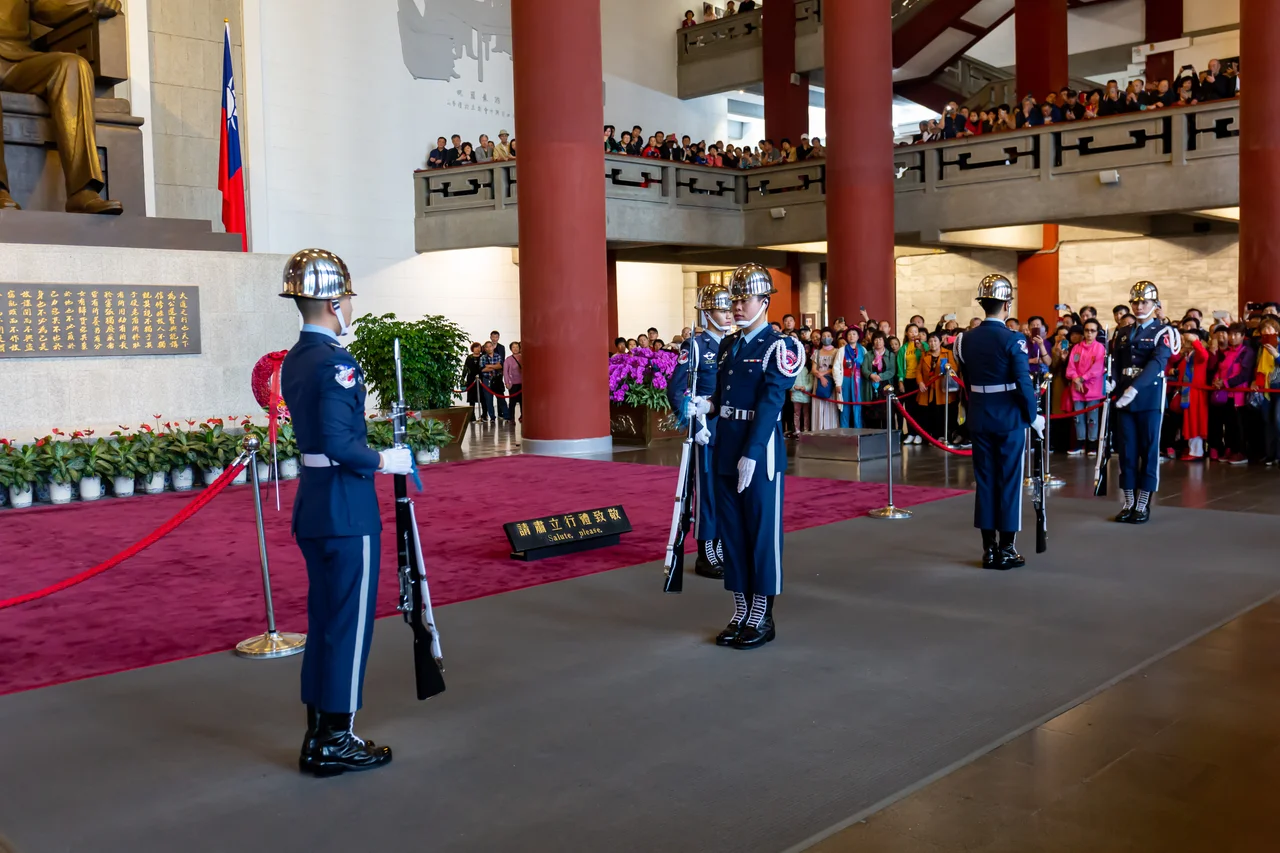
Sun Yat-sen led the Xinhai Revolution that overthrew the Qing dynasty in 1911, ending more than two millennia of imperial rule in China. His political philosophy — the Three Principles of the People, combining nationalism, democracy, and social welfare — became the founding ideology of the Republic of China and remains enshrined in Taiwan's constitution. The memorial hall's interior displays artifacts and documents from Sun's life and the revolution he led, a permanent historical exhibition that functions as the building's core institutional purpose. In the central hall, a large bronze statue of Sun Yat-sen sits beneath the vaulted ceiling. Every hour, honor guards perform a formal changing of the guard ceremony before the statue — a ritual that draws visitors and photographers throughout the day, a choreographed reminder that the building's symbolic role remains active.
More Than a Memorial
The building was never just a shrine. From the beginning it incorporated a performance hall, exhibition spaces, a multimedia theatre, an audio-visual center, lecture halls, and a library holding over 300,000 books. Taiwan's most prestigious film awards — the Golden Horse Film Festival and Awards — were held annually in the memorial hall auditorium for decades before the hall's closure for renovation in 2024. The juxtaposition is striking: a ceremony honoring Chinese-language cinema's best work taking place inside a monument to Republican revolutionary politics. The building absorbs these different uses without apparent contradiction, functioning as a public cultural institution in the full sense. In 1986, administrative authority transferred from the Taipei city government to the Ministry of Education, a change that formalized its role as a national rather than merely municipal resource.
The Park and the Pond
The grounds surrounding the memorial hall are as much the point as the building itself. Chung-shan Park, in which the hall is sited, includes gardens, historical walls, and — at the center — Lake Cui, known in English as Emerald Pond. The pond and its surroundings provide a green relief from the surrounding density of Xinyi District, which has developed in the decades since the hall's completion into Taipei's primary financial and commercial center. Taipei 101, for decades the world's tallest building, stands a few hundred meters away. The contrast between the memorial hall's traditional architecture and the tower's reflective glass expresses something about Taipei's relationship to its own history: the old and the new coexisting at close range without either disappearing.
Closed for Renovation
As of February 2024, the Sun Yat-sen Memorial Hall closed for a maintenance and renovation project, with expected reopening in 2026. For visitors who arrive before the reopening, the park and exterior grounds remain accessible even when the interior is closed. The renovation offers an opportunity to consider what the building will look like when it reopens — whether the interior will change along with the structural improvements, and what a refreshed institution will choose to emphasize about Sun Yat-sen's legacy in the political climate of contemporary Taiwan. These are not abstract questions. How Taiwan tells the story of its own founding involves, inevitably, decisions about what to celebrate, what to complicate, and what to leave in the past.
From the Air
The Sun Yat-sen Memorial Hall sits at approximately 25.040°N, 121.560°E in Taipei's Xinyi District. From the air, the building's traditional Chinese roofline and large surrounding park make it one of the most identifiable structures in the southern part of central Taipei — particularly visible against the dense urban grid. Taipei Songshan Airport (RCSS, 25.069°N, 121.552°E) lies about 3.3 km to the north; on approach or departure from RCSS, the memorial hall and Taipei 101 (visible to the east-southeast) form a recognizable visual pair. Taipei Taoyuan International Airport (RCTP) is approximately 40 km to the west. At 3,000 feet on a clear day, Chung-shan Park's green footprint is distinguishable within the surrounding urban density, with Emerald Pond catching the light at lower altitudes.
Nearby Stories
- Dapu Incident 9.3 km away
- Shuanglianpi Wetland 18 km away
- Toufen 41 km away
- North Jiangsu Main Irrigation Canal 980 km away
- General Cliff Rock Paintings 1050 km away
- Sinking of MV Sewol 1061 km away
- Yellow Sea 1111 km away
- Twin Forts of Romblon 1358 km away