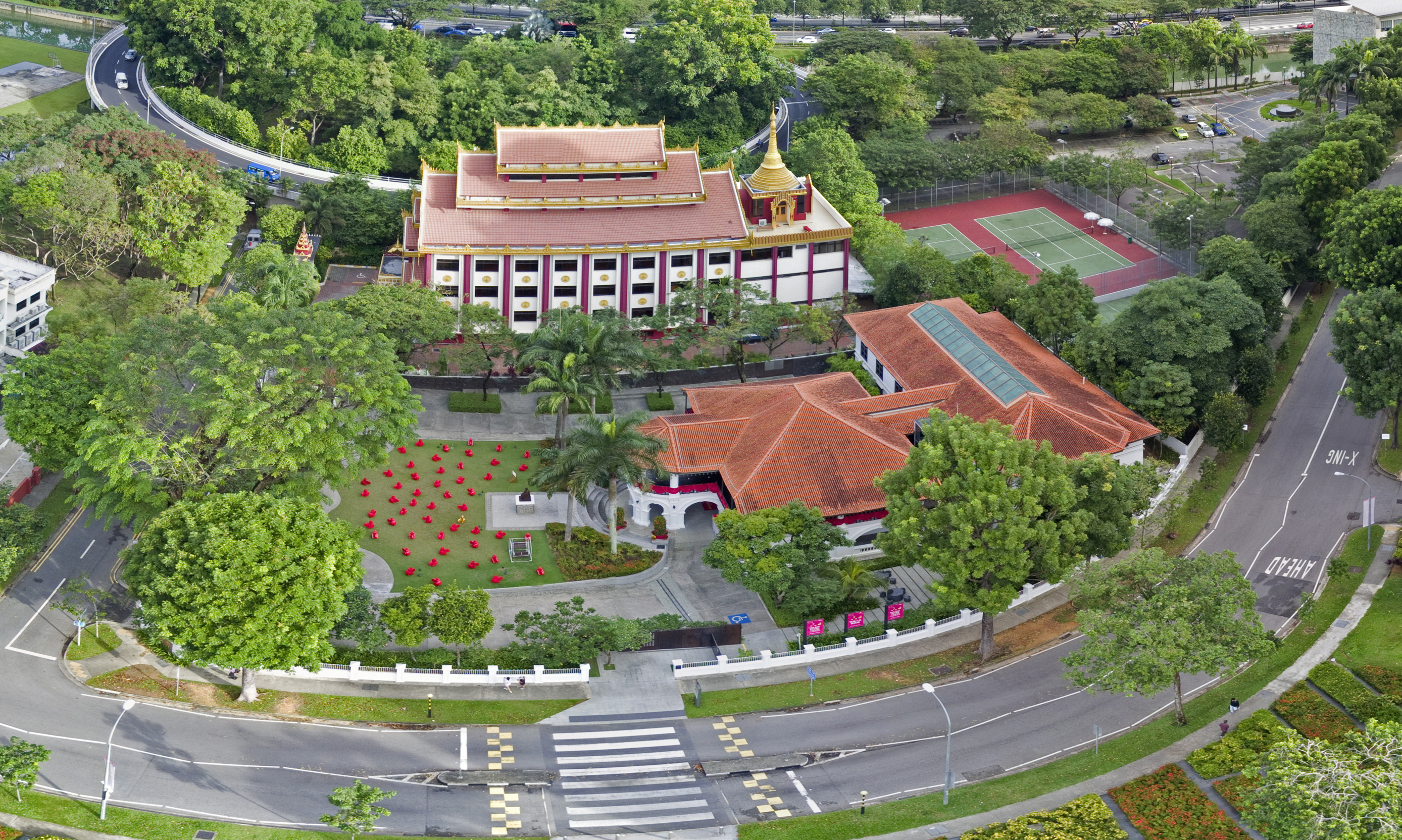
Sun Yat Sen Nanyang Memorial Hall
The villa at 12 Tai Gin Road was built for a mistress. It became the nerve center of a revolution. In 1901, a businessman named Boey Chuan Poh commissioned the two-story colonial house in Singapore's Balestier district, reportedly as a home for a woman named Bin Chan -- the locals called it "Bin Chan House" and left it at that. Within five years, the building would host Sun Yat-sen, the future founding father of the Republic of China, and serve as the Tongmenghui's covert headquarters for all of Southeast Asia. Three armed uprisings against the Qing dynasty were planned within its ornate, louvred rooms. The 1911 Xinhai Revolution that ended two millennia of imperial rule in China had roots, improbably, in a quiet Singapore neighborhood.
From Scandal to Strategy
The villa changed hands quickly in its early years, each transaction drawing it closer to history. Boey sold it in 1902 for $10,800 to Lim Ah Siang, a timber magnate and leader of the Teochew secret society Ngee Heng Kongsi. Three years later, rubber tycoon Teo Eng Hock purchased it for his mother, Tan Poh Neo, renaming the property Wan Qing Yuan -- "late Qing garden," a name that would prove prophetic. In July 1905, Sun Yat-sen passed through Singapore on his way from Japan to Europe and met Teo through a mutual friend. The connection transformed the villa's purpose. When Sun returned in April 1906, Teo offered Wan Qing Yuan as the operational base for the Tongmenghui, the revolutionary alliance that Sun had founded to overthrow the Qing. From this unlikely suburban headquarters, organizers coordinated uprisings, raised funds, and recruited supporters across the Chinese diaspora of Southeast Asia.
Three Uprisings, One Villa
Between 1907 and 1908, three major armed revolts against the Qing dynasty were plotted at Wan Qing Yuan: the Chaozhou Uprising of May 1907, the Zhennanguan Uprising of December 1907, and the Hekou Uprising of April 1908. All three failed militarily, but they chipped away at the dynasty's hold on power and galvanized overseas Chinese communities. Sun Yat-sen visited Singapore nine times between 1900 and 1911, and the Nanyang network -- the web of supporters, donors, and operatives across Southeast Asia -- became essential to his movement's survival during its most desperate years. Singapore was not merely a waypoint. For the revolutionaries, it was a sanctuary beyond the reach of Qing agents, a fundraising hub among wealthy Chinese merchants, and a base from which to coordinate action across an entire region. The villa, with its arched windows and floral eaves, concealed the ambitions of an empire's end.
Saved by Six Businessmen
After Teo Eng Hock sold the villa in 1912, the property drifted through a succession of owners, its revolutionary history fading from public memory. In 1937, six prominent Chinese businessmen in Singapore -- Lee Kong Chian, Tan Ean Kiam, Lee Chin Tian, Chew Hean Swee, Lee Choon Seng, and Yeo Kiat Tiow -- pooled resources to purchase Wan Qing Yuan. The following year, they donated it to the Singapore Chinese Chamber of Commerce, ensuring its preservation. The villa became a museum, though its significance deepened with time. In 2009, the National Heritage Board took over management, and a major redevelopment in 2010-2011 expanded the collection and restored the building in the style of an old Peranakan house. The museum reopened on October 8, 2011, exactly one century after the Xinhai Revolution it commemorated.
Bronze, Ink, and Memory
Today, nearly 400 artifacts fill the villa's five galleries across two floors. A sixty-meter bronze wall mural wraps around the back of the building, sculpted by Chinese artists between 1999 and 2005 at a cost of around one million Singapore dollars. It traces Singapore's transformation from an 1840s fishing village through the Japanese occupation and the Sook Ching massacre of 1942. Bronze statues dot the surrounding garden, including a seated figure of Sun Yat-sen presented by the Chinese government in 1937. Upstairs, oil paintings by Cultural Medallion-winning artists Ong Kim Seng and Tan Swie Hian hang alongside calligraphy by the Buddhist monk Song Nian. Among the most prized objects: a photograph of Sun and the Tongmenghui's Singapore branch taken at the villa around 1906, and a piece of calligraphy in Sun's own hand bearing the characters for bo ai -- "universal love" -- a gift to his host Teo Eng Hock's nephew.
From the Air
The Sun Yat Sen Nanyang Memorial Hall is located in Singapore's Balestier district at approximately 1.328N, 103.847E. The villa sits adjacent to Zhongshan Park, a mixed-use development completed in 2013. Nearest major airport is Singapore Changi Airport (WSSS), approximately 15 km to the east. The building is not individually visible from altitude but lies within the dense urban fabric north of the Singapore River. Seletar Airport (WSSL) is closer at about 8 km north.