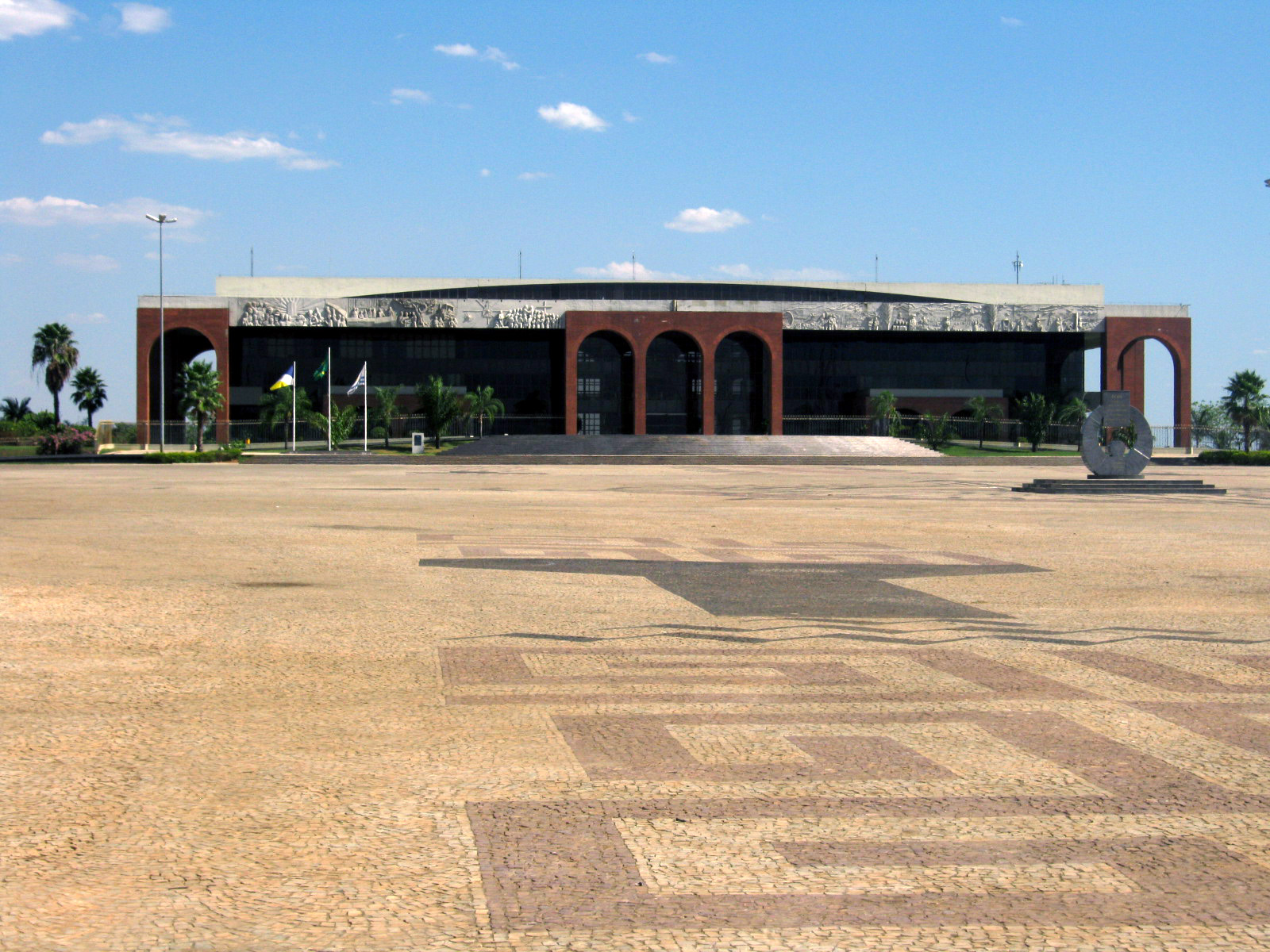
Sunflower Square
The statues face east. This is not an accident. In the Suplica dos Pioneiros, a set of bronze figures arranged like a family in Sunflower Square, the sculptor deliberately aimed them at the rising sun - a gesture of gratitude, the local story goes, from the first residents who arrived in a capital that did not yet exist. In 1989, there was no Palmas. The state of Tocantins itself was only one year old. A governor laid a foundation stone. A brazilwood cross went into the ground on the north side of a square that would, within two years, become one of the largest in the world.
Building a Capital From Nothing
On May 20, 1989, Governor Siqueira Campos laid the foundation stone of Palmas. Tocantins had been carved out of the northern two-fifths of Goias state just one year earlier, in 1988 - making it the newest state in Brazil. The existing towns in the region were too small or too awkwardly placed to serve as a capital, so Tocantins did something few modern states attempt: it built a capital from scratch. Palmas was planned on a grid. Sunflower Square - Praca dos Girassois in Portuguese - was designed as the monumental heart of the new city, the decision-making center for a government that had no tradition, no archives, no history. The Cruzeiro - a cross carved from brazilwood by the artisan Arnildo Antunes - was the first historical monument erected in Palmas. Listed as cultural heritage in 2000, it remains where it was placed, on the north side of the square.
One of the Largest Squares on Earth
Sunflower Square ranks among the largest public squares in the world, a claim Palmenses make with pride. Its vast expanse holds at least a dozen distinct attractions arranged with room to breathe between them. The Fonte Luminosa sends water jets fifteen meters into the sky. A giant sundial marks solar time. Kraho Square pays tribute to the indigenous peoples whose traditional territory this region was and remains. At the center of a compass rose, drawn on the pavement in Portuguese stones, stands the Monument to the Bible - a sculpture of a man with arms extended skyward, holding the Bible in his hands. It is the kind of composition that makes sense in a city built by politicians who wanted their new capital to announce itself loudly, sincerely, and symbolically. The Cascata represents the rivers and waterfalls of Tocantins, a reminder that this plateau state is shaped by water as much as by distance.
Echoes of Revolt
Two monuments in the square reach back to the 1920s - a decade when the Brazilian army was repeatedly in revolt against the First Republic. The bronze sculptures honoring the Eighteen of the Copacabana Fort commemorate the doomed 1922 uprising in Rio de Janeiro, when eighteen young officers marched onto Copacabana Beach to challenge the government and were cut down by loyalist forces. One of the revolt's leaders was a lieutenant also named Siqueira Campos - a coincidence of naming that weaves the governor's legacy into Brazil's broader tenente history. Beside these sculptures stands the Prestes Column memorial, designed by the great modernist architect Oscar Niemeyer. The Prestes Column was a guerrilla army led by Luis Carlos Prestes that marched 25,000 kilometers through the Brazilian interior between 1925 and 1927, crossing Tocantins territory in the process, evading the federal army without ever being defeated. Niemeyer's memorial honors that long march across the heart of a country that had not yet decided what it was.
The Palace and the Center of Brazil
Araguaia Palace, inaugurated in 1991, dominates the square as the seat of executive power. Its exterior is ringed by 144 friezes, each two meters long, which together narrate the story of Tocantins from the movement for state creation through the founding of Palmas itself. Golden sculptures on the rooftop reproduce the coat of arms of the state. Inside the hall, large painted panels tell the same story again, in a range of styles that move from expressionism to cubism. And inside that hall - inside one particular spot on the floor - is a marker that visitors line up to photograph themselves standing on. According to the builders of Palmas, this exact point is the geodesic center of Brazil. Whether that claim is geometrically precise or diplomatically asserted, it tells you what Tocantins wants its capital to mean: a new city at the center of the country, facing east with arms open, asking for the sun to rise on something that was only built yesterday.
From the Air
Sunflower Square is at 10.18 S, 48.33 W in central Palmas, Tocantins. The square is a visible urban landmark from altitude - a large green geometric plaza in the planned grid of Palmas. Araguaia Palace with its golden rooftop sculptures is the main identifiable structure. Palmas-Brigadeiro Lysias Rodrigues Airport (SBPJ/PMW) is 20 km from downtown and serves flights from Brasilia, Sao Paulo, Rio, and other major Brazilian cities. Recommended viewing altitude 2,500 to 4,000 feet AGL to appreciate the square and the surrounding planned grid. Palmas sits on a plateau with Lake Palmas to the west. Dry season May through October with excellent visibility; wet season brings strong afternoon storms.