Sunshine 60
There is a small stone monument in a park just north of the Sunshine City complex in Ikebukuro. Engraved in Japanese, it reads: 'Pray for Eternal Peace.' Most of the shoppers and office workers who pass it daily have no idea what once stood here. On this ground, before the 60-story tower rose to become the tallest building in Asia, there was a prison. And in that prison, on December 23, 1948, seven convicted war criminals -- including former Prime Minister Hideki Tojo -- were led to the gallows and hanged. Sunshine 60 stands 239.7 meters tall and houses offices, shops, and an observation deck. It also stands on one of the most historically charged plots of land in Japan.
Gallows to Glass and Steel
Sugamo Prison was built in 1895, modeled on European prison designs. It survived the firebombing of Tokyo in World War II and was subsequently taken over by Allied occupation forces to hold suspected war criminals awaiting trial before the International Military Tribunal for the Far East. The most prominent inmates included Hideki Tojo, the wartime prime minister who had ordered the attack on Pearl Harbor. On the night of December 23, 1948, Tojo and six other convicted Class A war criminals were executed by hanging inside the prison walls. The site also held Richard Sorge, a Soviet spy working under journalist cover in Tokyo, who was hanged there in 1944 during the war itself. The prison continued to operate until 1962, its buildings were demolished in 1971, and by 1978 the Sunshine City complex had risen in their place. The transformation from execution ground to commercial high-rise happened within a single generation.
The Tallest Tower in Asia
When Sunshine 60 was completed in 1978, its 239.7 meters made it the tallest building in Asia -- a record it held for seven years until Seoul's 63 Building surpassed it in 1985. Within Japan, it dominated the Tokyo skyline until the twin towers of the Tokyo Metropolitan Government Building in Shinjuku overtook it in 1991. The tower's construction required innovative engineering for earthquake-prone Tokyo. Its foundation is reinforced concrete, transitioning to a steel skeleton with 'slitted shear walls' in the upper stories -- a design that allows the walls to flex with earthquake tremors and wind loads rather than resist them rigidly, maintaining structural integrity through controlled deformation. Forty elevators serve the building. The observation deck bank rockets passengers from the lobby to the 60th floor at 600 meters per minute -- 36 kilometers per hour -- a speed that made them the fastest elevators in the world from 1978 until 1993, when Mitsubishi Electric installed even faster lifts in the Yokohama Landmark Tower. Mitsubishi built both sets of elevators and Mitsubishi Estate owns both buildings.
Ikebukuro's Vertical City
Sunshine 60 is the centerpiece of the larger Sunshine City complex, a mixed-use development that draws roughly 30 million visitors per year. The complex includes a shopping mall, an aquarium, a planetarium, and the Ancient Orient Museum. The office floors house the headquarters of several major Japanese corporations, including the convenience store chain FamilyMart, the financial services company Credit Saison, and the gaming company Sammy Corporation. Ikebukuro itself is one of Tokyo's major commercial districts, anchored by enormous department stores and dense entertainment quarters, and Sunshine City functions as a second nucleus within it. The observation deck on the 60th floor offers views that extend as far as 100 kilometers on clear days, reaching Mount Fuji to the west and the Boso Peninsula to the east. The complex stands as a self-contained vertical neighborhood embedded within one of the most commercially active districts in the world's largest metropolitan area.
Ghosts and Memory
In Japanese popular culture, the Sunshine 60 site carries a reputation for being haunted. The connection to Sugamo Prison's executions has generated decades of urban legend -- stories of elevator malfunctions, unexplained cold spots, and apparitions reported by late-night office workers. Whether or not one gives credence to ghost stories, the site's history is genuinely unsettling. The stone monument in the adjacent park -- the only physical remnant acknowledging what happened here -- stands in quiet contrast to the commercial bustle surrounding it. Sugamo Prison's function ended in 1962, and its walls came down in 1971, but the memory persists in a way that Japan's rapid postwar redevelopment could not erase. The juxtaposition is the point: a tower of commerce and leisure rising from ground soaked in wartime justice, where the tallest building in Asia replaced the place where a prime minister was put to death. Tokyo has always been a city that builds the future on top of the past, but few sites make that process as viscerally literal as this one.
From the Air
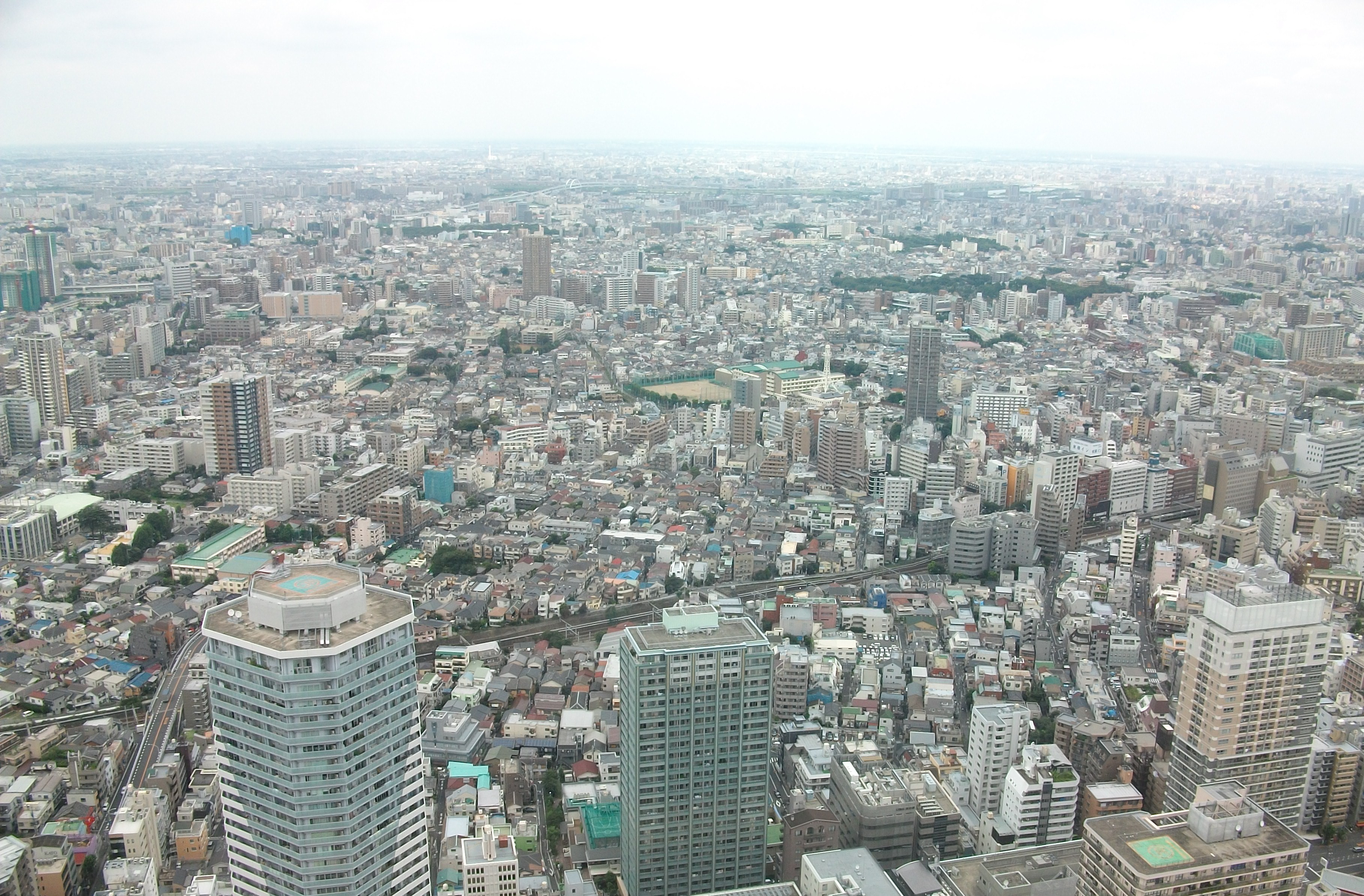
Located at 35.730N, 139.718E in the Ikebukuro district of Toshima Ward, Tokyo. Sunshine 60 is visible from altitude as a distinctive tall tower within the dense Ikebukuro commercial district, northwest of central Tokyo. The building rises 239.7 meters (787 feet) and stands notably taller than most surrounding structures. Ikebukuro Station, one of the world's busiest rail stations, is roughly 500 meters to the west. The broader Sunshine City complex occupies a large footprint at the tower's base. Nearest major airport is Tokyo Haneda (RJTT), approximately 18 km to the south. Narita International (RJAA) is about 65 km east-northeast. Yokota Air Base (RJTY) lies roughly 35 km to the west-northwest.