Sunspot Solar Observatory: Watching the Sun from a Mountaintop
In the tiny community of Sunspot, New Mexico, population measured in dozens, scientists point a 136-foot tower straight at the sun. The Sunspot Solar Observatory sits on the western ridge of the Sacramento Mountains, where the air is thin, the skies are clear, and views stretch from White Sands National Park below to El Paso and Ciudad Juarez on the distant horizon. The facility began as a U.S. Air Force project in 1950, driven by the military's sudden interest in solar physics during World War II. Radio communications depended on understanding solar activity, and forecasting required watching the sun. Seven decades later, the observatory continues its vigil, now operated by New Mexico State University in partnership with the National Solar Observatory.
The Tower That Goes Underground
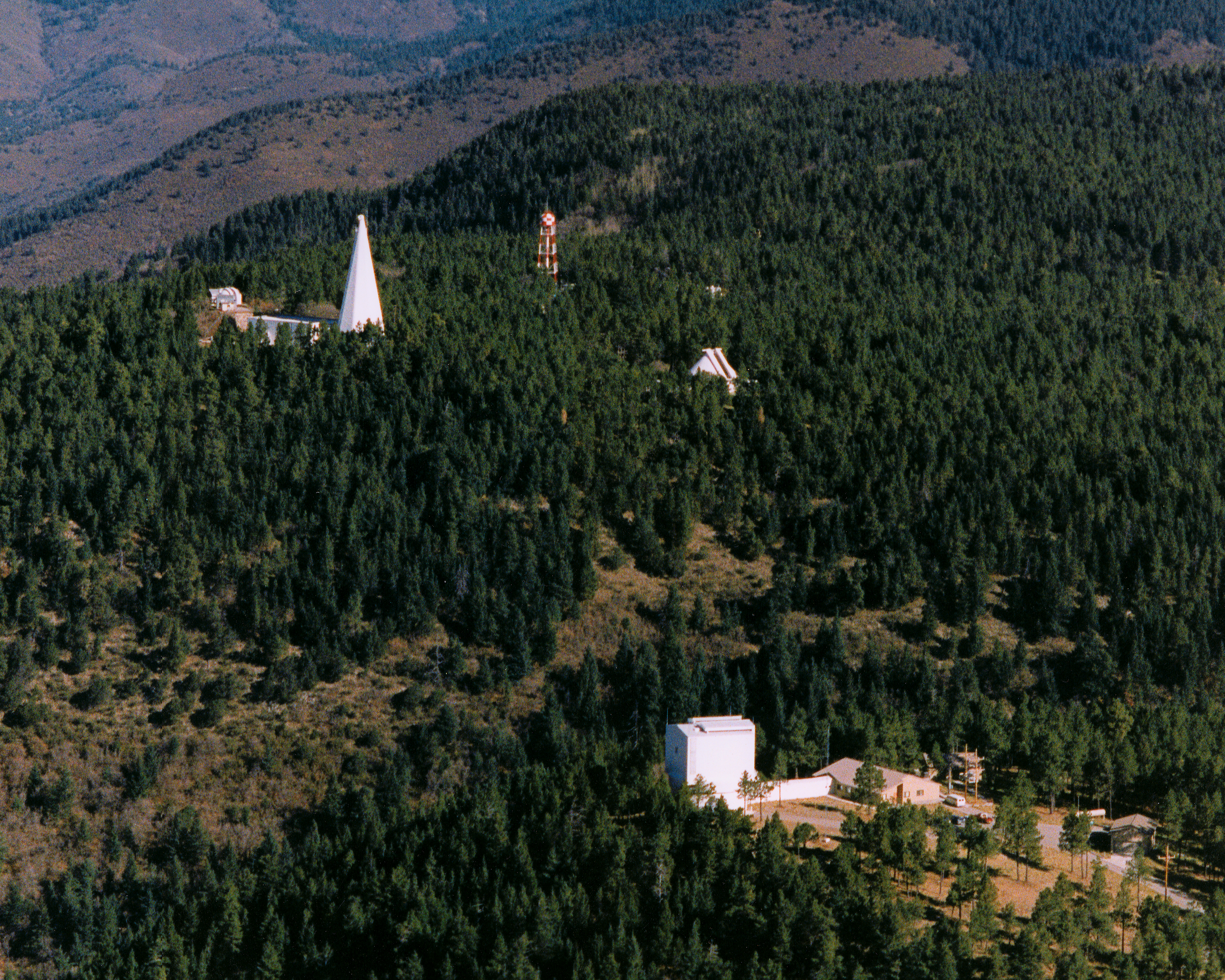
The flagship instrument is the Richard B. Dunn Solar Telescope, formerly known as the Vacuum Tower Telescope. Its design is distinctive: the tower rises 136 feet above the mountain, but extends another 228 feet below ground level. This subterranean construction keeps the optical path stable, isolated from temperature fluctuations that would distort the solar image. The telescope produces some of the sharpest images of the sun's surface ever captured from Earth, revealing the fine structure of sunspots, solar flares, and the churning granulation of the photosphere. The entire optical system operates in a vacuum to eliminate atmospheric distortion within the tube itself.
A Consortium of Solar Science
Sunspot Solar Observatory is no longer a single institution but a global consortium. Personnel work in Sunspot, at New Mexico State University in Las Cruces, and at partner institutes worldwide. The John W. Evans Solar Facility, originally built in 1952, served the High Altitude Observatory and Air Force Research Lab for decades, obtaining daily observations of million-degree coronal emissions that helped predict solar cycles. The site hosts four additional telescopes beyond the main tower, including an Antarctic Mount telescope previously deployed at the South Pole, now relocated beside the visitor center. The 2018 transition brought all scientific research and public outreach under the Sunspot Solar Observatory banner, with AURA maintaining the physical infrastructure.
Views That Reach Four States
The overlook beside the telescope offers one of the most expansive views in the American Southwest. White Sands National Park appears as a brilliant white patch against the tan desert floor of the Tularosa Basin. On clear days, visitors can see south to El Paso and Ciudad Juarez across the Mexican border, and north to the Trinity Site where the first atomic bomb was tested. The nearby Apache Point Observatory and Sloan Digital Sky Survey telescopes are visible on a neighboring peak. Rocket launches from White Sands Missile Range occasionally streak upward from the basin below. The Sunspot Astronomy and Visitor Center provides exhibits on solar science, offers guided tours on weekends, and maintains displays from both the Dunn Solar Telescope and Apache Point Observatory.
Wartime Origins to Modern Science
The observatory's existence traces to the sudden wartime urgency around solar physics. In 1940, Walter Orr Roberts and Donald Menzel established the High Altitude Observatory in Climax, Colorado, at over 11,000 feet elevation, purely to study the sun. Roberts worked with the Bureau of Standards forecasting radio conditions based on solar observations -- critical intelligence for military communications. The Air Force established the Sacramento Peak facility in 1950, transferring it to the National Science Foundation in 1976. A 1980 land use agreement with the U.S. Forest Service formalized the facility's presence in the Lincoln National Forest. Today the observatory continues the mission that began with wartime radio forecasters: understanding the star that shapes our technological civilization.
From the Air
Located at 32.79N, 105.82W on the western ridge of the Sacramento Mountains in south-central New Mexico. The observatory tower is visible from above as a distinctive vertical structure on a forested mountain ridge. The facility is approximately 18 miles south of Cloudcroft via State Highway 6563. White Sands National Park and the Tularosa Basin are visible to the west. Apache Point Observatory sits on a nearby peak to the north. Alamogordo-White Sands Regional Airport (KALM) is the nearest airport, at the base of the escarpment. Expect mountain wave conditions along the Sacramento escarpment with westerly winds.