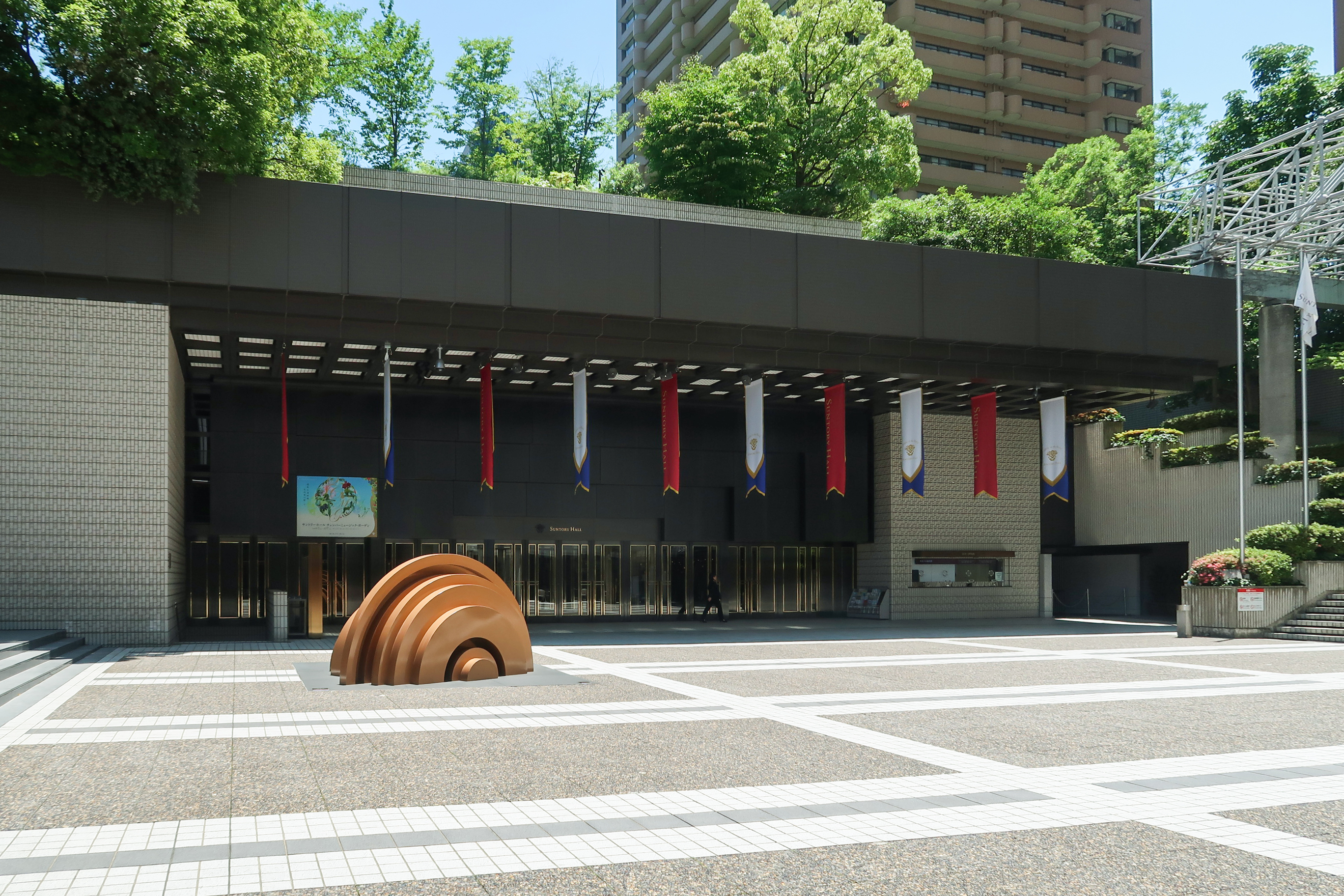
Suntory Hall: A Jewel Box of Sound
The story begins with whisky. In the 1980s, Suntory -- the Japanese beverage company that had been distilling whisky since 1926 and brewing beer since 1966 -- decided to celebrate its milestone anniversaries not with a new product line or advertising campaign, but with a concert hall. The company's chairman, Keizo Saji, originally envisioned a traditional shoebox-shaped auditorium like the celebrated Vienna Musikverein. Then Herbert von Karajan, the legendary conductor of the Berlin Philharmonic, offered a different idea. Build it like Berlin, he said. Surround the musicians with the audience. Let the sound wrap around everyone. Karajan did not merely advise -- he helped evaluate the acoustics and would later bestow on the finished hall a description that became its permanent identity: 'a jewel box of sound.'
The Berlin-Vienna Compromise
Suntory Hall opened on October 12, 1986, in the Ark Hills complex in Tokyo's Akasaka district. Its design represented a deliberate architectural experiment: a hybrid that borrowed from two of the world's most acoustically revered concert halls. From the Berliner Philharmonie, architect Shoichi Sano of Yasui Architects took the vineyard-style seating, where the audience rises in terraced sections around a central stage. From the Vienna Musikverein's classic shoebox shape, the design incorporated the strong lateral sound reflections that give orchestral music its warmth and enveloping presence. Acoustician Minoru Nagata of Nagata Acoustics engineered this compromise, placing substantially fewer seats in the acoustically inferior positions behind and beside the stage than Berlin's original layout. The result was a hall that avoided the Philharmonie's known weakness -- seats in the acoustic offside, where sound arrives weak and muffled -- while preserving the democratic, immersive feeling of being surrounded by music.
5,898 Pipes and a Blue Rose
The Main Hall seats 2,006 people across twenty-seven sections arranged around a 250-square-meter concert stage. At the rear of the hall stands a pipe organ of striking proportions: seventy-four stops and 5,898 pipes, custom built by the Austrian firm Rieger Orgelbau. It has since been fitted with computerized controls that allow remote consoles on the stage to command it. Below the main auditorium lies the Small Hall, known as the Blue Rose, an intimate space of wooden paneling seating 384 to 432 people. Its stage consists of three sections that can be raised in twenty-centimeter increments, up to sixty centimeters, allowing the room to be reconfigured for chamber music, solo recitals, lectures, or seminars. The Blue Rose is a space designed for close listening -- where the grain of a cello or the breath behind a vocal phrase becomes the entire experience.
The Conductors Who Came
From its opening, Suntory Hall attracted the world's finest musicians. Karajan himself performed there. Leonard Bernstein conducted. Seiji Ozawa, Japan's most celebrated conductor, made it a regular home. The hall's roster reads like a twentieth-century encyclopedia of classical music: Claudio Abbado, Giuseppe Sinopoli, Wolfgang Sawallisch, Hiroshi Wakasugi. Soloists of the highest caliber -- pianist Mitsuko Uchida, cellist Julian Lloyd Webber, the fiery pianist Ivo Pogorelich, baritone Hermann Prey -- all performed on the vineyard stage. Suntory Hall was the first concert venue in Japan to install a cocktail corner and intermission bar, facilities that seem unremarkable now but were a novelty in Japanese concert culture at the time. The foyer itself became an art gallery, housing the chandelier Symphony of Lights by lighting designer Motoko Ishii, stained glass panels depicting the Growth of Grapes by Keiko Miura, and wall art by Teppei Ujiyama.
A Garden on the Roof
One of Suntory Hall's most unusual features is invisible to concertgoers inside the building. The roof is an extended, tiered landscape garden that cascades over the structure, softening the hard edges of the Ark Hills development. Below it, 2,006 people sit in darkness listening to a Mahler symphony or a Bach organ fugue, while above them, greenery grows in terraced layers over one of the finest acoustic chambers in Asia. The juxtaposition captures something essential about Tokyo: the constant negotiation between density and beauty, technology and nature, commerce and culture. Suntory Hall was built with whisky money to house classical music from Vienna and Berlin, designed by Japanese architects with Japanese acousticians, and topped with a Japanese garden. It is, as Karajan said, a jewel box -- but one assembled from pieces that span continents and centuries.
From the Air
Located at 35.667°N, 139.741°E in the Akasaka district of Minato, central Tokyo. The hall is part of the Ark Hills complex, visible from altitude as a cluster of high-rises on the western edge of central Tokyo, south of the Akasaka Palace grounds. The rooftop garden creates a distinctive green patch amid the surrounding urban density. Best viewed at 2,000-4,000 feet AGL. Tokyo International Airport / Haneda (RJTT) lies approximately 9 nautical miles south-southwest. Narita International Airport (RJAA) is approximately 36 nautical miles east-northeast.